









Road freight transport in Europe has fallen victim to an economic slowdown that will limit this year’s sector growth to just 1.4%. A better economic climate is expected in 2024, although, in the opinion of industry experts, many current problems could have been avoided or minimized.
After three quarters of this year, it has become clear that this will be a weak year for road freight transport in Europe, which has fallen victim to the global economic slowdown that has been dragging on since 2022, inflation, declines in trade, poor sentiment in the industry, and the consequences of the war in Ukraine. According to current forecasts by Transport Intelligence, the real growth in the value of the sector on the Old Continent should not exceed 1.4% this year, which is a much worse result than the 3.5% expansion seen in the previous year. Even such a weak estimate is not certain, however, because at the beginning of the last quarter of 2023, the most important global institutions lowered their predictions regarding GDP growth and trade, with which the condition of transport is linked.
Chilly forecasts for GDP and trade – transport will suffer
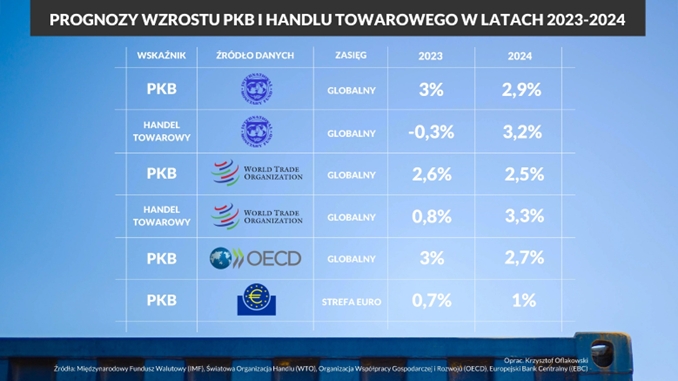
In October, the International Monetary Fund (IMF) lowered its global growth forecast for 2024 to 2.9%, while maintaining its July estimates for the current year, i.e., 3% growth. However, this is still a 0.5% decrease compared to 2022 and well below the historical average of 3.8% for the years 2000–2019. The cuts also affected trade in goods, which will shrink to -0.3% this year, while it will maintain its April estimate of 3.2% next year. The latest IMF predictions are also bad news for the eurozone, whose GDP will grow by just 0.7% this year and 1.2% next year. Poland also performs poorly in the forecast, with its economy expected to grow by only 0.6% this year and 2.3% next year.
In October, the World Trade Organization (WTO) also released its forecasts – there is no reason to celebrate there either. This year’s global trade growth rate for goods was estimated at only 0.8%. This is a painful drop from 1.7% in April. In 2024, trade in goods will rebound to 3.3%, which is a 0.1% improvement over the April forecast. According to the WTO, global GDP is expected to reach 2.6% this year and 2.5% next year, while merchandise exports in Europe are expected to grow by 0.4% this year and 2.2% next year. In turn, imports will shrink to -0.7% in 2023, but will rebound to 1.6% next year.
Chilly assessments are also shared by the Organization for Economic Co-operation and Development (OECD), according to which the global economy will grow by 3% this year and 2.7% next year. Meanwhile, the European Central Bank (ECB) cut its GDP forecasts for the eurozone in September to 0.7% this year, 1% next year, and 3.1% in 2025. During the same periods, exports and imports within the eurozone will also noticeably decline, which the transport industry will feel directly.
The slowdown in transport has been ongoing since 2022
Weaker expectations for GDP and trade indicate that the current year will weigh on European road transport, which is so important from the perspective of Polish operators, who in 2022 accounted for 20.05% of the transport work performed in the road transport of goods across the entire European Union. We thus maintained our position as a long-term leader, and there is no indication that this year’s result is at risk.
The weakness on the Old Continent is visible, however, and according to Eurostat data, transport work performed in road freight transport in the EU clearly began to decline after Q2 2022, amounting to 1,920,248 million tkm for the year as a whole. In Poland, however, the weakening of momentum started after Q1 and persisted until the end of the year. Despite this, Polish carriers managed to reach a level of 385,088 million tkm, and while there was a decline in transport work performed in the EU (by 0.04%), Poland recorded a slight increase of nearly 1.4%.
The European economy, however, ended the previous year with numerous problems, which translated in Poland into factors to which the Transport and Logistics Poland employers’ organization rightly attributes the hitherto dynamically growing demand for road transport services. Firstly, the momentum of GDP, both domestic and European, weakened. Secondly, the growth of merchandise exports fell. In Poland, in the period from January to August, it amounted to 3.2% year-on-year. At the same time, imports fell by over 6% year-on-year. Two stable factors were maintained, however: the export of transport services carried out by Polish companies for foreign entities and the high share of industry in Poland’s GDP.
The expected decline is visible, however, as confirmed by information from Statistics Poland (GUS) for the first three quarters of this year. They indicate that, in total, 3.1% fewer goods were transported than a year ago, with a significant decline (in terms of tonnage) recorded in maritime transport (by 16.6%). It was slightly better on the railways, where the decline amounted to 3.8%. In road transport, a slight increase was recorded, but it amounted to only 0.1%.
Not all companies are feeling the economic downturn
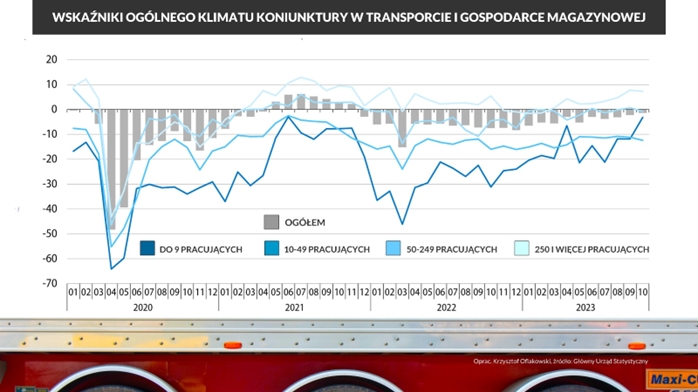
In the case of large enterprises employing over 250 employees, it is the exact opposite. The economic climate in transport and warehousing among these companies has been assessed positively since Q2 of this year.
– It was known at least since mid-2022 that the transport industry would operate in conditions of economic downturn this year. Of course, not all scenarios can be predicted, but practice shows that similar mistakes are made every time. This is a sign that there is a lack of strategic planning in the market regarding operational resilience in the event of weakening demand and economic turmoil. This refers not only to Poland but also to the wider European market. The lack of crisis scenarios simulating significant or long-term declines means that companies are not adequately prepared to avoid many current problems. An example would be, for instance, an excessive burden of fixed costs and limited flexibility in this area. A business model not adapted to economic dynamics always leads to unpleasant consequences, e.g., in the form of job cuts that are difficult to rebuild later, just like the trust of contractors. We also see that there is a lack of indexation models that automatically regulate service prices and insightful macroeconomic analyses. Our experience shows that one should think about building resilience before the economy gets into trouble, and the financial results after the third quarter of this year are proof that it is possible to develop a business even in times of economic downturn – says Piotr Mroczka, Transport Director at ID Logistics, which provides comprehensive logistics solutions as well as transport services and supply chain management in 18 countries.
Polish transport still in the zone of pessimism, but sentiment is improving
GUS data for October indicate that although the sector’s economic climate is still assessed below the neutral level, it is systematically growing. The current economic sentiment indicator stopped at -1.4, but it improved compared to the September value of 2.3. In August, it was -3.1 (on a scale from -100 to +100, where 0 is the neutral level). 12.6% of companies surveyed by GUS see a current improvement in the economic situation, but 14% still point to a deterioration, so the balance remains negative. The rest of the 855 companies surveyed declare that the situation is not changing in any direction.
Companies still negatively assess current demand and sales, but it may be comforting that the opinion regarding the deterioration of the situation in these areas is decreasing. Barriers hindering business operations remain at a high level. 90.8% of companies perceive them, and the most frequently mentioned are employment costs (64.1%) and the uncertain economic situation (60.9%). Further down the list are also fiscal burdens, unstable regulations, shortages of skilled workers, and insufficient demand. However, the economic climate in transport and warehousing is rated better than in October 2022, when it stopped at -7.4.
What is the sentiment on the Old Continent?
A study conducted among European road transport companies by the British analytical center Transport Intelligence (Ti) indicates that they are also experiencing a slowdown and business problems. As many as 84% of enterprises are experiencing an increase in operating costs and a weakening of demand, which translates into profit margins. Ultimately, this will not only lead to a reduction in this year’s real growth momentum to 1.4%, which will translate into total sector revenues of 456.7 billion euros, but will also affect the level of compound annual growth, which for the years 2022-2027 was estimated at 2.1%. Against the background of this year’s slowdown, however, it is clear that companies offering international transport will cope better. Growth in this area is estimated at 3.4%, while for domestic services it is 0.5%.
The symptoms of the slowdown in Europe are the same as in Poland and are manifested, among other things, in spot rates, which reflect current demand for transport services. According to analysts from Ti, IRU, and Upply, these fell in both the second and third quarters, which is a result of weak consumption and reduced demand for the distribution of goods. In the second quarter, an unusual situation even occurred, where for the first time in 6 years, the rate index on the short-term market was lower than for long-term contracts. The latter, however, were falling more slowly than spot values, the reasons for which were seen in improving business sentiment and the renewal of annual contracts by customers.
The decline in momentum in European road transport is also visible in the increasing availability of load capacity. Ti, citing an index maintained by Transporeon, states that in September this year, it was 9.4% higher compared to the previous year. This is simultaneously the fifteenth consecutive month of growing available load capacity in Europe, which is further confirmation of the demand stagnation for transport services.
Short- and long-term perspective
Several important indicators suggest that the condition of road transport may improve in 2024, at least in Poland. With more favorable forecasts for trade and economic growth for next year, not only is the general climate of transport and warehousing economy growing, but consumer sentiment is also improving. The current consumer confidence indicator (BWUK) for October, describing individual consumption trends, increased by 2.4% compared to September, and was 27.6% higher compared to October 2022. The leading consumer confidence indicator (WWUK) also grew by the same year-on-year value, and gained 1.3% compared to the previous month. Both values, although still in the negative (at -17.9 and -8.1 respectively), have been growing continuously for 12 months.
In the third quarter, a limitation in retail sales declines was also noted, and in September, the value of online purchases and their share in total retail trade increased slightly. This is a good signal before the last quarter of the year, which is the shopping season and usually a period of growth in transport. Inflation is also falling, which will additionally help consumers. Unfortunately, weak data are coming in from the industrial production sector, which is extremely important for road transport, and this situation prevails throughout the entire European Union. If the situation in industry does not improve, this will be a serious restraining factor in 2024 as well.
A positive accent in this area, however, was visible in the September and October PMI reading for Poland. As a reminder, the PMI (Purchasing Managers Index) measures the purchasing activity of managers in enterprises, is used to assess the economic climate, and is treated as a leading indicator, helping to determine in which direction the economic activity of the sector and the entire economy is heading. The PMI in October, although still in the zone of pessimism (44.5 points), grew for the second month in a row (for the first time since the beginning of 2023) and reached its highest level in four months. Although short-term perspectives remained weak in October, forecasts regarding production for the next 12 months improved. They were among the highest since 2022.
The Organization for Economic Co-operation and Development (OECD) has much more encouraging long-term forecasts. The OECD’s prognostic model covering non-urban road freight transport in Europe shows that demand for such services, especially with heavy vehicles on international routes, will systematically grow. In the period from 2022 to 2025, the growth calculated by transport work will amount to nearly 2% (from 1,794.85 billion tkm to 1,829.25 billion tkm). By 2030, it will be over 18% (2,124.88 billion tkm), and by 2050, it will be nearly 73% (3,102.11 billion tkm).
Such far-reaching predictions naturally contain a large dose of futurology, because even the next year’s condition of the Polish and European freight transport sector is influenced by a number of factors extending beyond the borders of the continent and purely economic frameworks. This was proven by the pandemic, the invasion of Ukraine, and currently the war in the Middle East, whose escalation and spreading throughout the region, which accounts for one-third of the oil transported by sea, could completely reconfigure both the TSL sector, industry, trade, and the entire global economy. For example, Bloomberg Economics estimates, assuming direct involvement in the conflict by Iran, would lead to a sharp rise in oil prices to 150 dollars per barrel, a drop in global GDP to 1.7%, and an inevitable recession that would wipe out 1 trillion dollars worth of production from the global economy.