










Europe is currently the second-largest contract logistics market in the world and will remain so at least until 2027. Services provided on the Old Continent will soon be worth more than 90 billion euros, but local operators will lose global market share to Asian firms. However, the sector will retain many unique characteristics, including an almost perfectly even split of revenues from distribution and warehousing operations. Industry experts are convinced that the market is set for stable growth, albeit not as dynamic as during the pandemic.
By the end of 2023, the global contract logistics market will be worth over 284.458 billion euros, with the sector growing by 3.8%. In 2022, growth was 2.9%, and the market reached a value of nearly 273.940 billion euros. Current analyses, presented in June by the British analytical center Transport Intelligence (Ti), indicate a significant slowdown in momentum compared to 2021, when the sector, heavily fueled by e-commerce, grew in value by 8.7%.
There is little expectation for growth as impressive as that seen during the pandemic, but despite weaker forecasts attributed to persistent macroeconomic and geopolitical disruptions, current estimates still exceed the expectations set for the market as recently as December 2022. Ti estimated at that time that contract logistics revenues would not exceed 253.706 billion euros in 2023 and that the market would grow by 3.1%. In six months, however, the sector has gained an additional 0.7% in value, and it is not impossible that the year-end result will improve further. In the medium term, contract logistics is expected to provide operators with stable revenue growth, but this will vary significantly by region.
Asia-Pacific will remain an unchanging leader. In 2023, revenues in that market will grow by 7.8%, mainly due to China and India, and will account for 40% of the total global pool, translating to over 113.783 billion euros in revenue. The second most dynamically developing market will be the Middle East and North Africa, which will achieve a rate equal to the global average of 3.8%. However, this area accounts for only 2% of global revenues, so the value of services provided there will be slightly over 5.689 billion euros. Generally speaking, all major markets will achieve positive growth rates, and Europe and North America will standardly stand on the revenue podium alongside Asia-Pacific.
Europe is currently the second-largest contract logistics market in the world, and revenues generated on the Old Continent account for 29% of the global value. At the end of the year, this will translate to an amount close to 82.493 billion euros. North America is also in the top 3, which will generate 25% of global revenues this year, or nearly 71.115 billion euros. 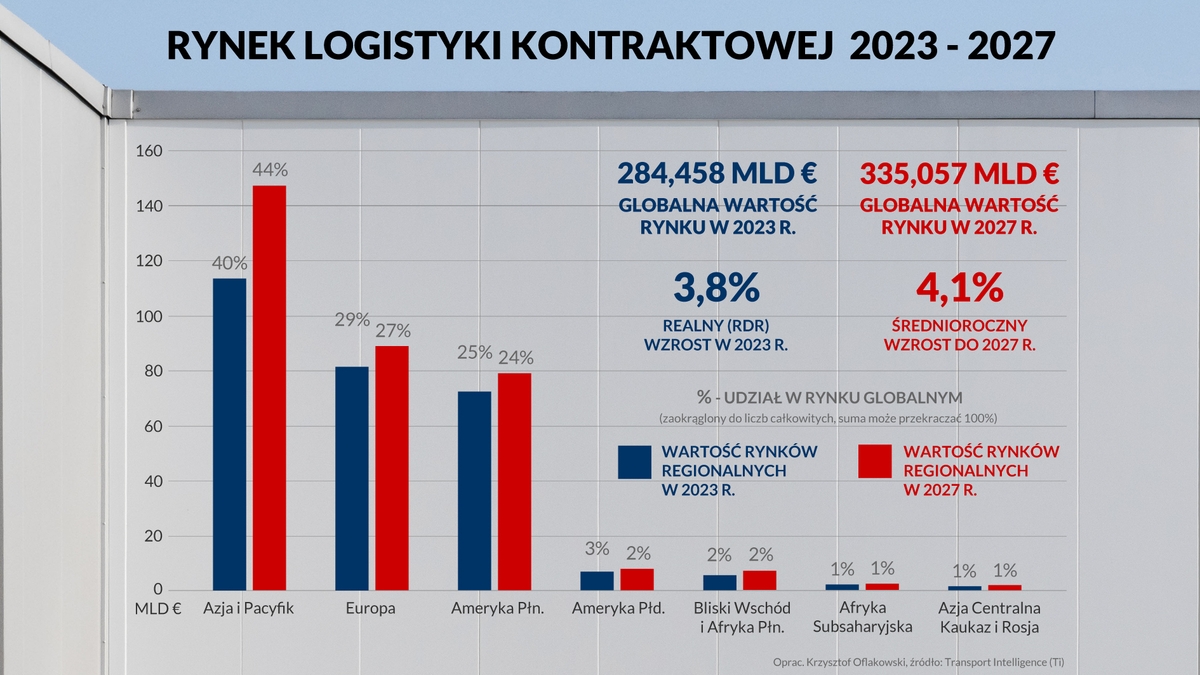
Better medium-term prospects
The podium layout will not change until 2027, and over the next 4 years, the global contract logistics industry will grow at an average annual rate of 4.1%, reaching a value of more than 335.057 billion euros at the end of the forecast period. As is the case now, Asia-Pacific will develop the fastest, achieving an average rate of 6.9% per year. This will allow Asian operators to capture as much as 44% of the market, which is 4% more than currently. However, the expansion of Far Eastern entities will come at the expense of companies operating in Europe and North America, whose market share will fall to 27% and 24%, respectively. While there will be over 147.4 billion euros to be shared in Asia, European operators will share more than 90.4 billion euros, and companies operating in North America more than 80.4 billion euros.
From 2023 to 2027, the global market will gain nearly 50.6 billion euros in value, and in Europe alone, revenue from contract logistics services will increase by almost 8 billion euros.
European distribution and warehousing operations will split the market in half
Ti estimated last year that the basic segmentation of the contract logistics market, i.e., distribution, warehousing, and ancillary services including co-packing, product refurbishment, or returns management, would split the global market in 2026 according to the following proportions: distribution 55.3%, warehousing 36.1%, and value-added services 8.6%.
In the Asia-Pacific region, distribution will play the biggest role (56.4%), followed by warehousing (37.8%) and value-added services 5.8%. In North America, the disparity between distribution and warehousing will be more pronounced, amounting to 58.7% to 29.1%. Value added in the form of complementary services will account for 12.3%.
The situation in Europe will look slightly different in this aspect. The share of distribution will be 49.6%, while warehousing and associated operations will account for 39.5% and 10.8% of the market, respectively. Thus, services performed in warehouses will generate more than half of the contract logistics revenue on the Old Continent. This is to be attributed to increasingly better cooperation with the e-commerce industry, which also visibly slowed down after the pandemic but can still count on several percent growth each year.
E-commerce in symbiosis with contract logistics
According to the latest Ti analyses, global e-commerce logistics support will grow this year by 7.9% to a level of over 451 billion euros, and by 2027, it will develop at an average annual rate of 10.3%, reaching over 683.5 billion euros. Growth, although small, is also expected in Europe, where e-commerce services in 2022 were worth over 81.6 billion euros, of which 38.6 billion were generated by warehousing operations, including fulfillment services. This is 47.3% of the value of the entire e-commerce logistics sector on the continent, where Poland, with revenues of over 2.1 billion euros, ranks 8th in terms of market share.
– Without a doubt, e-commerce has become a strategically important element of contract logistics, and it is this sector that has been an accelerator of growth for the largest market players in recent years, including us. In 2022, 50% of our revenues in Poland came from handling online orders, and these were exclusively dedicated solutions, directed at large and demanding contractors whose potential influenced the balance of power in the domestic e-commerce market. In turn, at the group level, 25% of all our clients are associated with online sales. E-shopping, although more slowly than during the pandemic, will continue to shape the contract logistics market because it is already so deeply embedded in the DNA of the European consumer that the sector will grow even in such an abstract scenario as a significant reduction in the launch of new online stores. Growth would then be generated even by the migration of existing stationary sellers to the web and the transition from a traditional to a multi-channel model. We have observed this mechanism in recent years, and it will certainly continue in the future, which is good news for logistics providers because managing resources in a multi-channel model is more difficult and more often delegated to external operators – says Sylwia Dunn, Business Development Director at ID Logistics, which offers a full range of dedicated and multi-client warehousing solutions as well as transport services and supply chain management in 18 countries.
– However, this is not the only positive and long-term forecast for the industry. Even such a basic feature as the demographic profile of the European consumer works in favor of the logistics market. Eurostat data show that in 2022, 96% of EU residents aged 16-29 used the internet daily, and 87% of consumers aged 25-34 made purchases online during the year. More than 80% of active e-consumers also came from the 16-24 and 35-44 age groups. Furthermore, the data for the entire Community look very good, with as much as 68% of the population aged 16-74 being e-customers, and several million more are added each year. It is clear that the market is growing along with consumers who will no longer give up the online option but will rather buy more on the web. However, not only will the share of online trade in total sales increase, but the geographical reach of transactions will also expand. Cross-border sales are developing at a good pace, which are almost entirely handled by logistics operators. This is visible in the Polish market, which is becoming a supply hub for regional e-commerce – adds Sylwia Dunn.
Current indicators work in favor of contract logistics
It is worth noting that although the TSL (transport, shipping, logistics) sector has gained significant resilience to crises in recent years, long-term forecasts regarding both the global and European contract logistics market are still subject to many increasingly difficult-to-predict macroeconomic and geopolitical factors, and therefore the trajectory of the industry’s development is increasingly difficult to determine. However, several current indicators suggest that the sector may exceed current expectations, as was the case with the forecasts from December 2022.
One of them is the CCI (Consumer Confidence Index), which measures whether consumers assess the economic situation optimistically or tend to approach the assessment with pessimism. This, in turn, translates into a greater or lesser propensity to shop or, in a negative scenario, to reduce spending.
The CCI published monthly by the Organisation for Economic Co-operation and Development (OECD) for, among others, the European Union, was 97.56 points in June this year and is still oscillating below 100, i.e., the boundary separating optimists from pessimists. Even though the index is still pessimistic, it has been growing continuously since September 2022, when it was 93.7 points, which in turn was the lowest result in the history of the survey for the EU. At least since September, the index has also been growing for the eurozone (98.39 points in June), G7 countries (97.91 points), and G20 (97.75 points). The total indicator for all OECD countries is also close to 100 (98.39 points), which has also been growing continuously at least since September 2022. According to the OECD, the consumer confidence index in Poland exceeded the 100-point threshold as early as May (100.02 points) and reached 100.6 points in June.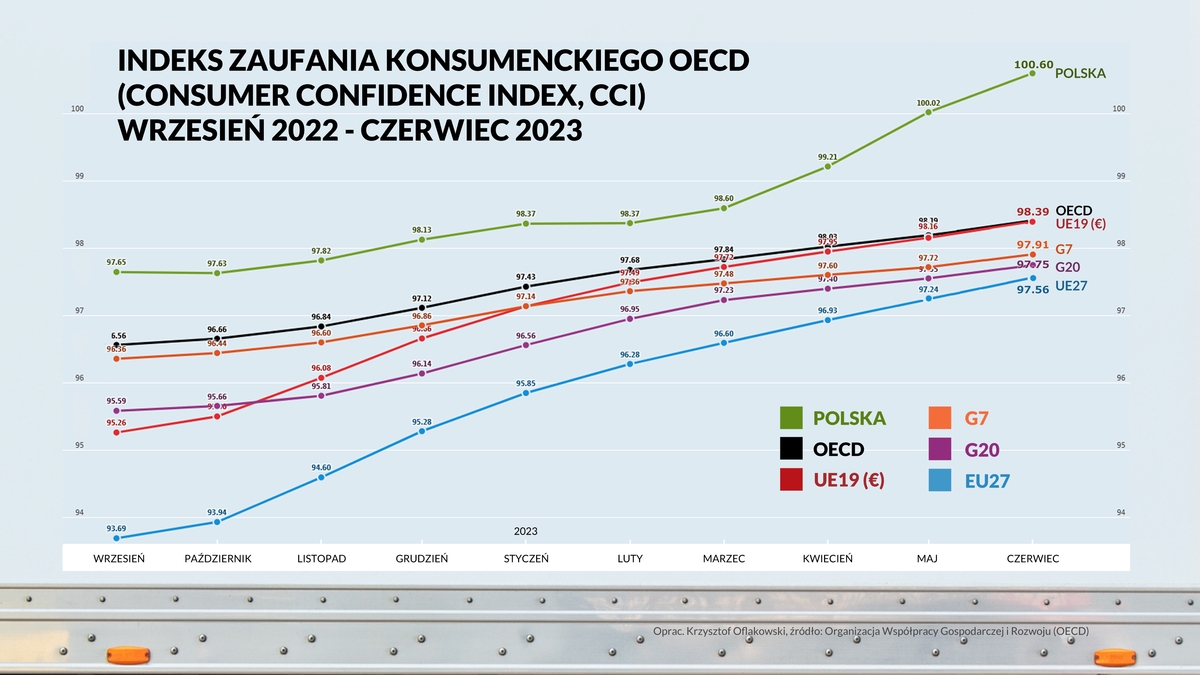
GUS also sees improvement in sentiment
Domestic consumer confidence data is also published by the Central Statistical Office (GUS), which, however, is not as optimistic as the OECD. According to the GUS methodology, the consumer confidence indicator can take values from –100 to +100, where any positive value means a predominance of optimistic consumers over pessimists. Similarly, any negative value means a predominance of pessimists. The latest July reading of the Current Consumer Confidence Indicator (BWUK) shows that it was 3.4% higher compared to the previous month. However, it was still at 24.9. At the same time, in relation to July 2022, the BWUK value is 16.8% higher.
The Leading Consumer Confidence Indicator (WWUK), which describes consumer expectations in the coming months, also improved. In July, it rose by 3.9% m/m and stopped at the level of -10.9. This value is 18.5% higher than in the corresponding month of 2022. Both the BWUK and WWUK indicators have been improving continuously since October 2022.
Also, the macroeconomic analysis of PKO BP from the second half of July this year indicates that despite poor retail sales results, the financial situation of consumers is beginning to improve, which will be reflected in economic growth and, ultimately, in real sales. July analyses by the Polish Economic Institute (PIE) also pointed to the expected improvement in retail sales in Q3 2023.
The latest GUS data on foreign trade turnover in the January-May 2023 period look much better in the context of the current impact on the logistics sector in Poland. We achieved a positive balance of 24.6 billion PLN during this time, whereas in the corresponding period in 2022, it was -37.6 billion PLN. Compared to last year, Polish exports grew by 8.1%, while imports fell by 1.6%.
Objectively good news for the market is also the latest update of the International Monetary Fund (IMF) global economic forecast. It raised expectations for global economic growth to 3% in both 2023 and 2024. This is 0.2% more than assumed in April but still less than the estimates for 2022, when the global economy grew by 3.5%. The dynamics of world trade (including goods and services) were estimated at 2% in the current year and clearly better, at 3.7%, in 2024. While the outlook for 2024 improved (by 0.2%), the forecast for this year is 0.4% lower than that presented in April.
Logistics operators are building operational resilience
The economic slowdown expected for a long time, but at the same time stable demand prospects for contract logistics solutions, remind us of old problems that have so far hindered the industry’s development. These include the pursuit of maintaining high efficiency despite rising operating costs and increasingly serious staff shortages, to which the logistics sector is reacting with massive investments in robotization and automation.
According to this year’s calculations by Interact Analysis, the order-picking robot sector alone, valued at 236 million dollars in 2022, will grow to 6.8 billion in 2030. The growth of an impressive 2,781% is to result from rising labor costs, the need to mitigate operational pressure, and the needs of the e-commerce sector and the rapid dynamics of warehouse automation. These are exactly the same factors that affect the overall condition of logistics, especially the warehousing sector.
Much better results than for order-picking robots are forecast for broader warehouse automation. The market value of such solutions will grow from 30 billion dollars in 2020 to 69 billion by 2025. Logistics operators will be jointly responsible for a significant increase in spending, as they will increase their demand share in the market. While in 2020 they were responsible for 10% of all purchases, in 2025 this value will increase to 12%, which means investments of at least 8.28 billion dollars.
– Investment in process automation is the only rational and long-term answer to the growing needs of the market. On one hand, it allows maintaining operational efficiency and increases the operator’s competitiveness; on the other hand, it constitutes a factor driving contract logistics from the perspective of customer needs. Aware of the challenges awaiting them, even in terms of staff rotation and shortages, they are more willing to delegate logistics service externally and focus on sales or the development of new product lines. However, these are not the only arguments in favor of the sector’s development, especially in Poland. The attractiveness of our market is also influenced by the demographic dividend and the axial location of the country, creating the possibility of easy access to the markets of Central and Eastern Europe. Recently, we have also advanced to the prestigious group of 5 European countries with modern industrial and warehouse space exceeding 30 million sqm. We have joined the ranks of such economic powers as Great Britain, Germany, France, and the Netherlands, while having lower costs of service, but also the relocation of operations, which should be taken into account when assessing the market condition and its prospects. The strength of these arguments, combined with good transport infrastructure, has made us an attractive distribution and warehouse center for the biggest global brands in recent years – concludes Sylwia Dunn from ID Logistics.
Capital is flowing from other continents and into warehouses
Poland is doing quite well with pruning investments, and despite the war across our eastern border, it remains an attractive and still safe place to locate various types of operations, including production. This was confirmed by Intel’s recent decision, but also by information from the Polish Investment and Trade Agency (PAIH). PAIH data on foreign direct investments (FDI) carried out with its participation indicate more than 3.7 billion euros in 2022. This is 200 million less than a year earlier and a billion more than in 2020. Germans, Swiss, and Japanese invested the most in us, and in 2021, South Korea, Germany, and the USA. More investment, especially in production and distribution, is obviously a good prognosis for contract logistics.
Despite the long-lasting economic slowdown, the warehousing sector is also doing well. According to CBRE, the world’s largest commercial real estate advisory and investment firm, we remain the leader in the Central and Eastern Europe region when it comes to attracting investments in projects of this type. In Q1 of this year, 26 Polish transactions reached a value of 651 million euros, of which the majority, 62%, was attracted by the industrial and warehousing sector. This gives 401 million euros, and the capital invested in this area was more than twice as large as in Q1 2022. However, demand for warehouses fell by 23%. At the root of the problems lie the same factors that are hindering the Polish and European economies, namely the uncertain geopolitical and macroeconomic situation, including persistent inflation, and additionally, the decline in trade dynamics, also among online sellers.
Another real estate intermediary – Colliers, pointing to declines in e-commerce, calculates that in 2020 and 2021, the share of contracts for e-commerce entities in total demand amounted to 14% each. In 2022, there was a reduction to 7%, but Poland still remains an attractive destination compared to Western Europe. This year, logistics operators will again generate the greatest demand for warehouses, and the market itself has an interesting development perspective ahead of it, resulting from the fact that the construction of another 20.5 million sqm of warehouses in Poland is awaiting on the horizon of concrete plans in the form of secured plots.
Cushman & Wakefield’s report at the beginning of the year also pointed to an interesting aspect of the sector, calculating that more than 80% of current warehouse resources are modern investments built after 2010, and more than 50% of available space has been completed within the last four years. This is of particular importance in the context of the sustainable plans of many potential tenants and the ESG activities of the largest European logistics operators. If we add the pace of new construction to the standard of offered facilities, the already reserved space, and the unanimous opinion of all industry intermediaries that the market’s potential will grow, then the warehousing sector will certainly contribute to attracting new investments and the development of contract logistics on the Vistula. The importance of this part of the market is crucial for the future of the industry, as half of the forecasted contract logistics revenues in Europe will come precisely from operations performed in warehouses.