








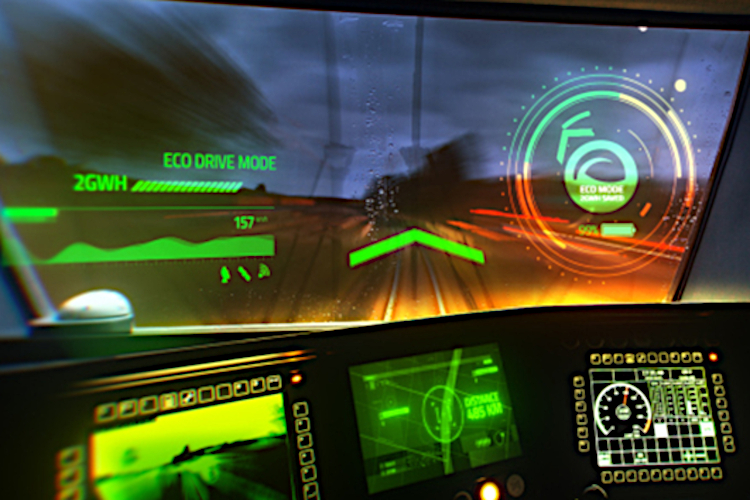
In December 2023, for over a month, 5 train drivers from Koleje Mazowieckie and 14 from Łódzka Kolej Aglomeracyjna have been testing how SENSUM works in practice – an eco-driving system for railway personnel, developed as part of one of the main initiatives of the Railway Energy Efficiency Centre by PKP Energetyka. Nearly 150 journeys have been completed, confirming the system’s high precision and the accuracy of teletechnical data. KM and ŁKA, as leaders participating in the development and implementation of the system, are co-creating this innovative solution that improves the efficiency, safety, and punctuality of transport.
What is eco-driving? It is conscious, skillful, and economical driving, allowing for the lowest possible consumption of energy or fuel. In rail transport, eco-driving must take into account many additional factors. Above all, the timetable, weather conditions, passenger load, and the type of vehicle. The train driver therefore has a lot of information to analyze and decisions to make in a short time. The SENSUM algorithm, currently being tested, collects and analyzes this data, and the driver receives precise instructions, similar to those we get from GPS navigation. That is why it is called the “train driver’s sixth sense.”
SENSUM consists of two elements communicating with each other. The central system (the “brain” of the solution) – an algorithm that collects and interprets data – and onboard terminals – tablets with an application placed in the driver’s cabins. During the tests, it was verified whether precise instructions and hints corresponding to real conditions were displayed on the tablets in real time. The algorithm processed over 500,000 records into the system, each with a 10-second data range. The results obtained confirmed the high accuracy of the network model within the range of the journeys performed and positively verified the assumptions regarding the method of handling telemetric signals acquired from the vehicles.
In parallel, the tablets collected and sent data from the vehicles (such as speed, driving dynamics, energy consumption, etc.), feeding the central system. Inside it, just like in a brain, not only are data aggregated and interpreted, but calculations and multi-variant simulations are performed. It has been confirmed that the SENSUM “brain” has a very high learning capability based on registered journeys, which allows for continuous optimization of the solution. The tests also confirmed that SENSUM works continuously, even offline, when there is no network coverage.
The results were obtained over four weeks of monitoring nearly 150 scheduled journeys with a total duration of approx. 140 hours. The journeys were conducted by 17 selected train drivers using 8 system terminals. The journeys were recorded on the following vehicle types: 36Wed, 45WEkm, EN57AKMwl, EN57AL.wKM, EN76, ER160, LM4268.
– An important part of this test phase was gathering feedback from the train drivers, including recommendations regarding the scope and method of presenting information in the cabin, in order to increase their work comfort and situational awareness. I am especially pleased that the train drivers confirmed the high precision of, among other things, indicating train stopping points, which greatly facilitates their work in low visibility. We place great emphasis on SENSUM providing comprehensive guidance to support safety decision-making – said Witold Bartnik, CEO of REDS, the company responsible for the system’s technological solutions.
– The SENSUM application is a tool that not only improves the train driver’s work but also allows for more ecological driving, even in difficult conditions. The technology analyzing travel conditions ensures a smoother ride and reduces the use of sudden acceleration or braking, which generate higher traction energy consumption. Importantly, the mentioned analysis also works on the principle of memorizing routes, which also affects subsequent journeys on the same line section – assessed Czesław Sulima, Board Member, Operations Director of Koleje Mazowieckie.
– We act innovatively and with care for the environment. We use green energy to power our trains and maintain technical facilities. We have introduced recuperation and eco-driving, thanks to which we have reduced electricity consumption by approx. 25%. We want to use energy as efficiently as possible while reducing our carbon footprint, and SENSUM will allow us to do this even more – emphasized Janusz Malinowski, President of the Board of Łódzka Kolej Aglomeracyjna, Chairman of the CEEK Program Council Presidium.
What are the most important benefits of SENSUM confirmed in the tests?
Smooth driving = less energy consumed.
SENSUM fills in the missing elements in the drivers’ situational awareness, making them “see” much more. It works similarly to car navigation, which, for example, points out speed limits or obstacles on the route. Thanks to this, the driver can react in advance, adjusting their driving style and speed, thus operating the train more evenly – without sudden braking or acceleration. This translates directly into the optimization of driving technique and at the same time reduces the amount of traction energy or fuel consumed.
– I already have six years of experience as a train driver and I know that most energy – both my own and the vehicle’s – is lost on so-called strenuous driving. This type of driving reduces travel comfort because it relies on sudden acceleration and braking of the train, which is not always necessary. Now the tablet tells me in advance that I don’t have to drive at full speed to reach the next stop on time, and I cover that section using less energy – said Filip Pełkowski, a KM train driver.
Support for punctual driving
On the railway, punctual driving is when a train covers given sections in a strictly defined, pre-determined time – it does not enter the destination station either earlier or later. During the tests, the train drivers appreciated that SENSUM helps them drive on schedule by providing tips based on, among other things, the analysis of railway traffic specifics in a given area, travel time, or sudden restrictions. The value of the system is concrete guidance, such as “slow down to 20 km/h,” and not just routine information about the state of the track or speed limit. At the same time, it was pointed out that when approaching a station, information about the distance (in meters) should be provided, not the travel time (in minutes). Such tips are very valuable and will be taken into account while refining SENSUM and tested in the next phase.
Interface, the friendly “face” of SENSUM
SENSUM is not only technologically advanced but also user-friendly. The interface – the layout of the tablet screen – was developed based on suggestions from the train drivers themselves, so that the amount and arrangement of the presented information was graphically friendly and best suited to their needs.
There are plans to ensure compatibility with other devices used by the train driver. The tests included suggestions regarding integrating the application with the timetable displayed on the carrier’s tablet.
Railway “GPS” operating in real time
Similar to “reporting hazards” in a GPS, SENSUM enables communication between train drivers within the system. This functionality was also confirmed in tests. Drivers reported hazards, e.g., icing, reduced visibility, or so-called “slippery rail.” Ultimately, SENSUM will analyze and send information about the potential occurrence of a phenomenon to all vehicles in range. Access to this type of message in real time will obviously affect the safety of the entire railway traffic. As part of subsequent testing phases and during product development, this and other functions will be added to the system, which still has many technological and IT possibilities. As in any such solution, it is key that as many vehicles across the country as possible use it. The scale effect will make the system’s indications more accurate and complete.
Co-creation, the process of SENSUM development
SENSUM tests are carried out as part of the industry initiative of the Railway Energy Efficiency Centre (CEEK). This is the next stage of the development process of this innovation, which began in February 2020. At that time, the first workshops on economical driving took place, attended by train drivers and instructor-drivers from railway companies across Poland, both freight and passenger. The conclusions drawn from the workshops were helpful in creating the system, and the comments provided were taken into account in further work on SENSUM. The current test phase is a natural consequence of the previous two stages of system development in a co-creation model, i.e., the joint creation of a valuable solution, best suited to the needs of the end user.
It is in this way: in stages, in close cooperation with carriers who verify the validity and usefulness of the adopted solutions in each iteration, that the project is led by PKP Energetyka in collaboration with Polish IT specialists and engineers from REDS. This is a unique approach in the railway market and proof of successful B2B cooperation.
– Our mission is to support the development of Polish railways. By proposing innovative solutions for the industry, we invite our customers to the process of their creation, at every stage – from the moment of conceptual planning to the practical tests of the jointly developed tool. From the beginning, SENSUM has been subject to verification by the end user – that is, the train drivers. It must be, above all, useful in everyday work; only then will it be used and fulfill its functions – informs Leszek Hołda, Board Member of PKP Energetyka, which developed and is implementing SENSUM.
Eco-driving on European tracks
The issue of eco-driving on railways has been explored for years in other European countries. For example, Nederlandse Spoorwegen (Dutch Railways) launched a pilot project in this area as early as 2010. This program is being continued with the support of special applications for train drivers implemented by both the carrier and the infrastructure operator. A similar initiative is being conducted by SNCF (the main carrier in France), which announced this year that the efficient driving program would cover all its trains. Advanced systems supporting train drivers are also used in CFL (Luxembourg), Deutsche Bahn (Germany), LKAB (Sweden), SOB (Switzerland), and in the UK.
CEEK assumes that the implementation of a consistent eco-driving system for railways will enable the generation of electricity savings of 400 GWh and a reduction in CO2 emissions of 320,000 tons. The next stage in Phase IV will be the production launch of the system, which is planned for June of next year.