









More than 156,000 European companies rely on suppliers from Russia or Ukraine. This is 11,000 fewer companies than those dependent on supplies solely from the Shanghai region. Europe’s growing dependence on China means that the global economic shock caused by the war in Ukraine may only be a prelude to another disaster if companies do not take real steps towards shortening supply chains. Data shows that businesses are not keen on this, but if they do turn towards Europe, Poland has a chance to become the logistics and manufacturing base of the Old Continent. We have very competitive labor costs in industry and logistics, trained personnel, a galloping warehouse market, a location close to sales markets, and several other advantages.
A month after the Russian aggression, the United Nations Conference on Trade and Development (UNCTAD) reported that the war in Ukraine will lower global economic growth from 3.6% to 2.6% in 2022. In addition to Russia, which will experience a deep recession, a significant slowdown is also expected in Western Europe and in Central, South, and Southeast Asia.
The World Trade Organization (WTO) has also lowered its forecasts, this time regarding the growth rate of global trade in goods. According to the organization, growth in 2022 will be 3%, not 4.7% as previously assumed. The forecast for 2023 is currently 3.4%, although the WTO warns that this data may also change due to the unpredictable course of events in Ukraine.
Although the war is local, its consequences are global, and the deterioration of forecasts is also noted by the S&P Global agency, which, during its monthly PMI surveys, asks companies about their own subjective expectations regarding production in the coming year. The latest study showed that Russian aggression has lowered global business optimism so sharply that in the past decade, it is only surpassed by indicators from the beginning of the pandemic, i.e., March and April 2020. Sentiment has fallen in both the manufacturing and services sectors, and among the 45 countries for which PMI data is available, as many as 84% of economies recorded a decline, including all European countries. Sentiment on the Old Continent has regressed to the level of 17 months ago. To make matters worse, this happened at a time when companies did not expect major market disruptions and were positive about emerging from the pandemic. These two factors were key to improving business prospects for the year that was just beginning. Everything changed on February 24.
The effects of the war were immediately felt by the Polish economy, especially trade and logistics
The transport sector is a barometer of the economy, which is why we saw the first effects of the war almost immediately. Due to the structure of energy raw material supplies from Russia, fuel prices skyrocketed. Transport rates became more expensive as a result, but it is worth noting that the attack on Ukraine also temporarily froze trade. In the first few days, we observed a reduction in retail chain stocking in several product categories, and orders placed via the e-commerce channel also fell. This was a consumer shock caused by the war, manifesting in a freezing of household budgets. The situation has already stabilized, but this swing was noticeable. In the next stage, there was an increased demand for warehouse space, as retail chains operating in the East began to redirect the import of their goods to Poland. Here, the increase reached even a dozen percent or so, followed by increased deliveries of products to stores to sell off excess stock. Currently, we observe a sustained increase in interest in warehouses, as contractors who suspended or withdrew from business in the East are trying to permanently redirect operations to Poland. We estimate that this trend will stay with us for longer, says Beata Troczyńska, Sales Director for Logistics Services at Spedimex, a Polish logistics operator serving retail chains, e-commerce, and LTL and FTL transport in Poland and Europe.
The change in consumer behavior, which is a direct consequence of the war, is also visible in a survey conducted by SW Research on March 9-10. It shows that after the armed attack on Ukraine, as many as 48% of Poles made changes to how they manage their money, with 23% limiting funds for entertainment and pleasure, and 22% making a general reduction in spending. Changes also manifested in hoarding fuel (18%) and reducing car travel (16%).
Further disruptions may still come
The war in Ukraine, commodity prices, inflation, coronavirus, transport difficulties, and a number of other factors have already lowered forecasts for global trade and GDP, but they have also affected Poland. The World Bank lowered its forecast for economic growth in our country to 3.9%. Previous announcements spoke of 4.7%. It may soon turn out that further trouble will arrive when supplies from the East cease and companies in Europe and the USA exhaust their inventories.
Calculations by Interos, a company specializing in supply chain risk management and enterprise operational resilience, indicate that Russia’s invasion of Ukraine could have far-reaching consequences for both the American and European economies, and the global system of linkages and dependencies leading to Russia and Ukraine is more complicated than it seems. According to Interos analysts, more than 2,100 US companies and 1,200 European companies (EU and UK) have at least one direct, first-tier supplier in Russia. To clarify, such a supplier is considered an entity that provides finished solutions, components, and subassemblies that do not require any further modifications. More than 450 US companies and more than 200 European companies have the same category of suppliers in Ukraine. Although this seems small, it should be remembered that individual tiers of suppliers are connected to each other in a linear dependency, and here the matter becomes much more serious. There are already 8,200 European companies with second-tier suppliers in Ukraine, and 38,000 in Russia. More than 109,000 European companies have third-tier suppliers in Russia or Ukraine. In total, this is more than 156,000 companies in Europe relying on supplies from these two countries. If a ban on commodity imports from Russia occurs, a huge number of these enterprises will have a significant problem to solve, although many of them today already have no sentiment when it comes to abandoning Russian suppliers.
The situation is completely different in the case of China
The serious consequences that a long-term disruption of supplies would cause in the event of import sanctions on China are perfectly demonstrated by the mounting problems resulting from the closure of Shanghai. As Interos calculations indicate, European entities have 770 direct first-tier suppliers, over 48,800 second-tier, and over 118,000 third-tier suppliers in that region. In total, this is more than 167,700 suppliers, and these are only economic ties leading to the Shanghai region. It is difficult to even estimate what a halt in supplies from the whole of China would mean today. Undoubtedly, the European economy would shake at its foundations, and with it the US economy, where more than 318,500 companies rely on supplies from just the Shanghai region.
The EU has been moving towards dependence on China for years
In 2021, EU exports to China reached a record 223 billion euros and were 75.6% higher than in 2011 (127 billion euros). This is an average annual growth of 7%. Imports from China also broke a record and amounted to 472 billion euros last year. Since 2013, when there was a slight decrease in imports (239 billion euros), it has grown at an average annual rate of 6%. Eurostat data indicates that in 2021, China was the EU’s 3rd most important partner in terms of goods exports, with 10% of EU goods going to that market, including 52% of EU machinery and vehicles, 20% of industrial goods, and 15% of chemicals. The situation looks much worse in imports, because in 2021, as much as 22% of EU imports came from China, including 56% of machinery and vehicles, 35% of industrial goods, and 7% of chemicals. As if that were not enough, the Union constantly records a trade deficit with China, which grew from 129 billion euros in 2011 to 249 billion last year.
China attracts investment, and companies are not even thinking about moving
Despite many assurances, and exceptionally even individual examples of companies withdrawing from China, the loud announcements about mass relocation of production from the Middle Kingdom and diversification of supplies still remain only in the sphere of declarations. It seems that the painful effects of dependence on the Chinese economy observed after the outbreak of the pandemic, and the resulting global debate about the necessity of reshoring and deglobalization, have brought results completely opposite to those assumed, or to put it briefly, simply turned out to be a myth. China attracts more and more foreign investment every year.
According to UNCTAD, the value of global foreign direct investment (FDI) in 2021 reached 1.65 trillion dollars, recording an increase of 77% compared to 929 billion dollars in 2020. While the US attracted the most (323 billion dollars), China recorded a historical record, bringing 179 billion dollars in investments into the country. This is 20% more than the year before and about 11% of total global FDI. In 2020, at the height of the pandemic, during a period of endless disruptions in supply chains and trade, China was the largest beneficiary of FDI in the world, and according to UNCTAD, their value amounted to 149 billion dollars. This is not the end of the Chinese economy’s successes, however, because it not only attracts more and more foreign investment, but only a small percentage of American and European companies plan to leave the Middle Kingdom.
According to a study conducted in the middle of last year by the American Chamber of Commerce in Shanghai among 338 American companies operating in China, as many as 77.9% indicated optimism or relative optimism regarding 5-year business prospects. Additionally, 59.5% reported an average of 30.9% larger investments compared to 2020, and 72% of companies producing in China had no plans to move any production out of the Middle Kingdom in the next 3 years, i.e., until mid-2024. Among the remaining 28% of entities that planned to move at least part of their production, only 2 companies, or 1.6%, want a complete relocation outside of China. Interestingly, none of the companies surveyed have plans to move to the US.
Similar conclusions flow from a study published in 2021 by the European Union Chamber of Commerce in China, carried out together with analysts from Roland Berger on a sample of 585 European entities operating in the Middle Kingdom. Summarizing the pandemic year, only 9% of organizations considered moving any planned or current investments outside of China, which is the lowest result in the history of the study. At the same time, 68% of companies assessed business prospects with optimism, and this was a 20% y/y increase.
But if European companies wanted to move, where would they go?
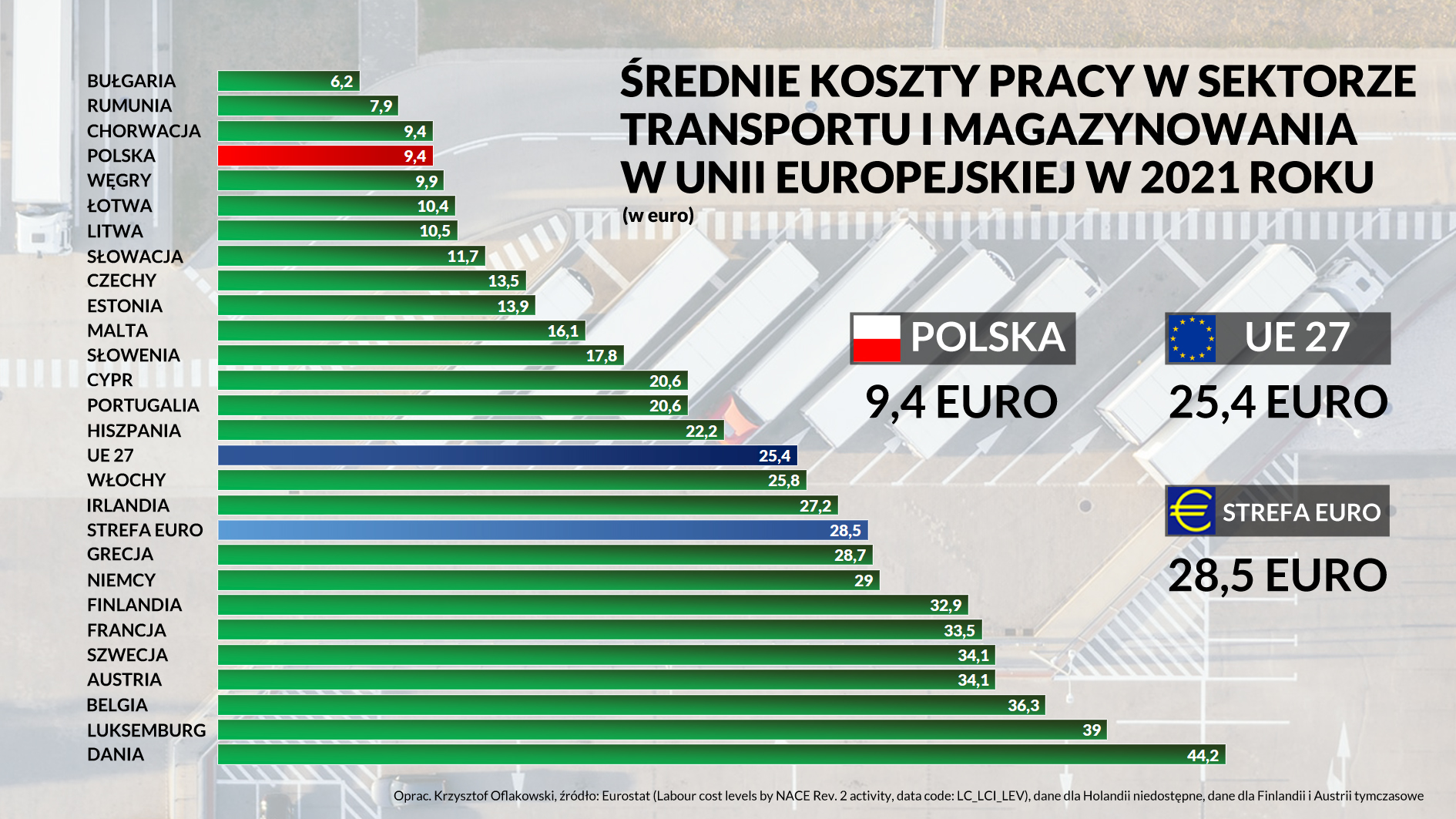
Poland has some of the lowest hourly labor costs in the transport and warehousing sector in the European Union. Eurostat data published at the end of March this year indicates that in 2021, the average labor cost in the transport and warehousing sector in Poland was 9.4 euros, while the average value for the entire Community stood at 25.4 euros, and in the eurozone at 28.5 euros. Among EU countries, only peripheral Bulgaria (6.2 euros) had a better result than Poland, then Romania (7.9 euros), and only Croatia recorded the same average labor costs as Poland. Behind us were Hungary (9.9 euros), Latvia (10.4 euros), Lithuania (10.5 euros), Slovakia (11.7 euros), Czech Republic (13.5 euros), and Estonia (13.9 euros), our main competitors in the region. Such low labor costs, combined with a location on the main transport axes of Europe and Poland’s access to the sea, make our country a convenient bridgehead for locating production and logistics investments for companies in all industries, including those wanting to move from Belarus, Russia, and war-torn Ukraine. The sum of these factors means that we can constitute an attractive alternative to the German offer, where the average hourly labor cost in the transport and warehousing sector was 29 euros last year, which is more than 208% more than in Poland. Competitive labor costs do not only apply to logistics, but also to production (10.4 euros in Poland compared to the average of 29 euros in the EU), industry (11.2 euros compared to the average of 29.1 euros in the EU), and general average labor costs in the Polish economy, which in 2021 were 11.5 euros, while in the Union they were 29.1 euros.
Poland lies at the center of the largest sales market in this part of the world, we have increasingly better transport infrastructure, Polish drivers have reigned on European roads for years, and last year we were responsible for over 20% of the transport work performed in EU road transport. The Polish logistics sector has huge potential, although many challenges still lie ahead. We constantly have relatively low saturation with robotization and automation of logistics processes, and the industry relies to a very large extent on personnel, especially in warehouse logistics. A separate issue is the notorious shortage of drivers, which holds back the development of the entire economy. A study published last year by Transport Intelligence shows that there is a shortage of almost 124,000 drivers in our country, and over 400,000 in all of Europe. Despite these obstacles, we are doing very well, and companies locating their logistics centers on the Vistula, especially those from the e-commerce sector, see this. We expect that in light of recent events in the East, companies will be more willing to launch their processes here, also due to geopolitical security and in the interest of their own capital. Poland’s position will grow even more if the announcements of Ukraine’s accession to the European Union come true. This will shift the logistical center of gravity even more towards our country, and in time will open a sizeable sales market for Polish products. Although this is still a distant future, we believe that we should think about it now – adds Beata Troczyńska from Spedimex.
Location, labor costs, and dominance in EU transport are complemented by a galloping warehouse sector
According to the latest Walter Hertz report, last year in Poland, more than 3 million sqm of warehouse and industrial space was added, and its total supply reached 23.8 million sqm. More than half of this space was built in the last 5 years, and at the end of 2021, another 4.7 million sqm were under construction. This is the highest result recorded on the Polish market. Domestic warehouse resources are assessed similarly by JLL experts, according to whom 23.8 million sqm at the end of the year makes our country the sixth largest European market. In turn, 2.9 million sqm of new supply corresponds to 15% of the total space delivered in Europe in 2021. According to JLL, if investments under construction are taken into account, only Germany was a more active market. If, however, we look at the growth of resources over the last 5 years (an increase of approx. 15% annually), we are the most dynamic warehouse market on the Old Continent.