









Distribution centers for e-commerce, predictive logistics, research and development, technical infrastructure, and Industry 4.0 are the areas that, according to Incheon, will determine the future of the airport and the development directions of the global air cargo market. Based on these instruments, one of the world’s largest transport hubs, and since February also a strategic advisor to CPK, is currently implementing a vision intended to change the paradigm of modern airports by transforming Incheon into a 3rd generation airport. Is this also a ready-made development scenario for CPK?
Little is still known about the details concerning cargo in the airport component of CPK, although information published by the Centralny Port Komunikacyjny (Solidarity Transport Hub) company indicates that in the first stage of construction, the airport will be able to handle 1 million tons of cargo per year. Logistics centers are also to be built around the investment, and the multimodal nature of the port is intended to make it an important cargo hub. Even before the first shovel hit the ground, Poczta Polska declared its presence at the airport, planning to establish a transshipment center for handling domestic and international shipments. Interest in the project is also visible from the logistics industry participating in the CPK Stakeholder Forum, a series of meetings aimed at defining the needs of future airport users.
Incheon International Airport is also participating in the planning and dimensioning of CPK; as a strategic advisor, it is meant to be an important source of the knowledge needed to design the country’s new transport center. The South Korean partner certainly possesses such knowledge, having already advised over a dozen airports around the world, and while involved in optimizing Poland’s most important infrastructure investment, it is also implementing its own development project focused on the production environment and logistics. The elements and goals of that project are known and may be included in CPK’s plans, however, it is worth emphasizing that due to a number of significant differences between the two ventures, it is difficult to expect a direct implementation of individual solutions on the Vistula. Nevertheless, they shed some light on what the development of air logistics looks like from the perspective of one of the world’s largest cargo ports.
Scale of flows and Incheon’s logistics plans
According to the latest data from the Airports Council International (ACI), over 2.82 million tons of freight and mail handled at Incheon in 2020 gave it 6th place in the ranking of the world’s largest airports in terms of cargo traffic, of which 2.76 million tons translated into 3rd place in the global ranking of ports handling the most cargo on international routes. The airport’s current transshipment capacity is, however, significantly higher, amounting to as much as 5 million tons; additionally, the fourth expansion of the port, which is to be completed in 2024, is set to increase capacity to 6.3 million tons of cargo per year. The number of parking aprons intended exclusively for cargo aircraft is also to increase from 47 to 60, and in the year of completion of the modernization works, Incheon plans to handle 3.85 million tons of goods, which is over 1 million tons more than in 2019.
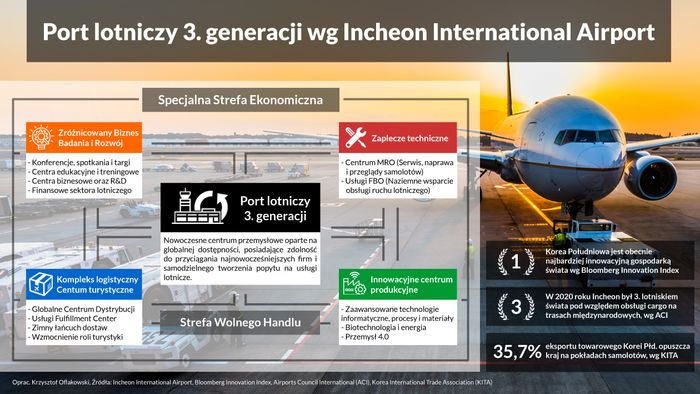
The plans of the global transport hub, however, reach much further than just increasing the volume of cargo. Incheon intends to change the paradigm of modern airports by soon becoming a 3rd generation airport. As it explains, the first generation of airports focused mainly on building infrastructure providing efficient take-off and landing handling and commercial amenities for passengers. The second, alongside transport and shopping, also offered cultural and entertainment spaces, the possibility of recreation, and facilities favoring business development in the form of conference and exhibition centers. The result of this stage of evolution are the so-called Airport Cities built around ports all over the world. A 3rd generation airport, on the other hand, is to serve as a modern industrial center based on global accessibility, which, through its ability to attract cutting-edge companies, will be able to independently create demand for air services.
Realizing this vision is to be enabled by the airport’s special economic zone focused on the development of four basic pillars. The first is building a diverse business environment coupled with educational complexes, R&D centers, and aviation financing sources. The second pillar, in addition to strengthening the role of tourism, places special emphasis on increasing the competitiveness of logistics through the pursuit of obtaining Global Distribution Center status for the e-commerce industry, developing services in the Fulfillment Center model, and expanding infrastructure to handle the so-called “cold supply chain.” The third core is to fulfill the tasks of an innovative production complex focused on the advanced technology, materials, and energy sectors, but also biotechnology and other branches of Industry 4.0. The fourth element of the foundation is to be top-class MRO (Maintenance, Repair, Overhaul) services, i.e., servicing, repairing, and inspecting aircraft, and other aviation technical support services.
Full logistics transformation by the end of the decade
The concept of a balanced economic ecosystem capable of independently generating demand for air services is to become a reality in 2030, ensuring 8.1 billion dollars in direct sales revenue in the first year of operation. An additional 13.6 billion dollars is to be gained by the South Korean economy thanks to the indirect impact and synergy of the four pillars creating the airport’s special economic zone.
In carrying out tasks in the field of production and logistics, a key role is to be played by the already functioning free trade zone, which, in addition to a cargo terminal with an area of over 1.1 million square meters, also includes a logistics complex with an area of 1.6 million square meters (another 597,000 square meters is planned or under construction). It is there that the Global Distribution Center (GDC) and a modern production complex are to be created. One of the basic assumptions underlying the GDC idea, i.e., a logistics hub specialized in handling e-commerce, is to use global know-how in the field of predictive logistics based on the analysis of big data, artificial intelligence, and machine learning. Obtaining the ability to predict purchasing trends and the possibility of warehousing goods in advance are to allow for the optimization of production and faster satisfaction of future demand, thereby increasing the competitiveness of not only the port itself but also the suppliers using its infrastructure. The attractiveness of the airport for the e-commerce sector is also to be ensured by supplementing the offer with a base for Fulfillment Center services, i.e., entrusting the entire process of online order fulfillment to external logistics companies. In this way, Incheon wants to increase its own share in the distribution cycle of goods, working on the assumption that the more handling stages take place on its territory, the higher the competitiveness and profits for all involved parties.
– A similar air logistics development scenario could also be implemented in Poland, of course after adapting the assumptions to the local market operating conditions. CPK can be a very important point on the European e-commerce flow map, because it is not just an airport, but also an entire infrastructure network being developed in the very center of the continent. Focusing attention on the comprehensive handling of international e-commerce would also be a reflection of a global trend visible in logistics for at least a decade, and it is not just about air transport, but also other types of transport. The same applies to the “cold supply chain,” i.e., the transport of goods in controlled thermal conditions, especially food and medicines. In recent years, this market has also been developing very dynamically and has very optimistic forecasts for the coming years. The past year has shown how important it is to have the capability to handle this type of cargo. Kuehne+Nagel is responsible for the transport of vaccines, those against COVID, but also others, in many countries around the world. Developing certified global solutions, both for vaccines and for the transport of other pharmaceutical goods, took us several years. This is our evident competitive advantage and proof of far-sighted strategic thinking. Having the right infrastructure, supported by international certification, would undoubtedly also strengthen the position of CPK and its cooperating partners – says Wojciech Sienicki, Managing Director of the Polish branch of Kuehne+Nagel, one of the world’s largest logistics operators.
How to encourage carriers, producers, and sellers to move to the airport?
Considering the activities of Incheon to date, but also other ports around the world, the answers can be found in the approach to creating and financing infrastructure, incentives for investors, and IT solutions ensuring the fluidity of logistics processes. So far, as a source of financing for the logistics facilities at CPK’s strategic advisor, PPP, i.e., Public-Private Partnership, has been successfully used, including in particular the BTO (Build, Transfer, Operate) model. It assumes that a private investor finances the construction of the facility, then transfers ownership to a public partner, but under a long-term contract has the right to use the investment and profit from it. In the BTO model, among other things, cargo terminals for Korean Air and Asiana Airlines were built, setting an operating period of 20 years. In a slightly different version of PPP, however, both AACT cargo terminals were realized, i.e., a joint investment by Atlas Air and Sharp Aviation K. The projects were based on the BOT (Build, Operate, Transfer) model, in which the transfer of the built facilities to the public side will take place at the end of the usage periods, i.e., in 2028 and 2039. Regardless of the choice of specific mechanics, PPP gives investors greater opportunities to design for their own needs and scale, which affects not only the cost of construction and maintenance of the investment but also the date of its launch.
For companies that decide to start operations at the port, an extensive system of incentives and discounts has also been developed. For example, cargo carriers starting flight operations at Incheon are completely exempt from landing fees for a period of 2 years. Total or partial exemption from such fees is also associated with launching a new flight route or an additional connection on an existing route. The airport also pays an extra amount for each ton of cargo that is a surplus compared to shipments carried in the same period a year earlier. This applies to both goods transported as belly cargo, but also those carried on board freighters.
The discount system also includes fees for the use of airport land by production companies. Investment in infrastructure exceeding 30 million dollars means complete exemption from the aforementioned fees for 5 years, and 50 million in contribution extends this period to 7 years. Similar discounts can be counted on by distribution companies, global freight carriers, or entities dealing with warehousing, for whom 15 million dollars of investment means exemption from fees for 5 years, and 30 million for 7.
Taxes have also not been forgotten, from which goods imported from abroad and used to launch and carry out production, including machines, construction materials, or office equipment, are exempt. Investors allocating at least 1 million dollars for R&D and manufacturers and distributors exceeding the sales level set for them can, in turn, count on CIT exemptions.
Existing IT tools for handling and managing the logistics process are also to help in the transformation
One such tool is UNI-PASS – the world’s first electronic customs clearance system operating 100 percent online. The platform, which has been operating in South Korea in a “single window” model since 2004, integrates and automates the exchange of customs information not only between 27 government agencies directly related to trade but also with over a hundred other administrative bodies, including, among others, the Bank of Korea, the Ministry of Energy, and even the Korea Meteorological Administration. Over 260,000 companies participating in trade with South Korea also have appropriate access to data processed in real-time, and the system itself is considered one of the fastest and safest customs handling mechanisms in the world. According to Incheon data, the implementation of UNI-PASS at the airport allowed for shortening export clearance from over 24 hours to 2 minutes, while import clearance time was reduced from over 2 days to 2.5 minutes. Customs fee payment procedures (from over 4 days to 10 hours) and their refund mechanisms (from 3 days to just over 5 hours) also accelerated dramatically.
For years, the AIRCIS (Air Cargo Information Service) system has also been operating at Incheon, created jointly with the Ministry of Land, Infrastructure and Transport as a platform dedicated to all entities involved in the logistics process involving the airport. AIRCIS not only provides up-to-date and comprehensive information about handled cargo but also allows airlines, ground handling companies, warehouses, or logistics operators to track transport in real-time, make bookings online with all carriers operating at the port, monitor flight schedules and disruptions, and thanks to the possibility of integration with external systems, also send and handle electronic airway bills. In addition to entities operating at the airport, the platform is also used by shippers, recipients, customs agencies, and for statistics purposes also IATA (International Air Transport Association). The system is considered one of the best platforms in the world for managing air logistics.
What will South Korean know-how bring to the CPK project and what challenges await air cargo in Poland?
The agreements signed in February of this year between CPK and Incheon, but also between Poland and South Korea, assume the transfer of knowledge and technology and support at the stage of designing the airport along with its business environment. The cooperation is also meant to help in integrating CPK with other types of transport and using innovation, providing a significant substantive contribution at the planning stage of Poland’s future communication center. The Asian partner has already advised on over a dozen airport projects around the world, including co-creating the operational and business strategy for the new port in Istanbul, which, after the completion of the second stage of expansion, is to achieve a capacity to handle up to 200 million passengers and over 5 million tons of cargo annually. It is much more important, however, that Incheon has already carried out a successful investment at home, with which CPK has an essential common feature.
Both projects are multimodal communication hubs located at the intersection of important trade routes, which is one of the basic conditions for the success of airport investments in cargo matters. CPK, like Incheon, is also a staged implementation, but if we are talking about initial assumptions for freight traffic, other goals regarding the volume of handled cargo have been adopted. Preliminary plans for the Polish port speak of a capacity to handle 1 million tons of goods per year, while the first stage of Incheon’s construction assumed 2.7 million tons of cargo. This is related to another factor that, alongside the location on global trade routes, determines the possibilities and success of cargo airports. It is about the economic environment and industry that can make large-scale use of air freight services.
According to the World Trade Organization (WTO), South Korea was the world’s seventh-largest exporter of goods (542.2 billion dollars) and the ninth country on the list of top importers (503.3 billion dollars) in 2019. As much as 87% of the country’s exports were production goods, with the largest category of goods sent abroad being electronic integrated circuits (14.6% of total exports), i.e., cargo that, due to its small volume and weight and high price, is practically made for air transport. South Korea currently accounts for about 20% of the global semiconductor market; it is also an important link in the global value chain and the most innovative economy in the world according to the Bloomberg Innovation Index ranking. Companies like Samsung, Hyundai, Kia, LG, or SK Hynix have their headquarters there. Additionally, according to data from the Korea International Trade Association, the share of air transport in Korea’s total exports amounted to as much as 35.7% in 2020 and increased by 5.4% compared to 2019. The increased use of air transport in exports was particularly influenced by the increased demand for South Korean semiconductors, mass storage media, OLED diodes, and pharmaceuticals. The total value of goods that left the country on board aircraft reached 188.3 billion dollars, i.e., about 70% of the value of Poland’s entire last year’s commodity exports, which amounted to 269.9 billion dollars (according to GUS data from February 2021).
So far, Poland does not have the independent capacity to generate such large cargo flows dedicated to air transport, although the cargo sector on the Vistula is developing very dynamically. Even during the global slowdown in transport in 2019, i.e., even before the outbreak of the pandemic, air cargo in Poland grew by 7.9%. In 2018 by 7.2%, the year before by 11.7% and 17.1% in 2016. Results were improved not only by Chopin Airport (5.9% in 2019), but also Pyrzowice (9.1%) and Gdańsk (23.7%). According to Civil Aviation Authority (ULC) data, the total mass of cargo carried on board aircraft and handled at Polish airports in domestic and international traffic amounted to over 123,000 tons in 2019.
Compared to the planned capacity of CPK, it is still not much, especially since ULC data concerns cargo handled in the whole country. Strong growth dynamics still do not allow breaking through a 1% share of Polish airports in the EU cargo market. However, there is huge potential and opportunity for CPK in that same market.
Above all, Poland’s location means that in terms of freight traffic, its airspace is one of the most congested in the entire European Union. Data from the European Statistical Office shows that in terms of transport work performed in 2019 during the transport of freight and mail over the territory of individual countries of the Community, Poland was surpassed only by France, Great Britain, and Germany. Only four countries also achieved a result above 1 billion ton-kilometers (tkm), including 13.539 billion tkm for the entire Union, of which 1.283 billion tkm fell to Poland, 1.502 billion tkm to France, 1.612 billion tkm to Great Britain, and as much as 3.126 billion tkm to Germany. A good result at the level of 866 million tkm was also achieved by Romania, otherwise, no other country exceeded the threshold of 600 million tkm.
– The appearance of high-capacity airport infrastructure in Poland could bring some of the cargo to the Vistula, especially those coming from Far Eastern directions. In Europe, there is still room for a large hub airport that would be used not only by Poland but also by neighboring countries. International passenger connections alone would trigger huge potential for cargo development, because more than half of global air freight is carried out using passenger aircraft. Poland’s position as an important transport hub for the region also argues for the creation of CPK, and this is no longer just a plan for the future, but a reality. Just look at the last few years of development of seaports, rail and warehouse logistics. Each subsequent year is a new record of transshipment or available space. We are becoming a respected distribution center, knowing at the same time that the possibilities of the largest airport, which also handles 80% of cargo in the country, are being exhausted. The lack of high-throughput infrastructure also means that the largest cargo airports in Poland have been feeding transport hubs beyond our western border for years – adds Wojciech Sienicki.
According to Eurostat, in 2019, the most important cargo partner for Warsaw, Katowice, and Gdańsk was Leipzig/Halle Airport. Cologne/Bonn Airport also ranked high, which was the third cargo partner for Warsaw, the second for Katowice, and the most important cargo port for Poznań. Part of the transshipment between Polish and German ports is of course the result of normal trade exchange, but western airports also serve as transport hubs from which Polish goods arrive or fly out further into the world. Also interesting in the context of cargo potential at CPK is the fact that supplying German hubs does not concern only Poland, but also the largest cargo airports in the Czech Republic, Slovakia, Hungary, Lithuania, and Slovenia, for which the leading partners in terms of transshipment are either Leipzig/Halle or Cologne/Bonn. German airports are also in the top four most important cargo partners for ports in Austria, Romania, Croatia, Bulgaria, and Sweden. CPK will certainly fight for these markets, especially since the location of the port will be more favorable from the perspective of transporting goods from and to Asian countries, which are closer to Poland than to Germany. Air cargo on this route flies over Poland anyway, so it could just as well land here and be distributed to destination countries either by plane or other types of transport.
At least partially, this would solve the issue of the Polish economy’s limited ability to independently generate large volumes of cargo dedicated to air transport, because they would come not only from the domestic market but also from other countries in the region. This applies equally to goods sent abroad as well as those imported to Europe from other continents. The air cargo market is, however, very competitive, and besides a convenient location, additional instruments will also be needed that will allow for building a strong position for CPK in the freight transport sector. One of them will be, among other things, the ability to attract carriers guaranteeing constant cargo service on long-haul routes. Other logistics industry entities must also find a place at the airport for whom starting operations at the port will be economically justified. Perhaps CPK will benefit from South Korean experiences, creating incentive programs for airlines, investors, and the broadly understood logistics environment. The presence on the CPK board of a strategic advisor who created one of the best-managed airports in the world, and is currently implementing a vision intended to change the paradigm of modern airports, certainly stimulates the imagination. Building such a large project from scratch is, however, a series of challenges, but also opportunities, both in terms of the potential for impact on the market, financing, and the size of cargo infrastructure, the use of IT tools, as well as all other aspects affecting the competitiveness of the future airport as an important cargo hub in Poland and Central and Eastern Europe.