








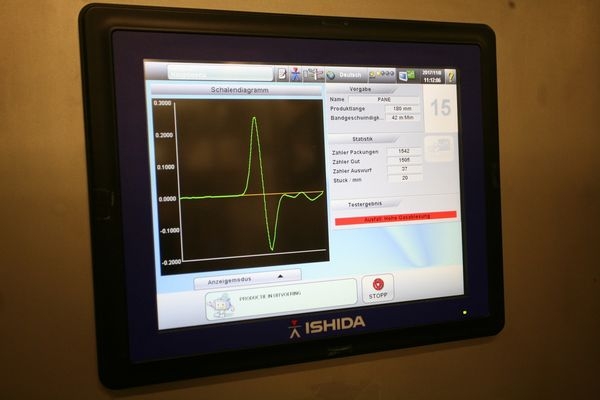
An X-ray inspection system should meet the specific requirements of a company. Before choosing a specific machine, we should consider a series of factors.
Contaminant-free products
The presence of foreign bodies in a food product can lead to unpleasant consequences, such as product recalls, financial penalties, or damage to customer trust that is difficult to repair. For these reasons, purchasing the right quality control system is not just a good investment, but a necessity. It is worth spending some time choosing the right machine to ensure the selected model is the most appropriate in terms of both performance and cost.
X-ray technology, compared to traditional quality control devices such as metal detectors, is gaining popularity in the product and packaging inspection process due to its versatility. X-ray inspection systems are capable of detecting a much wider spectrum of unwanted foreign bodies, such as metals, high-density plastics, rubber, glass, or stones. Furthermore, they can also perform a number of additional control functions in the quality management process. They can identify, for example, missing product components, incorrect dimensions, damage, deformation of the product and packaging, underfilled chambers, the presence of cracks and fissures in products, and allow for the estimation of product weight.
There is a wide range of X-ray detection models on the market representing different levels of capability. It is important, however, that before making a choice, companies spend appropriate time defining and evaluating their specific needs.
Criteria for selecting an X-ray system
When initially considering this, two important factors should be taken into account. These are the characteristics of the product, including its packaging, and the location of the machine on the line. Unpackaged products intended for further processing, as well as meat, poultry, salads, vegetables, and nuts, are inspected at the very beginning. In contrast, finished and packaged products are inspected at a much later stage of the line. The placement of an X-ray inspection system depends on whether the system is to assess the condition of primary packaging or to look for defective packaging already in a transit crate.
Regarding the product itself and its packaging, when choosing a machine, it is essential to consider the overall dimensions of the product. Ishida, in its offered range of X-ray inspection systems, offers a machine model with an inspection chamber height of up to 390 mm. This enables the handling of large product sizes, such as 25 kg blocks of cheese or butter.
Most X-ray systems operate by scanning from top to bottom, emitting an X-ray beam vertically through the product. For taller packaging formats, such as bottles, cartons, or tubes, there are device models available that emit the beam horizontally. This layout, in addition to classic foreign body detection, allows for the checking of fill levels and the correctness of the packaging seal.
How precise of a system do we need?
When choosing an X-ray system, the appropriate selection of sensitivity level based on product characteristics, the type of potential foreign bodies, or other functions, such as the detection of deformed elements or missing items, is of key importance. X-ray detection involves projecting a relatively low-energy beam onto a sensor or detector. The product or packaging moves under the X-ray beam, and only residual energy reaches the sensor. Measuring the differences in X-ray energy absorption levels between the product and a foreign body allows for the detection of the foreign body.
The sensor matrix is built from small pixels and is similar in operation to a digital camera sensor. As with a digital camera, the more pixels of a smaller size there are, the higher the resolution of the image indicating the location of the foreign body. Higher-resolution X-ray detection devices are better at catching softer and smaller foreign bodies. Consequently, specific X-ray models are characterized by varying levels of sensitivity. Cheaper, entry-level systems, such as our IX-EN model, are able to detect relatively high-density foreign bodies. In contrast, for the detection of soft or lower-density objects, such as glass or rubber, machines with higher sensitivity are required, e.g., the Ishida IX-GN series.
Genetic algorithm
Ishida X-ray inspection systems operate based on software that uses a so-called genetic algorithm, which is capable of analyzing image data from multiple measurement generations, allowing for an extremely high level of detection accuracy. Since many applications require the detection of similar foreign bodies, the system can be optimized to detect these objects. This enables the elimination of recurring sources of contamination.
Inspection of unpackaged products
The further down the line inspection takes place, the more difficult the detection process becomes. A factor influencing the choice of machine is also the type of packaging used. Products inspected in bulk and unpackaged represent a significant inspection challenge. In the case of meat and poultry, a typical quality control requirement is the detection of unwanted bone fragments in fillets. The existing slight difference in density between bone fragments and meat constitutes a major challenge.
With such products in mind, dual X-ray detection systems have been developed, equipped with two line sensors, one of which takes images using a high-energy beam and the other using a low-energy beam. This solution ensures a better overall image of the product, providing higher contrast between the product and the bone or other unwanted foreign objects.
In some cases, there may be a need to install two separate X-ray inspection systems located at different points on the line. This concerns the function of detecting foreign bodies in the product in bulk before it is packaged and in already sealed packages, as well as providing additional assurance that each batch contains the correct number of packages. A wide range of models facilitates meeting needs, where each model has the appropriate specification and is designed for the functions it must fulfill.
Selection based on the type of rejection system
Another important element to consider is the type of rejection system. Typical options include arm rejectors, pneumatic rejectors, pushers, and drop-down belts. The final choice will depend on the size and weight of the product and the speed of the line. Many retailers also require confirmation of the effectiveness of rejecting defective products and assurance that they have not been allowed to proceed further in the production cycle.
For bulk products, drop-down belts are a common method of product removal. A pneumatic rejection system means that less product is lost, but the system itself is more expensive, so it may only be suitable for higher-value products.
In most applications, an X-ray inspection system will not work in isolation but as part of a fully integrated line. Talking to suppliers with the appropriate technical knowledge and application familiarity will be invaluable, as they have in-depth expertise in supply and installation gained on other packaging equipment, as well as extensive experience in handling many different types of products.
With any investment, it is important to consider the cost of ownership of the system, using the criteria of the initial purchase price of the machine and its ongoing operating and service costs. An almost impossible cost to estimate is the cost of protecting a company’s reputation – and this is what should determine the decision regarding the choice of an X-ray inspection system.
Source: ishidaeurope.com