








Quick Response Manufacturing is a concept of rapid manufacturing that dates back to the 1980s. To what extent is it used today?
<\/strong><\/p>
 Karol Bąk, QRM and LEAN trainer, consultant at 4Results<\/strong><\/em><\/strong><\/em>: The industrial revolution after the Second World War enabled large-scale production and product availability for the mass market. Globalization processes, technological development, and an increasingly wealthy global economy led customers at the end of the 20th century to expect products more tailored to their individual needs. For companies, this means applying different management methods than those used in mass production. Small-batch and custom-made production, known as HMLVC (High-Mix, Low-Volume, Custom Engineering), makes it unprofitable to produce for stock. There is a risk that the customer may decide not to make the purchase. What is worse, in make-to-order production, the manufacturing process may begin only when the customer decides what the product should look like. This means that, in addition to production costs and quality, lead time itself becomes a new value-added component. The problem of lead time as a value-added factor also affects the Toyota Production System (TPS), a precursor to the “Lean” concept. A car is assembled on the production line in several hours, yet the customer is forced to wait 3 months. As a result, customers increasingly choose to buy a car off the lot instead of utilizing the millions of configuration options. The competence of the future is the ability to quickly manufacture products according to individual customer preferences.
Market changes inspired Professor Rajan Suri to develop a new production strategy in the 1980s and 1990s called QRM (Quick Response Manufacturing). In QRM, order lead time is the most important factor determining management functions, because time as a resource cannot be accelerated, delayed, or stored. The very first QRM implementations allowed managers to achieve spectacular successes in terms of reducing lead times by 50-90%. Offering shorter lead times on the market allowed sales teams to secure new contracts. In QRM, lead time is even more important than manufacturing costs, which does not mean that costs increase. Reducing lead times, apart from increasing sales, simultaneously allows for a 5-20% increase in total business profitability. Currently, there are estimated to be over five hundred QRM implementations worldwide in well-known corporations such as Harley Davidson and Trec American Bike, as well as in smaller companies employing up to 30 people. Management based on Quick Response Manufacturing can also be increasingly found in Polish enterprises (e.g., Rockfin, Syzan, Base, Ellert, Transsystem, Mikomax, Schindler).
QRM is a strategic tool whose implementation is based on 4 pillars.
Pillar I – The role and power of time<\/strong>
The first step of implementing QRM is an MCT (Manufacturing Critical Path-Time) analysis. Based on MCT, we learn that for 95% of the time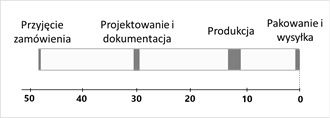 that orders are in the company, nothing happens to them. They spend this time in so-called white time (e.g., queues, warehouses). Less than 5% is gray time, during which activities are performed to complete the product (e.g., production, setup, transport, design). This means that QRM actions do not focus on gray times. The goal of QRM is to focus on reducing white times. At the same time, according to Professor Rajan Suri, maintaining white times is very costly (e.g., frozen cash, warehouse maintenance, logistics, planning processes). By reducing 50-70% of white times, total business profitability can increase by 5-12%.
Pillar II – Organizational structure<\/strong>
The traditional, functional organizational structure causes employees to have a limited view of the entire process. As a result, decisions made focus on local optimization. For example, in the paint shop, the queue is aggregated by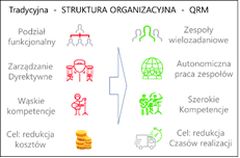 color, and on the cutting laser, by sheet metal thickness. According to QRM, this is one of the key causes of the spiral of increasing white times. The QRM solution is to design a new organizational structure based on QRM teams. They possess a complete set of resources and competencies that allow them to autonomously handle an order – from the moment of ordering to execution within the served FTMS (Focus Target Market Segment). FTMS is a filter based on which the QRM organizational structure is divided. The most important criterion for division is a focus on markets where shortening lead times can bring the greatest benefits. This is a different approach than in the case of the “Lean” concept, where the criteria are technological processes (cost concentration).
Pillar III – System dynamics<\/strong>
The focus on cost reduction means that the key performance indicators found in companies are efficiency (e.g., OEE). To maintain a high level of efficiency, managers strive to maximize resource utilization. As a result, even minor variability (e.g., an additional customer order or a request to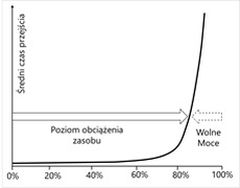 accelerate the delivery date) can disrupt the production plan and, consequently, spark a major fire across the entire organization. We increasingly encounter situations where a carefully crafted production plan ceases to be feasible before production begins. As a result, instead of relying on the production plan, foremen begin manual scheduling, which is colloquially referred to as “firefighting.” According to QRM, the source of the problem is an excessively high level of planned resource loading. Therefore, a revolutionary solution is proposed: planning and maintaining 10-15% of Spare Capacity, which acts as a safety buffer. The validity of using spare capacity is supported by queuing theory principles, where 15% of spare capacity allows for a reduction in average queues (white times) by more than 60%. According to Professor Rajan Suri, the costs resulting from investing in spare capacity are recouped through savings from reducing white times. Companies that operate using spare capacity report a 5-20% improvement in business profitability.
Pillar IV – Holistic approach<\/strong>
QRM is a strategic tool that focuses the entire organization on the continuous reduction of white times. This means that besides production, QRM goals are implemented in office and auxiliary areas. Unfortunately, in practice, it is not always possible to divide central resources and include them in QRM teams. This most often applies to areas such as: purchasing, planning, or finance. In such a situation, QRM includes a range of solutions on how to improve central departments so that their work does not slow down the QRM teams. For the needs of QRM, an innovative material flow control system called POLCA (Paired-cell Overlapping Loop with Cards of Authorization) was developed. It is a hybrid “Push-Pull” system that enables the process to be executed per customer order using pull signals. Managers decide to implement POLCA when, after implementing QRM, a complex, non-linear flow of materials still exists.<\/p>
If the competence of the future is the ability to react quickly to market volatility, then Quick Response Manufacturing is undoubtedly the management strategy of the future. Currently, the popularity of QRM is low, but it is growing dynamically year by year. We increasingly learn that subsequent managers deciding to work based on QRM have been able to overcome employee resistance and, together with them, achieve spectacular results (reducing lead times by over 50%). Interestingly, in the vast majority of companies where QRM implementation began, other popular work improvement tools were already functioning, e.g., MRP, Lean Manufacturing, WCM. QRM is not an alternative to these considerations; together with them, it creates a synergy effect. For those who would like to become experts in the Rapid Manufacturing Strategy (QRM), participation in the QRM Institute International Certification Program (also available in Polish) is recommended.<\/p>