








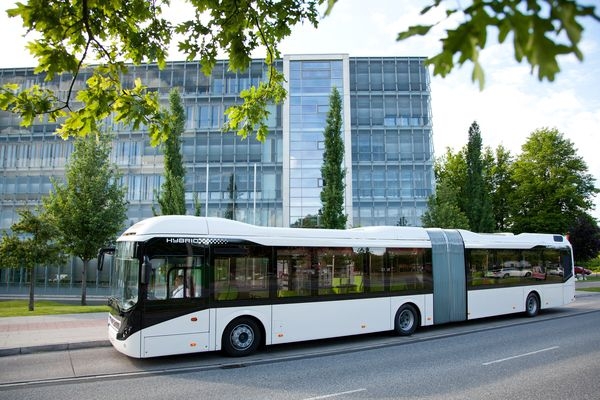
On July 21, another edition of tests for the Volvo 7900 Hybrid city bus began in Poland.
The vehicle will be tested by public transport operators in regular city traffic. Initially, the Volvo hybrid will operate in the fleet of the Municipal Transport Company (MZK) in Ełk. This is the latest in a series of tests for the Volvo hybrid vehicle in this city. At the beginning of 2013, the Ełk carrier tested the previous model of the bus – the Volvo 7700 Hybrid. The next city on the route of this test edition is Włocławek. Here, from July 28 to August 3, the Volvo 7900 Hybrid bus will serve passengers of the Municipal Transport Company (MPK). Next, the bus will travel to Grudziądz, where from August 4 to 8 it will carry residents on a line operated by the carrier Arriva. This carrier already has Volvo buses in its fleet, including the intercity Volvo 8900 purchased last year, which runs on the Tczew – Gdańsk route.
Serial production of Volvo hybrid buses began in 2010 in Wrocław. Since then, the company has sold over 1,350 hybrids to public transport operators in more than twenty countries, including Sweden, Norway, Denmark, Germany, Austria, Luxembourg, the Netherlands, Spain, and the United Kingdom. Thus, Volvo has gained a leading position in terms of the application of hybrid technology in buses in Europe. By introducing such a large number of hybrid buses onto the streets of European cities, Volvo has proven that it offers a product that meets the highest customer requirements regarding the total cost of vehicle ownership, availability for operation, fuel economy, as well as low environmental impact in congested city traffic.
Volvo hybrid bus in Polish cities
Volvo meets the expectations of cities pursuing a decisive policy of implementing ecological public transport and wishes to provide innovative transport solutions of the highest quality to customers in Poland as well. Since 2011, numerous presentations and tests of the Volvo hybrid bus have been conducted in Polish cities, including Wrocław, Lublin, Tarnobrzeg, Białystok, Siedlce, Gliwice, Warsaw, Olsztyn, Gdynia, Szczecin, Opole, Łomża, Ełk, Bielsko-Biała, Kraków, Elbląg, the Tri-City, Inowrocław, Jarocin, Kędzierzyn, and Jelenia Góra. Since January 2014, a Volvo hybrid bus has been operating on a regular city transport line served by MPK Wrocław.
– The tests we have conducted so far on public transport lines in various Polish cities confirm that the Volvo hybrid bus performs well in Polish conditions as well, achieving low fuel consumption – from 26 to 30 liters per 100 km, depending on the route. We have also received very positive feedback from companies that previously tested the bus, both regarding the driver’s working conditions and the vehicle’s dynamics. We are pleased that the latest model of our hybrid bus produced in Wrocław – the Volvo 7900 Hybrid – will be tested in regular traffic in further cities and that both carriers and residents of Polish cities will be able to take a closer look at it – says Małgorzata Durda, Bus Sales Director, Volvo Polska.
Volvo hybrid bus in public transport
Volvo’s hybrid technology is an optimal solution for public transport, making a huge contribution to environmental protection. The hybrid drive works perfectly in vehicles forced to constantly stop and start, and therefore it is an ideal solution for city buses moving in heavy traffic.
As a parallel hybrid, the vehicle can be powered independently by an electric motor or a diesel engine, or by both engines at the same time. Energy generated during braking is stored in the battery and then used to produce energy for the electric motor, which significantly reduces fuel consumption.
A huge advantage of Volvo’s hybrid technology is the fact that the diesel engine turns off automatically at bus stops and traffic lights, and the vehicle is powered silently and without exhaust fumes by electric energy. The bus also starts only with the help of the electric motor, and after reaching a speed of 15-20 km/h, it automatically switches to the diesel engine. This is an extremely beneficial solution for the urban environment, which means that passengers, pedestrians, and other road users are exposed to much less noise and exhaust fumes. The latest generation of hybrid models – the Volvo 7900 Hybrid consumes up to 39% less fuel and has a correspondingly lower impact on the climate than comparable diesel buses, while emitting half as much nitrogen oxide and particulate matter.
Facts: Volvo 7900 Hybrid Euro 6
• Fuel consumption up to 39% lower compared to an equivalent diesel-powered bus.
• Exhaust emissions 40-50% lower.
• Quiet operation without exhaust production at bus stops.
• Vehicle powered by electricity/diesel or biodiesel.
• Equipped with an electric motor, batteries, and a diesel engine.
• The diesel engine meets the new European Euro 6 emission standards.
• The drive system is a parallel hybrid, which means that the diesel engine and the electric motor can be used independently of each other.
• Batteries are charged with energy generated during vehicle braking.
• The electric motor is used mainly for acceleration up to 15-20 km/h.
• Sales of Volvo electric hybrid buses have already exceeded 1,350 units, which have reached over 20 countries around the world.