










An interview with Tomasz Rochowiak, Sales and Marketing Director, Hitachi Rail GTS Polska Sp. z o.o.
Tomasz Janiak: Sustainable mobility is embedded in the strategy of rolling stock manufacturers and operators. Could you share with us Hitachi Rail’s long-standing global experience in this area?
Tomasz Rochowiak: Electrified rail transport, including railways, is low-emission transport, which is why it fits perfectly into both the European Union’s climate policy and the development strategies of cities, infrastructure managers, and carriers. However, it is worth emphasizing that sustainable mobility is much more than just choosing a low-emission mode of transport. It is determined by the entire ecosystem, which consists of: digital traffic control systems, diagnostic and predictive tools, rolling stock solutions, and the integration of individual modes of transport, which encourages the choice of public transport, especially low-emission, as an alternative to cars.
For example, the implementation of a modern ERTMS system enables energy consumption reduction by shortening train travel times and increasing the smoothness of travel, which translates into less frequent acceleration and braking of the vehicle. Hitachi Rail, which is the largest supplier of this system in Poland, also has additional technologies that increase energy efficiency while simultaneously reducing the carbon footprint. We can configure ETCS with solutions such as our advanced, modular ARAMIS traffic management system, which increases railway network capacity. ARAMIS can also be integrated with ATO (Automated Train Operation) and DAS (Driver Advisory System) systems, which also contribute to optimizing energy consumption. At Hitachi, we have developed a solution called GreenSpeed™ DAS, which optimizes train speeds to significantly reduce energy consumption and CO2 emissions. Studies indicate a reduction of about 15% by preventing unnecessary acceleration and braking, improving punctuality, and increasing overall network efficiency.
We use similar traffic management systems that contribute to emission reduction and lower energy consumption in urban transport. Our most advanced traffic control solution available for metro, light rail, and other rail public transport vehicles is CBTC technology. It uses wireless communication between trains and infrastructure to operate transport systems more efficiently and sustainably than conventional signaling. In Singapore, we used a variant of this technology – Green CBTC Next Gen, which allows for reduced traction power through the use of data analysis in our SelTrac™ signaling system. The first phase of the project brought an additional 8% energy savings for automatic trains on the East-West and North-South lines, supporting the Singaporean carrier’s environmental goal of achieving net-zero energy consumption by 2050. The annual additional savings amount to over 15 million kWh, which corresponds to the electricity consumption of approximately 3,000 households per year.
Our diagnostic systems also contribute to reducing energy consumption and the carbon footprint, such as HMAX – a digital asset management platform that enables problem prediction and service optimization, especially maintenance and repair, which translates into lower operating costs and greater reliability of rail transport. According to data from one of our clients, thanks to the implementation of HMAX, they achieved an 8% energy saving, and the potential for savings across the entire enterprise is 15%. We also want to offer these types of solutions in Poland.
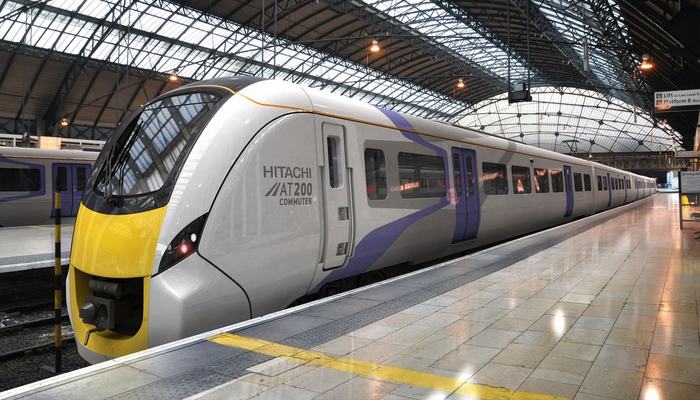
We use further low-emission and energy-efficient technologies in the rolling stock area. Hitachi Rail has developed tri-hybrid trains. We offered these types of vehicles, under the name Blues, to the Italian carrier Trenitalia. It is the first train in Europe that has three different power sources – electric, diesel, and battery drive, which it switches between seamlessly depending on needs. This allows for a 50% reduction in CO2 emissions compared to existing diesel-powered vehicles.
At Hitachi Rail, we have advanced technologies for the entire rail ecosystem and urban mobility that enable a significant reduction in CO2 emissions and energy consumption. Poland, which is on the verge of building high-speed rail and is investing in the development of regional transport, can benefit from these solutions – not only to reduce the environmental impact of transport but also to increase its reliability, because these technologies go hand in hand for us. Examples from Singapore or European cities show that we are a strategic partner in achieving their environmental goals, both for public entities and for business.
T.J.: Hitachi Rail is increasingly involved in digitalization and the implementation of BIM (Building Information Modeling) solutions in our country. What is the essence of this system, and how can it be assessed in the context of the effective implementation of railway infrastructure projects and the improvement of safety?
T.R.: The essence of BIM is the creation of a common, digital model of an object that integrates not only its 3D geometry but also technical, material, cost, and schedule information. This model accompanies the investment throughout its entire life cycle – from the design phase, through implementation, to the operation of the infrastructure.
In the context of railway projects, BIM significantly increases the efficiency of investment implementation. It enables better coordination between all participants in the construction process, reduces the number of design errors, and allows for the early detection of potential collisions between individual disciplines. As a result, the risk of costly changes at the construction stage is reduced, the investment implementation time is shortened, and control over the budget and work schedule is increased.
An equally important aspect is the impact of BIM on safety. Digital models enable the analysis of potential risks at the design stage, the planning of safe work sequences, and the simulation of crisis situations. Reducing construction errors and better work planning translate into greater safety for both workers on the construction site and future users of the railway infrastructure.
Implementing the BIM methodology is an important step towards modern, safe, and effective implementation of railway investments, which is why Hitachi Rail uses it in its various projects around the world. As an active participant in the PKP PLK Investment Forum, including working groups, we have also been involved in work on digitalization and the implementation of BIM technology in Poland, because it not only streamlines the investment process but also increases the quality, durability, and safety of transport infrastructure.
T.J.: What, in your opinion, could be the impetus for the cooperation of different branches of transport in our country?
T.R.: First of all, better synergy between different branches of transport and investments in new technologies, thanks to which combined transport will be even more competitive compared to road transport.
Let’s start with infrastructure. From the perspective of a railway industry representative, further investments in the development of track infrastructure are necessary – this applies not only to interregional or even international connections but also to ports, where tracks are often too short to handle long trains. In turn, the use of long trains is necessary to increase the efficiency of freight transport, which has lower priority on railway routes than passenger transport. Modern digital signaling systems, such as ERTMS, which enable increased capacity and interoperability of railway lines and which we are successfully installing in Poland, come to the rescue here. Diagnostic and predictive platforms that provide real-time monitoring, contributing to the improvement of railway traffic reliability, are also very useful. An example of such a solution is the HMAX I already mentioned.
Another impetus is the development of innovative intermodal terminals, enabling more efficient loading and unloading operations. An example is the modern CLIP terminal in Swarzędz, which is the only one in Central Europe to have the LOHR Railway system for horizontal loading of standard semi-trailers without the use of a crane, which provides shortened loading time and the ability to handle four semi-trailers simultaneously.
Further digitalization and automation of logistics processes are also necessary, enabling, among other things, the integration of data between carriers from different branches of transport, shipment tracking, and responding to incidents in real-time in an integrated supply chain, more effective management of time windows, and greater efficiency of each branch of transport separately.
T.J.: In last year’s DGG ranking, the aforementioned CLIP intermodal terminal in Swarzędz advanced to third place, overtaking such long-known locations as the Spanish Plaza Logística de Zaragoza or the Italian Interporto Padova. This is a success, but the success of one operator… What conditions must be met in the development of terminals so that other Polish intermodal platforms join the TOP 20 in the future?
T.R.: Several fundamental factors influence the attractiveness of intermodal terminals. The most important are: location, handling capacity, and modern technologies that increase the efficiency of unloading and loading operations.
The CLIP terminal in Swarzędz is located at the intersection of two TEN-T corridors, on the main European E20 railway line connecting Paris with Beijing via Poland. This is a key corridor for intermodal transport on the New Silk Road, connecting Western European ports with terminals in China. Secondly, after expansion, the terminal has as many as eight handling tracks with a length of 750 m, can handle up to 20 trains per day, and store up to 10,000 TEU at the same time. Furthermore, it is packed with modern technologies, such as the aforementioned LOHR Railway system. Additionally, the siding tracks have been equipped with a signaling system. All this ensures greater terminal capacity, shorter handling time, a high level of work safety, and lower energy consumption.
If we want Polish terminals to join the European elite, investments in both infrastructure and modern technologies, including automation and digitalization of processes, are necessary. Signaling systems, such as ETCS, are of significant importance here – their installation on railway lines throughout the country and in the terminals themselves contributes to an increase in the capacity and reliability of railway traffic. Hitachi Rail is a leading supplier of ETCS systems in Poland – our innovative, digital devices are installed on approximately 2,000 km of railway lines across the country, ensuring a higher level of reliability.
T.J.: What goals and challenges have you set for yourselves in 2026?
T.R.: Poland is one of the key European markets for the entire Hitachi Group – not only in terms of the scale of operations but primarily as a place for building lasting local value. We employ approximately 7,000 people here, including highly qualified specialists in the areas of modern railway technologies, energy, IT, OT, and cybersecurity, actively developing local competencies and knowledge.
We are consistently increasing local content, treating it as the foundation of our strategy in Poland. This includes both the development of production and engineering competencies as well as strengthening the local supply chain and creating high-quality jobs. We are investing in new operational and technological centers, as well as in strategic partnerships that raise the competencies of the entire market and enable the transfer of advanced technologies to Poland. Last year, at the Hitachi Rail factory in Poznań, we launched a production line for signaling system devices, significantly increasing the share of local production in implemented projects. In parallel, Hitachi Cyber and GlobalLogic companies opened a Security Operations Center (SOC) in Krakow, which serves as a regional center of competence in the field of cybersecurity.
A special example of our approach to building local content is the strategic partnership with PESA Bydgoszcz announced in mid-June. This cooperation includes not only the development and production of high-speed rolling stock or a joint offer of double-decker trains but, above all, a real transfer of technology and the development of national industrial potential. Thanks to this, a strong, local production and engineering base is being created, which will support the development of modern rail transport in Poland and in the region.
At the same time, we are actively participating in projects for the modernization and development of railway infrastructure in Poland, providing modern signaling systems and digital solutions. Each of these projects is not only the implementation of technology but also a further increase in the share of local resources – both in terms of implementation and maintenance of systems throughout the entire life cycle. An example is the recently completed investment on the line to Łomża or the project being implemented on line 202, which, in addition to the infrastructural effect, strengthen local operational and technological competencies.
We believe that investments in the digitalization of railways and the development of systems such as TMS constitute not only a step towards a modern, network-centric transport model but also a significant opportunity for further increasing local content in Poland – through the development of national competencies in the field of advanced analytics, AI, and traffic management.
We want to continue to develop our presence in Poland, implementing projects with the participation of Polish resources and for the Polish economy, creating long-term value for customers, partners, and the entire market.
The interview originally appeared in the Logistyka magazine no. 3/2026.