









The Rhenus Group has published its 2025 Sustainability Report, describing how it has strengthened the systems, governance structures, and operational foundations necessary for more consistent sustainability management across its global organization. The report positions 2025 as a significant year in the transformation process toward a more centralized, scalable, and transparent approach throughout the Group.
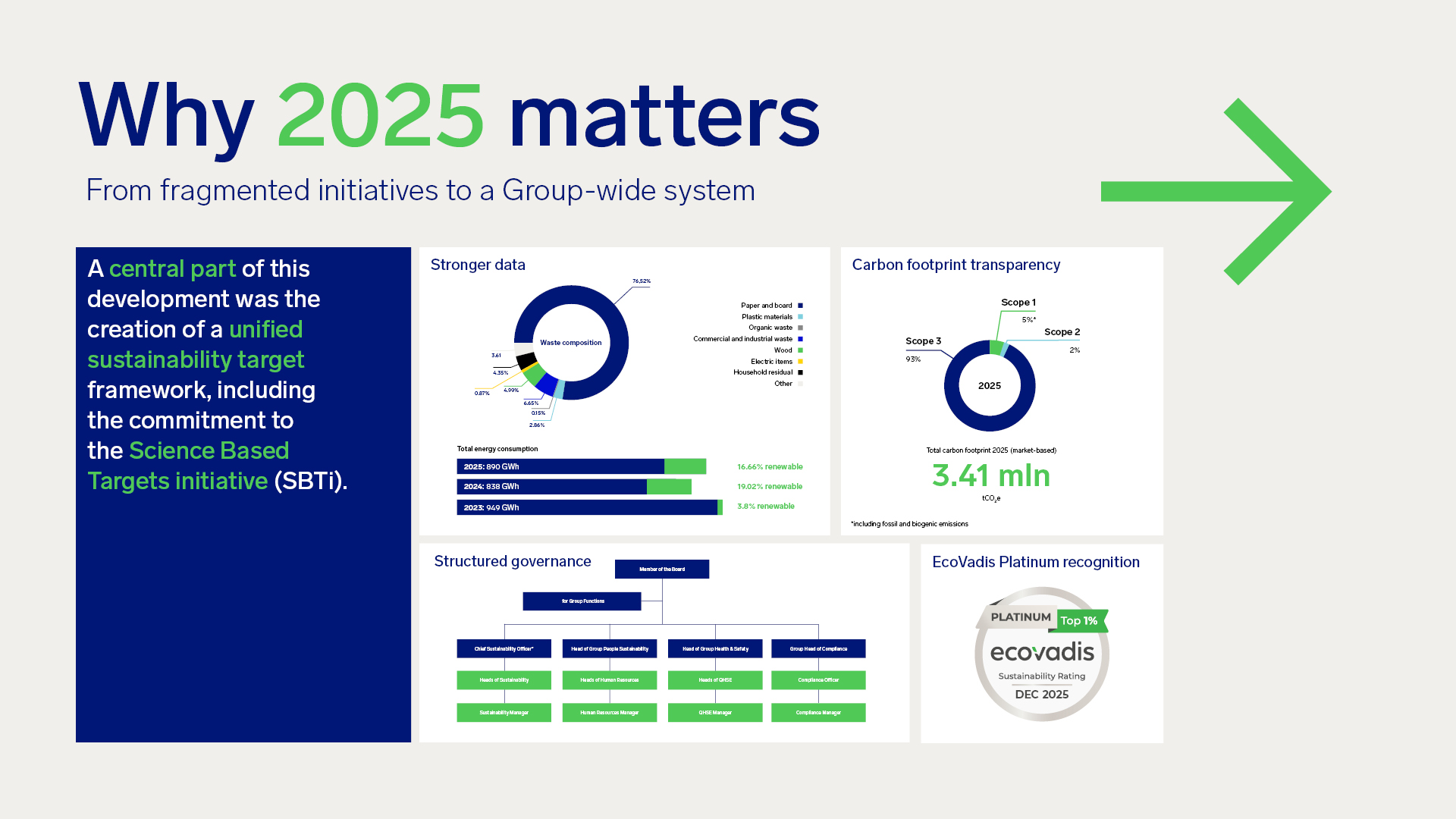
A key development in 2025 was the Group’s commitment to the Science Based Targets initiative (SBTi), supported by work on emission baselines, target-setting methodologies, and a more detailed decarbonization roadmap. External verification of the report also increases the credibility of the reported progress. External recognition of this progress was confirmed by the awarding of EcoVadis Platinum status, which represents an important milestone on the Group’s path to sustainability. This includes a unified emissions database, expanded reporting structures, and dashboard testing to improve transparency and streamline the decision-making process.
2025 was a decisive step forward in how we manage sustainability at Rhenus. Today, we operate based on an integrated and harmonized system covering the entire Group, which allows us to manage performance in a consistent, transparent, and scalable way. Our EcoVadis Platinum certification reflects this level of maturity. Building on this solid foundation, we are now focusing on actively using this system to make decisions, track progress using clear KPIs, and strengthen accountability across the organization.
– said Dr. Joana Baetz, Member of the Board, responsible for HR, Sustainability, and Compliance.
The report also shows how sustainability is becoming increasingly visible in daily operations. An example is the hybrid push boat Mannheim I+II, which can reduce CO₂ and NOx emissions by up to 72% in daily operation compared to conventional propulsion systems. When using HVO100, emission reductions can reach up to 90%. The vessel was designed with flexibility and operational resilience in mind on key Rhine routes, even at low water levels.
In addition to climate-related actions, the report highlights progress in occupational safety and resource management. In 2025, Rhenus recorded zero fatalities. The Lost Time Injury Frequency Rate (LTIFR) improved from 13.8 in 2024 to 9.70, and the Lost Time Injury Severity Rate (LTISR) improved from 20.10 to 18.10. In terms of waste management, the Group generated 106,449 tons of waste, of which 98,237 tons were diverted from landfills and 98,029 tons were recycled. These data reflect the importance of sustainability not only for long-term climate goals but also for operational discipline and risk management.
The 2025 Sustainability Report also highlights progress in social and corporate governance structures. Rhenus introduced updated global Social Policies and continued the implementation of a platform for anti-corruption, antitrust law, and whistleblowing. All these changes support a more unified ESG management model across the Group.
We now have a much clearer foundation for action, especially regarding data quality, governance, and how we connect sustainability to our operations. Thanks to independent auditing and the compliance of our report with Global Reporting Initiative (GRI) standards, we have further strengthened transparency and credibility. The next step is to translate this into actions that can be scaled across the company and consistently implemented in the way we serve our customers.
– emphasizes Juthaporn Srinang, Group Director of Sustainability at Rhenus.
Looking ahead, Rhenus announces that from 2026, its focus will increasingly shift from building systems to using them more actively to drive performance, track progress with clearer KPIs, and develop sustainable services in a more market-ready way. This gives the report a forward-looking character: 2025 was a year of building foundations, and the next stage involves transforming these foundations into measurable value for the business and customers.
Source: Rhenus Group