










E-commerce has become synonymous with savings for Poles and a space where they can find the best shopping deals. We are increasingly looking for such offers outside the European Union, with Asian platforms being the undisputed leaders in this context in terms of the number of mentions – according to a study by K+Research for ID Logistics, as many as 87 percent of customers who made purchases outside the EU in the last year chose this direction. Interestingly, as many as 90 percent of those surveyed who shop in Asia declare that they are guided primarily by price, while accepting longer delivery times. This is an important perspective in the context of upcoming changes in customs tariffs, which may mean that from July 1st, shopping on platforms operating outside the Community will no longer be as profitable.
From July 1, 2026, the European Union will impose new, temporary customs duties on all packages worth up to EUR 150 imported from outside the EU. The effects of this change will therefore be felt by consumers with small and medium-sized shopping baskets. In their case, an additional fee of 3 euros will become crucial, as it will be charged on every product category included in the shipment, which may mean an increase in the total cost of the order by even a dozen or several dozen euros. In connection with the entry into force of the new regulations, one of the leading contract logistics service providers, ID Logistics, checked what the average shopping basket of Poles buying in Asia looks like today, and what the announced changes may mean in practice.
New regulations will cover more than half of those currently shopping in Asia
The most popular shopping region outside the European Union is currently Asia – as many as 87 percent of respondents ordered from there in the last 12 months. As for the value of the basket, the largest number of people (46 percent) spend between 51 and 100 PLN on a single order including shipping. Packages worth 101–200 PLN (29 percent) are in second place. We buy cheaper products, up to 50 PLN (11 percent) or more expensive ones, in the 201–300 PLN range (8 percent), much less frequently. The smallest percentage of respondents (4 percent) choose orders exceeding 300 PLN.
Interestingly, shopping on Asian e-commerce platforms is the domain of older generations. Transactions of this type are declared by as many as 94 percent of people aged 65–69, while in the group of young adults (25–34 years old) this indicator is 75 percent. These data clearly show a significant change in the consumer behavior of Poles: the “silver” generation (people 50+) is becoming an extremely active group in cross-border e-commerce, distancing younger age groups in this respect.
Online, we think mainly about household items
Orders placed online are no longer just an occasional impulse and often fall into the area of daily needs – also in relation to transactions concluded on Asian platforms. What does the average basket of people choosing such distant shopping destinations look like? Household items (66 percent) and clothing with accessories (55 percent) are purchased most often, followed by electronics and GSM accessories (36 percent) and hobby/DIY (33 percent).
The ID Logistics data also shows the segmentation of Polish e-commerce in the context of gender. Women were significantly more likely to buy clothing and accessories (62 percent) compared to men (48 percent). Consumer attitudes were similarly distributed regarding jewelry or accessories (women 34 percent vs. men 12 percent) and beauty products (women 22 percent vs. men 11 percent). In turn, men were definitely more likely to choose electronics and GSM accessories (51 percent compared to 17 percent of women).
Why do we go so far for shopping?
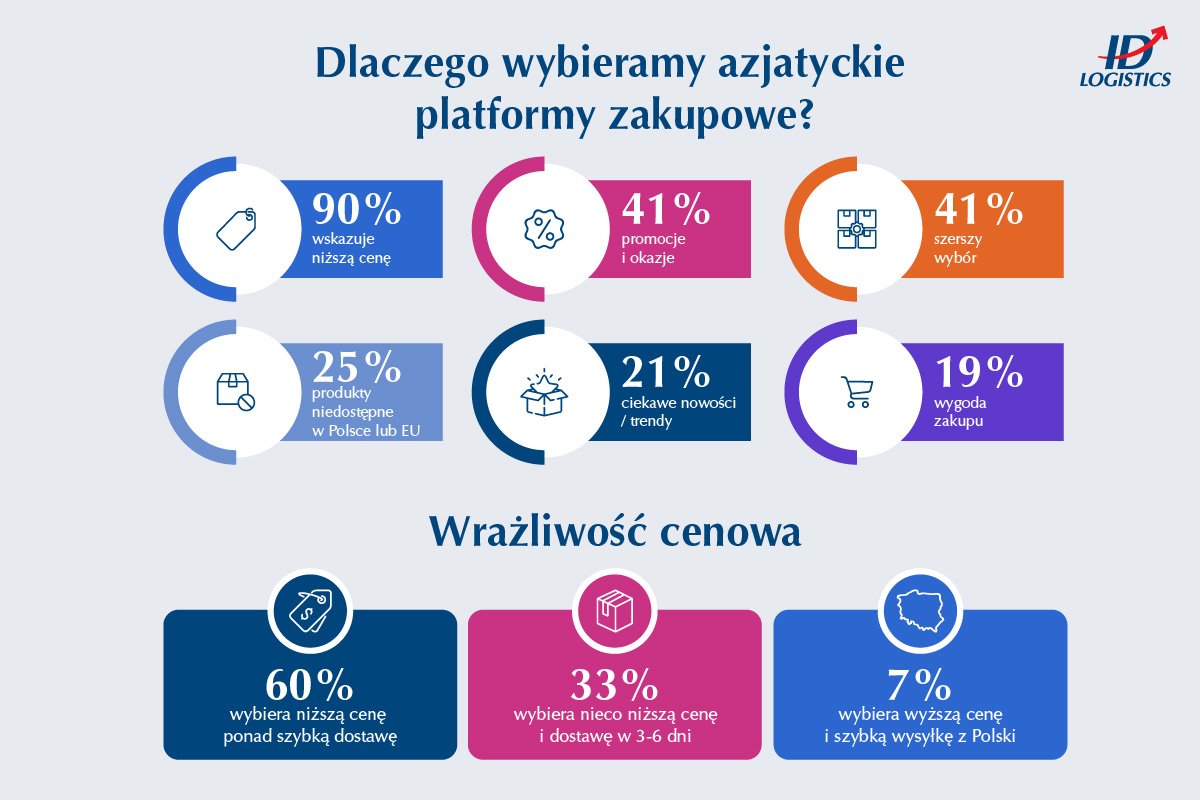
For Polish consumers shopping in Asia, the economic aspect remains the key motivation – the possibility of paying less outweighs the need for fast delivery. A lower price is the most important factor for 90 percent of respondents, and an additional 41 percent are convinced to purchase by promotions and deals. Poles are happy to accept the fact that the package is sent from a distant warehouse, e.g., in Asia, and the waiting time is extended. Three out of five respondents choose a lower price over fast delivery, while only 6 percent of respondents would be willing to pay extra for express delivery carried out in the country.
New regulations and customs duties are a clear signal that a certain era is coming to an end. The introduction of new rates significantly changes the current rules of the game and will make shopping on foreign platforms from outside the EU no longer as profitable as before. The key question remains how the market will react to this, as it will have to revise both its sales strategies and logistics models. We expect changes related to moving some warehouse and logistics resources to the EU, which is already becoming part of the strategy for many Asian companies.
– says Marek Kaniera, E-commerce Operations Director at ID Logistics.
The study was carried out by K+ Research on behalf of ID Logistics in April 2026 using the CAWI method on a sample of 1049 Poles who had ordered products online for private use from outside the European Union in the last 12 months.
Source: ID Logistics Polska S.A.