









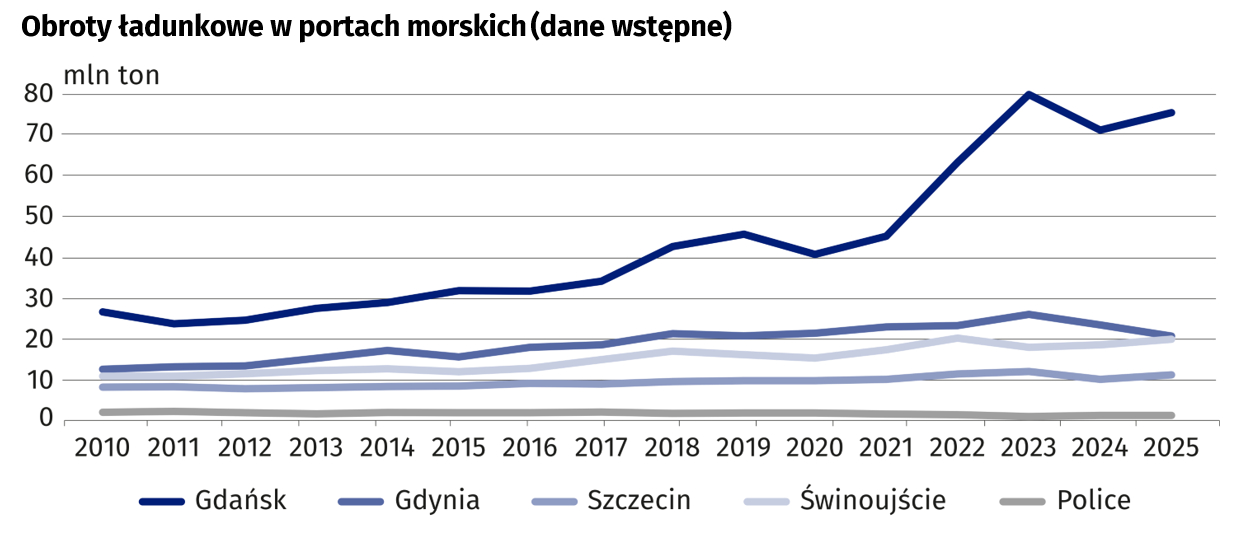
Compared to 2024, cargo turnover and the number of vessels entering ports increased in Polish seaports. In international communication, an increase in cargo transported by the maritime fleet by Polish carriers and an increase in passenger transport were recorded. As of the end of 2025, the number of maritime and coastal transport fleet units decreased by 6 vessels year-on-year. Cargo turnover in seaports in 2025 amounted to 128.0 million tons, i.e., 3.1% more than in 2024. An increase in turnover was recorded in Szczecin (by 10.8%), Świnoujście (by 7.2%), and Gdańsk (by 6.0%), while a decrease was recorded in Gdynia (by 11.7%) and Police (by 1.7%).
Seaports
Cargo turnover in seaports in 2025 was 3.1% higher than a year ago
Compared to 2024, cargo turnover and the number of vessels entering ports increased in Polish seaports, while passenger traffic decreased. In international communication, an increase in cargo transported by the maritime fleet by Polish carriers and an increase in passenger transport were recorded. As of the end of 2025, the number of maritime and coastal transport fleet units decreased by 6 vessels year-on-year.
Liquid bulk cargo dominated the cargo turnover structure in 2025 (43.9%)
The share of individual ports in national turnover in 2025 was as follows: Gdańsk – 58.8%, Gdynia – 16.0%, Świnoujście – 15.4%, Szczecin – 8.6%, Police – 0.8%, and other ports – 0.4%.
In the structure of cargo turnover in 2025, the largest share was held by liquid bulk cargo – 43.9% (including crude oil and petroleum products – 36.7%), dry bulk – 23.5% (including coal and coke – 7.0%), and large container cargo – 20.7%.
In 2025, compared to the previous year, an increase in the turnover of other general cargo (by 12.0%), large containers (by 8.6%), ro-ro cargo (by 3.3%), and liquid bulk (by 1.9%) was recorded. A decrease was observed only in the dry bulk cargo category (by 0.8%).
In 2025, the majority of international cargo turnover (65.3%) was conducted with European ports
In 2025, domestic maritime turnover amounted to 8.6 million tons (93.8% more than in the previous year) and accounted for 6.7% of total turnover. In international maritime trade, a total of 119.4 million tons of cargo were handled, i.e., 0.3% less than in 2024.
In 2025, cargo transported by ships in relation to European ports accounted for 65.3% of international cargo turnover in Polish ports, with African ports – 15.6%, North and South American ports – 13.3%, Asian ports – 5.4%, and Australian and Oceanian ports – 0.5%.
In 2025, the main countries in sea-land and land-sea transit through Polish ports were: Germany (59.5%), the Czech Republic (5.0%), and Slovakia (3.2%)
Transit cargo turnover in 2025 amounted to 24.7 million tons and increased by 14.0% compared to the previous year. The most transit cargo was handled in the port of Gdańsk (65.7%), followed by the ports of: Świnoujście (25.9%), Szczecin (5.9%), and Gdynia (2.5%). On an annual basis, an increase in the mass of handled transit cargo occurred in the port of Świnoujście (by 19.6%), Gdańsk (by 15.2%), and Gdynia (by 2.8%), while a decrease was recorded in Szczecin (by 11.3%). Compared to the previous year, transit cargo turnover increased in both imports (by 15.7%) and exports (by 2.3%).
In 2025, 20.3 thousand vessels called at Polish ports (compared to 20.0 thousand units in 2024) with a gross tonnage (GT) of 312.2 million (3.4% more than in the previous year) and a deadweight tonnage (DWT) of 236.0 million tons (4.7% more).
Maritime and coastal shipping
At the end of 2025, the maritime transport fleet included 83 vessels (six vessels fewer than a year earlier) owned or co-owned by Polish shipowners and operators, as well as chartered vessels. The total deadweight tonnage (DWT) of the maritime fleet amounted to 2499.5 thousand tons, while the gross tonnage (GT) was 1852.9 thousand (compared to 2807.1 thousand tons and 2029.0 thousand in 2024, respectively).
In relation to Polish ports, 6002.5 thousand tons of cargo were transported by the maritime transport fleet (7.9% more than in 2024), of which exports from Polish ports to foreign ports accounted for 47.6% (2.2% less than a year ago), and imports – 52.4% (19.1% more). Between foreign ports, 1030.7 thousand tons of cargo were transported (2.9% less compared to the previous year), while between Polish ports – 50.6 thousand tons (20.5% more). Intra-port transport accounted for 0.3% of the total cargo transported by the maritime transport fleet and amounted to 20.4 thousand tons.
The coastal transport fleet at the end of 2025 numbered 41 vessels with a total deadweight tonnage (DWT) of 11.5 thousand tons and a gross tonnage (GT) of 9.9 thousand. All vessels of the maritime coastal transport fleet sailed under the Polish flag. The average age of a vessel was 50.4 years.
Source: Statistics Poland (GUS) / Statistical Office in Szczecin