









According to data from the end of March 2026, a total of 143,689 fully electric passenger and commercial vehicles (BEVs) were registered in Poland. In the first quarter of this year, their number increased by 11,439 units, which is 59% more than in the same period of 2025, according to the Electromobility Meter launched by PZPM and PSNM.
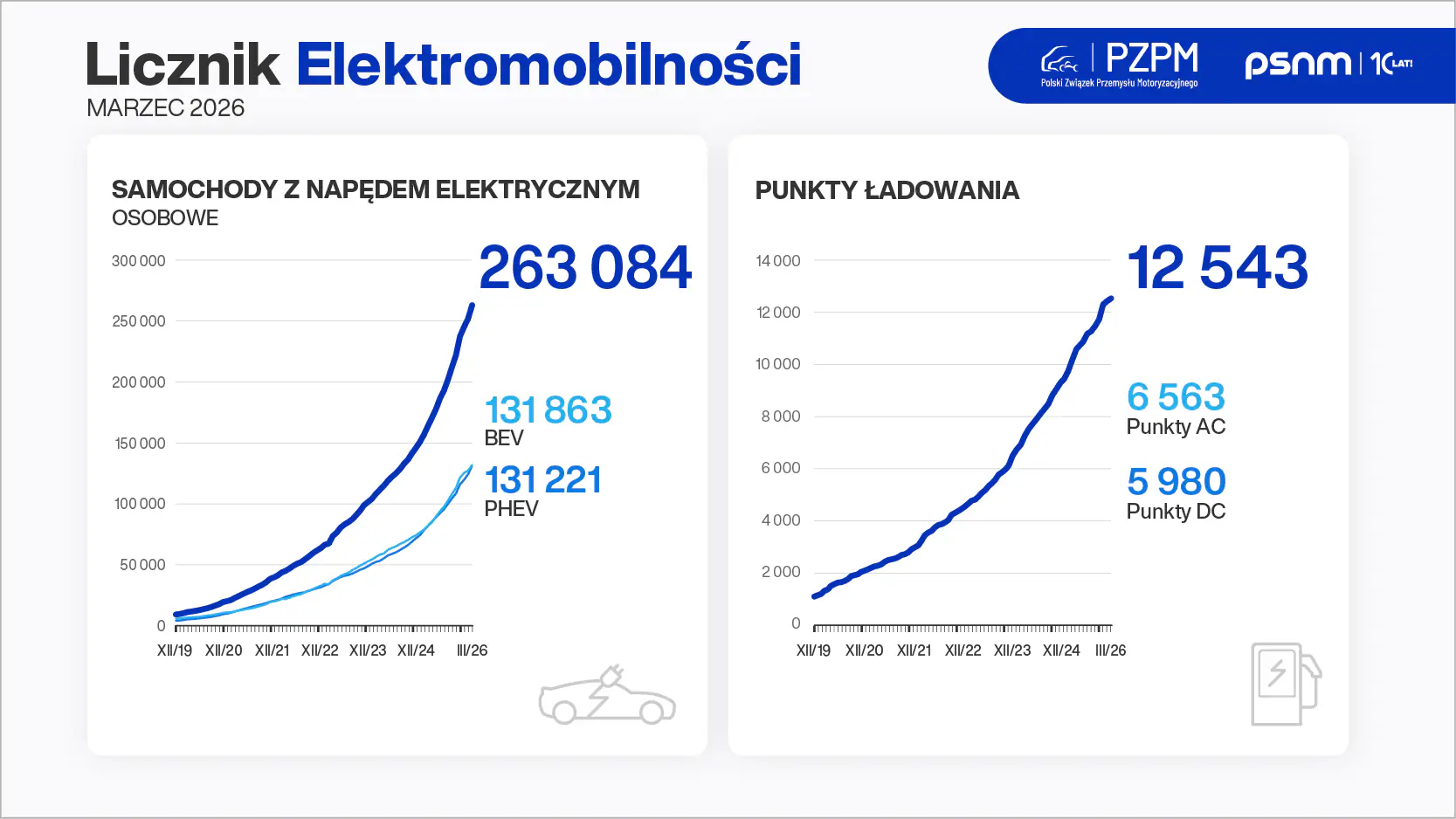
At the end of March 2026, there were 263,084 electric passenger cars on Polish roads. The fleet of fully electric passenger cars (BEVs) numbered 131,863 units, and the fleet of plug-in hybrid electric vehicles (PHEVs) totaled 131,221 units. The number of electric delivery and heavy-duty vehicles amounted to 12,630 units. The fleet of electric mopeds and motorcycles is constantly growing, reaching 28,885 units at the end of the first quarter of this year, as is the number of hybrid passenger and delivery vehicles, which increased to 1,360,218 units. By the end of last month, the zero-emission bus fleet in Poland grew to 2,068 units (of which fully electric vehicles accounted for 1,915 units, and hydrogen vehicles for 153 units).
Parallel to the fleet of electric vehicles, charging infrastructure is also developing. At the end of March 2026, there were 12,543 publicly accessible electric vehicle charging points in Poland. 48% of them (5,980 units) were fast DC charging points, and 52% were slow AC charging points with a power of 22 kW or less. For 21% of DC points, it is also possible to use AC charging as an alternative.
The March result shows, in the case of battery electric vehicle registrations, that after a boom period caused by subsidies from the NaszEauto program, we have returned to the result we have been recording in recent years, i.e., a year-on-year increase in registrations of approx. 50 percent. Despite the final decision not to allocate 300 million PLN for subsidies for the purchase of zero-emission vehicles, it seems that this year, in terms of BEV registrations, will not be significantly worse than the previous one. It is worth highlighting the very high level of plug-in hybrid registrations, the purchase of which is not covered by any support system. In the first three months of this year, the number of registered zero-emission buses increased about fourfold compared to the previous year. This means that after a clear market slowdown caused by the pandemic, local governments are more willing to allocate funds for fleet replacement to make it more environmentally friendly. Compared to last year, registrations of hydrogen passenger cars are slightly lower, while registrations of classic hybrids remain at a similar level.
– says Jakub Faryś, President of PZPM.
The number of new BEV passenger car registrations in the first quarter of this year increased by almost 75% year-on-year, while in March alone by almost 50%. The market share of M1 category “electric vehicles” exceeded 5.3% last month. This is a better result than a year earlier, which may be a good prognosis, especially in the context of the formal exhaustion of the “NaszEauto” allocation. Certainly, however, a significant portion of those who purchased an electric car in recent weeks are counting on obtaining a subsidy, especially after announcements regarding increasing the program’s budget. Today we already know that the transfer of additional funds will not happen. Despite this, long-term BEV rental offers are still available on the market at prices of 1,000 PLN per month or less. In the coming months, we can expect a further intensification of price competition, among other things, due to growing pressure from Chinese manufacturers and the inexorably approaching deadline for meeting emission reduction obligations for 2025-2027.
– says Jan Wiśniewski, Director of the PSNM Research and Analysis Center.
Source: PSNM