








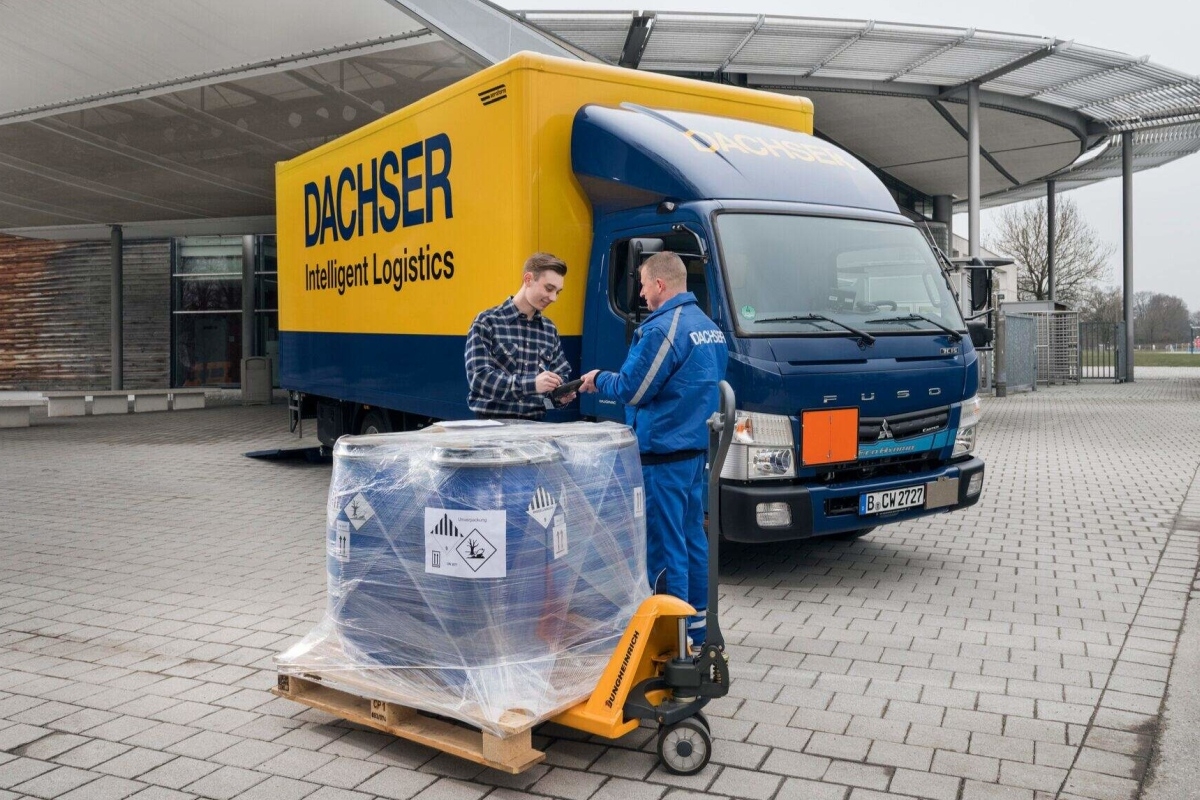
Safety begins with awareness. In chemical logistics, the foundation of the supply chain is safety, understood as a comprehensive process based on transparency and trust.
The transport of dangerous goods is a process defined more broadly than just ensuring efficient transport organization. In chemical logistics, the foundation of the supply chain is safety, understood as a comprehensive process based on transparency and trust: from the classification of goods, through packaging and documentation, to handing over the shipment to the carrier along with the accompanying information. The global logistics operator DACHSER is developing a cooperation model based on consulting, transparency, and real technical support, and one of its elements is the free ADR review. This service allows clients to gain a complete picture of their logistics processes and the certainty that the company’s operational activities are in compliance with regulations and the best standards of workflow and information flow. And although the final responsibility rests with the client, the free ADR review from DACHSER is a useful consulting tool and a real value-added service offered by an international logistics provider.
As industry research shows, most incidents involving dangerous goods result not from bad intentions, but from a lack of knowledge, different interpretations of regulations, and improper process organization. The ADR review helps to organize and reduce these risks – before legal or operational consequences arise. The service also allows clients to gain full knowledge of their logistics processes and, together with an expert, develop improvements that increase the safety and efficiency of the entire supply chain.
– says Ewelina Staszewska-Kobiela, Business Development Manager at DACHSER Chem Logistics Poland.
The DACHSER standard
DACHSER Chem Logistics combines standardized DACHSER logistics services with the specific requirements of the chemical industry. Operations are based on a consistent European safety management system (DGSA Compliance Framework). Thanks to this, processes in Poland are the same as in Germany, Austria, or France.
In the logistics of dangerous goods, there is no room for approximation. Consistent expert knowledge, continuous training, and adherence to standards are crucial to ensure safe and compliant ADR transport. An important element of the on-site client review is the ADR checklist created by the global DGM team, which ensures consistent safety and compliance standards in all countries.
– emphasizes Thomas Jaeger, Lead Expert Dangerous Goods & Work Safety at DACHSER.
A client who sends their goods through the DACHSER network gains the certainty that:
- their cargo is handled in accordance with ADR and IMDG Code regulations,
- process transparency is maintained at every stage,
- documentation is correct and compliant with legal requirements,
- risk control takes place at both the local and international levels.
A major role is played here by the DACHSER dangerous goods safety specialist team, which supports the client’s operational activities by analyzing the correctness of dangerous goods transport processes (including the correctness of shipments, packaging, and transport). Reviews performed by specialists whose expertise is confirmed by obtaining a DGSA advisor certificate also bring a practical understanding of the client’s needs in terms of processes, which increases the efficiency of the company’s daily operations.
In ADR reviews, we can identify inconsistencies at an early stage that often remain invisible in the organizational workflow. Our goal is to focus attention and actions on supporting clients in safely conducting processes – in accordance with regulations and good industry practices. During the ADR review, we carefully analyze all elements of dangerous goods transport – from shipping activities, through technical documentation of goods, to transport conditions adapted to the properties of the transported goods. Everything is done to ensure that regulatory and safety requirements have been met. Additionally, for clients shipping goods in multimodal transport (road-sea), the review includes regulations related to the IMDG Code maritime code.
– comments Kordian Surosz, Dangerous Goods Transport Safety Coordinator at DACHSER in Poland.
What does the free DACHSER ADR review look like?
The ADR review is a 2–3 hour meeting during which specialists verify, among other things:
- product structures and UN classification of goods, safety data sheets (SDS), technical documentation (e.g., for batteries), and their currency,
- compliance of packaging and labeling,
- procedures for packaging, picking, and releasing goods,
- other shipping activities resulting from the specifics of the client’s business.
The review is not an audit, but a consulting tool that helps clients:
- confirm the compliance of processes with the law,
- identify gaps and risks,
- improve the quality of documentation,
- standardize procedures,
- better prepare for international transport.
Most often, recommendations concern:
- updating SDS, technical documentation, and verifying the information recorded in them,
- appropriate labeling,
- the scope of possibilities for using shipments under exemptions from regulations,
- the method of securing shipping units,
- important issues when carrying out return transports,
- details of preparing documentation for sea transport.
A great value of the ADR review is enabling companies to look at their processes from a different perspective. In practice, it turns out that minor improvements – better information flow, clarifying instructions, or consistency in updating SDS – significantly increase the level of safety, a key quality factor. Our task is not to control, but to support the maintenance of processes responsible for safety in the transport of dangerous goods, which are both compliant with regulations and actually work in the clients’ operations. In many companies, the biggest risk is not the regulation itself, but its understanding and embedding in all related processes of the company’s environment. The free review is therefore a real support tool in this area.
– adds Kordian Surosz.
Why do companies in the chemical industry use the ADR review?
- Risk awareness: Data from the ERSO (European Road Safety Observatory) and PHMSA (Pipeline and Hazardous Materials Safety Administration) indicate that most incidents result from human error and improper process organization, not the transport itself. It is therefore worth acting preventively.
- Compliance with regulations: Penalties for violating regulations are high, and liability covers both the manufacturer and the shipper.
- Cost optimization: The review allows for avoiding operational errors that generate costs: these include incorrect shipments, packaging damage, delays, and the consequences of failures.
- High quality: Safety has a real impact not only on maintaining the company’s operational continuity but also on its reputation and the trust of employees and clients.
- Partnership and expert support: Clients gain not only recommendations but also the possibility of consultation and education for future shipments.
Safety is a joint project
The free DACHSER ADR review is a tool that really supports companies in increasing process safety, improving service quality, and minimizing risk. It is also an opportunity to talk about processes, cooperation, and planning long-term improvements that strengthen the entire supply chain. DACHSER acts proactively in this area – not waiting for complications, but helping to prevent them.
– summarizes Ewelina Staszewska-Kobiela.
Companies wishing to ensure that their ADR processes are correct, safe, and prepared for further development can contact DACHSER. The company’s experts will conduct a review, present findings, and prepare practical recommendations.
Source: Dachser