











Serving clients in the industrial sector requires specialized warehousing and logistics solutions that ensure the continuity and security of supply chains. Individual elements of this area differ in their level of automation, technological requirements, and the pace of regulatory changes. This diversity means that logistics for the industrial sector differs significantly from standard services. It requires precise planning, dynamic operations management, a good understanding of the specifics of production processes, and the ability to integrate multiple activities within a single operational environment. Industrial logistics is therefore comprehensive support for production continuity, flow optimization, and flexible adaptation to the changing needs of the industry.
Infrastructure tailored to needs
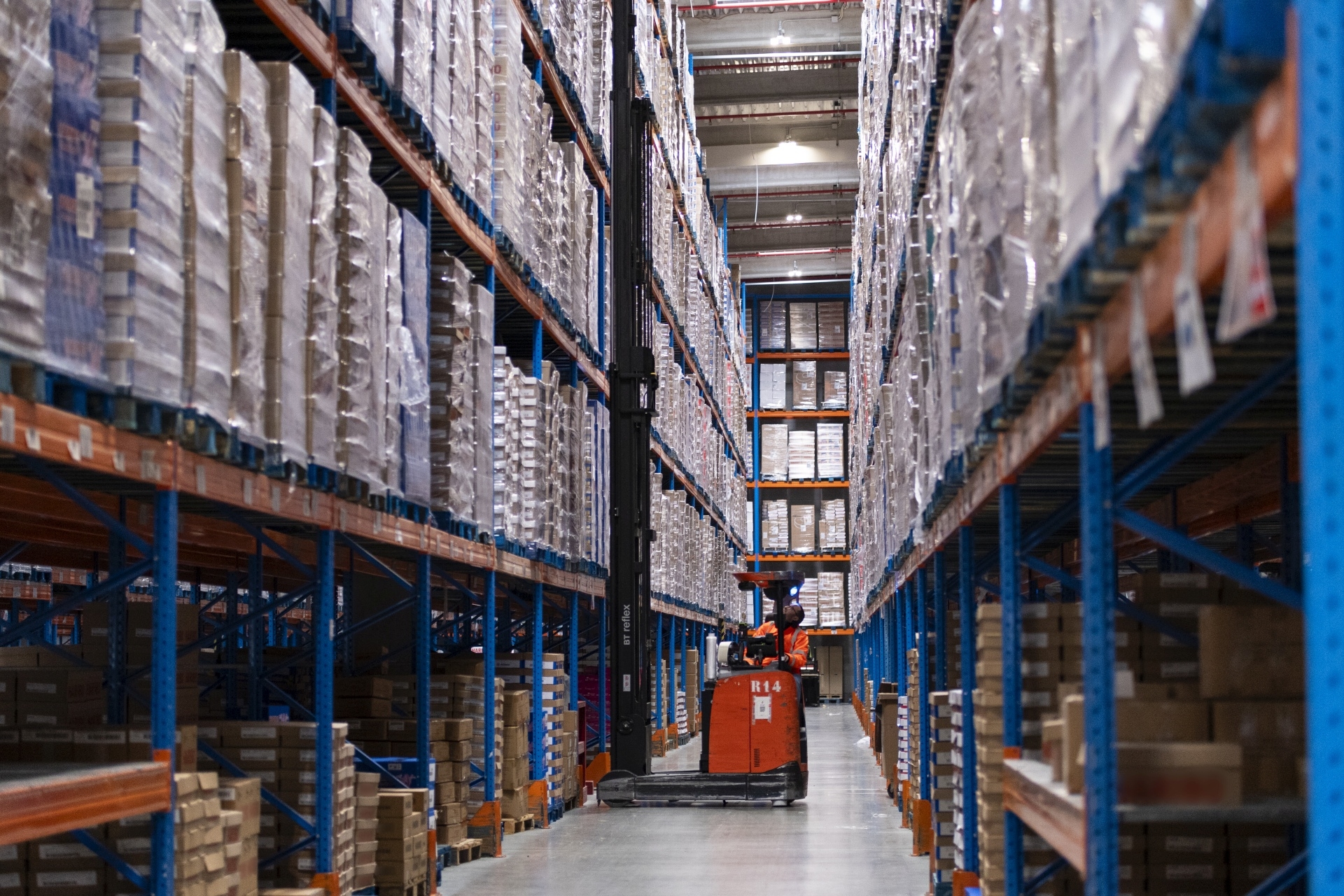
Flexibility and the ability to adapt warehouse infrastructure to the specific needs of the client and the nature of the stored assortment is not just a matter of available space. It is crucial to adapt the platform to specific storage regimes, such as appropriate temperature or safety requirements related to the storage of hazardous goods. These include, among others, chemical agents or electrochemical products such as batteries and accumulators.
A value appreciated by clients in this sector is the operator’s specialized knowledge and experience in the safe storage and handling of hazardous goods. Possessing facilities such as our platform in Będzin, which meet the requirements of the SEVESO directive and ADR procedures, demonstrates the highest level of preparation in terms of risk management and compliance with the most rigorous standards. Preparing such a space requires not only specialized knowledge but also regular audits and investments in advanced fire protection and monitoring systems.
– says Dariusz Rurka, Senior Business Development Director at FM Logistic.
Solutions based on warehouse automation are also of key importance. They contribute to faster order picking and maximize the use of warehouse space. Thanks to solutions like AutoStore, storage density can be increased up to fourfold in the same area. Equally important is the ability to quickly adapt internal processes, allowing the warehouse to effectively respond to changing operational needs.
Comprehensive support in distribution and after-sales service
In industries with high demand volatility and complex production processes, services that allow companies to unburden their own operational resources and focus on core competencies are gaining importance. Therefore, logistics operators are expanding their activities to include specialized processes supporting production and service, taking over tasks that require precision and strict quality control. As a result, they are a real partner supporting the efficiency, speed of operation, and competitiveness of enterprises.
One of the most frequently implemented outsourcing services on the part of the logistics operator is co-manufacturing, which streamlines enterprise processes in terms of packaging. In the furniture industry, this includes preparing complete sets by attaching all necessary accessories and small assembly components so that the end customer receives a product ready for proper assembly. Carrying out this stage in a logistics center significantly relieves the manufacturer and shortens the time to market for products.
– adds Dariusz Rurka.
A logistics operator can also take over processes related to after-sales service, consisting, among other things, of order picking for service centers. Based on orders, for example from power tool service centers, it prepares spare parts kits and ensures their fast delivery. Such a solution supports the maintenance of service continuity and, consequently, a high level of customer satisfaction.
Integration of processes in one place
Logistics services used by industries within the industrial sector can be carried out in one place under the so-called One Roof concept. This is an excellent way to optimize product flows and increase the efficiency of industrial supply chains.
In our logistics centers, we use a resource consolidation model, bringing together teams, specialized equipment, and services performed for many clients under one roof. This approach allows us to dynamically and flexibly manage both personnel and infrastructure, and thus quickly respond to changing operational needs. Advanced synchronization of processes carried out in parallel for different clients significantly increases overall efficiency. Thanks to this, we can also concentrate all operations for one client in one location, which reduces product flow and simplifies the management of the entire process.
– emphasizes Dariusz Rurka, FM Logistic.
The application of the aforementioned concept works especially well in the case of projects with critical delivery deadlines, such as limited edition products. Often, components necessary for final production arrive at the warehouse at different times and from different suppliers. The operator’s role is to effectively receive and register these resources in such a way as to enable the start of fragmentary production or prefabrication at the earliest possible stage. Thanks to this approach, part of the production process can be completed earlier, and the whole thing finished immediately after the arrival of the remaining components. In this way, the client receives the final product on time and with optimal cost efficiency.
Source: FM Logistic Central Europe