








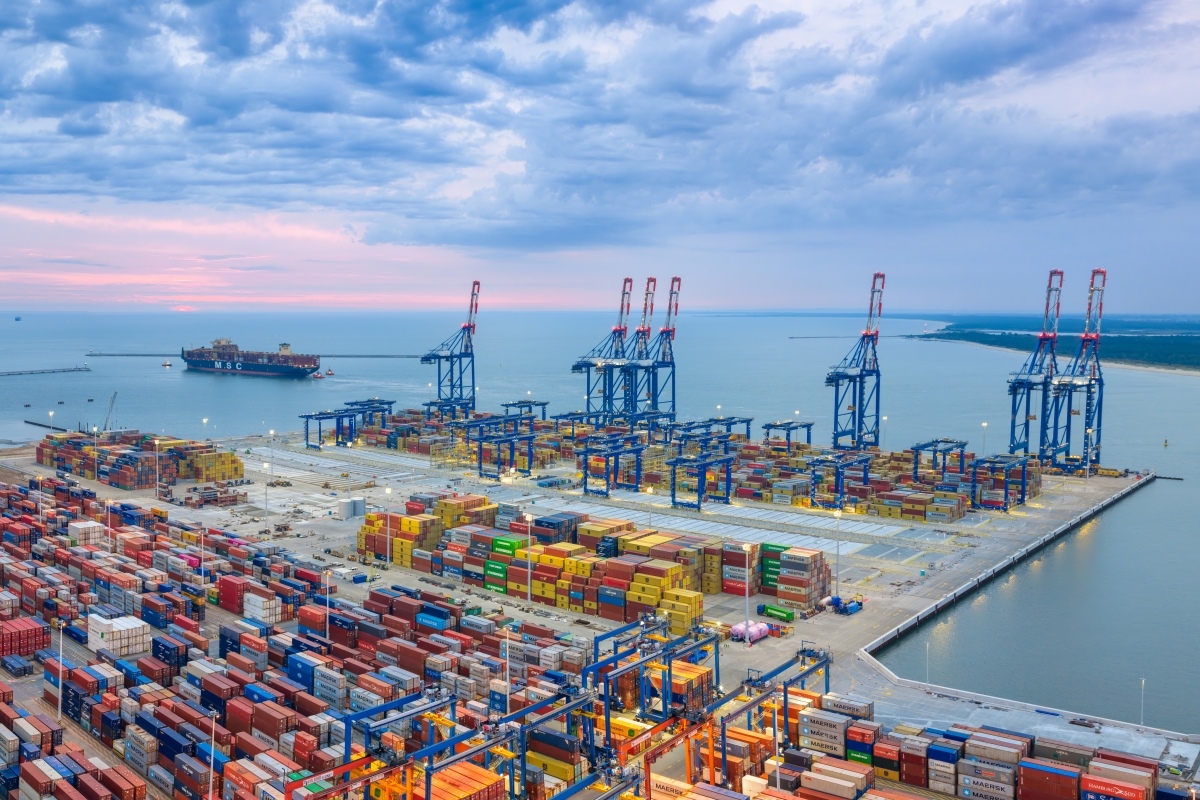
Baltic Hub has completed the construction of the T3 quay – the largest port investment in the Baltic Sea region. In September, the terminal received the occupancy permit for the final section of the yard, and at the beginning of October, the remaining four of the 20 aRMG cranes were commissioned. The T3 terminal increases the total handling capacity of Baltic Hub by 1.5 million TEU annually, reaching 4.5 million TEU, significantly strengthening Gdańsk’s position as a strategic logistics hub for Central and Eastern Europe.
36 hectares in 36 months
Three years ago, the construction of one of the most ambitious hydrotechnical and port investments in the region’s history began in the Gulf of Gdańsk. On September 22, 2022, after receiving the necessary decisions and approvals, Baltic Hub issued the order to commence work to the General Contractor – a consortium of Budimex and DEME. Supervision of this massive undertaking was entrusted to the company Haskoning. From that moment on, the construction site was filled not only with professional equipment but, above all, with teams of engineers, designers, workers, and subcontractors from all over Poland.
Over 36 months, from the start to the completion of the investment, more than 400 employees participated in the entire construction process, and at the peak of implementation, there were almost 600 of us. We engaged hundreds of suppliers and cooperating companies both from Poland and abroad. The total number of man-hours worked exceeded 3.2 million.
– says Dominik Wróblewski, Civil Engineering Projects Director, responsible for the implementation of T3.
Baltic Hub, together with its partners, completed this monumental engineering and organizational challenge on schedule. To implement the investment, 4,370,000 cubic meters of sand were used to reclaim an area of over 36 hectares, which formed an artificial island at sea. If this amount of sand were transported by single trucks, 350,000 trucks would be needed. Placed one after another, they would form a column corresponding to the distance from Gdańsk to Beijing. In turn, 17.5 thousand tons of structural steel were used to build the terminal’s retaining walls, which is roughly equivalent to the weight of 2.4 Eiffel Towers. The amount of concrete needed for the construction of pile caps, walls, buildings, and surfaces amounted to 160,000 cubic meters, which is 52 fully filled Olympic swimming pools.
The most modern terminal equipment in Europe and over 700 m of quay
The T3 terminal features a deep-water handling quay with a depth of 17.5 meters and a length of 717 meters. The area covers 36.4 hectares. This includes 7,608 container storage slots arranged in 14 stacks and four stacks intended for empty container storage.
Baltic Hub has equipped the new terminal with state-of-the-art equipment. Seven automated STS quay cranes traveled by sea over a distance of almost 29,500 kilometers. Each of these giants weighs almost 2,000 tons, reaches a height of 96 meters, and with the boom raised – almost 150 meters. These cranes are among the tallest and most technologically advanced in Europe, enabling the handling of the world’s largest container ships carrying over 24,000 TEU on board.
The T3 infrastructure is complemented by 20 automated aRMG cranes, which operators control remotely from the administration building. Baltic Hub powers all machines with green energy from renewable sources, which aligns with the company’s sustainable development strategy and the goal of reducing emissions by 50% by 2030 and achieving climate neutrality by 2050.
The largest and deepest container terminal on the Baltic Sea
The completion of the T3 terminal is of key importance for the entire Central and Eastern European region. Baltic Hub, which currently covers over 124 hectares of operational area and 2.1 kilometers of deep-water quays, has become the largest and deepest container terminal on the Baltic Sea. Thus, Gdańsk has strengthened its position as a key transport gateway not only for Poland but also for Central European countries such as the Czech Republic, Slovakia, and Hungary.
Thanks to the combination of new STS cranes and the automated terminal configuration, Baltic Hub significantly increases operational efficiency and safety. The completion of the T3 terminal not only supports the growing needs of international trade but also strengthens Poland’s role in the global logistics network. Baltic Hub increases supply chain resilience and expands access to global markets, while strengthening intermodal connectivity between global shipping routes and the European rail network.
– says Jan Van Mossevelde, CEO of Baltic Hub.
The completion of the T3 terminal is not only a milestone in the history of Baltic Hub but also an investment in the future of the Polish maritime economy. The Gdańsk terminal consistently pursues its vision of development as a global logistics ecosystem, combining advanced infrastructure, a sustainable approach, and intermodal capabilities.
Source: Baltic Hub Container Terminal Sp. z o.o.