











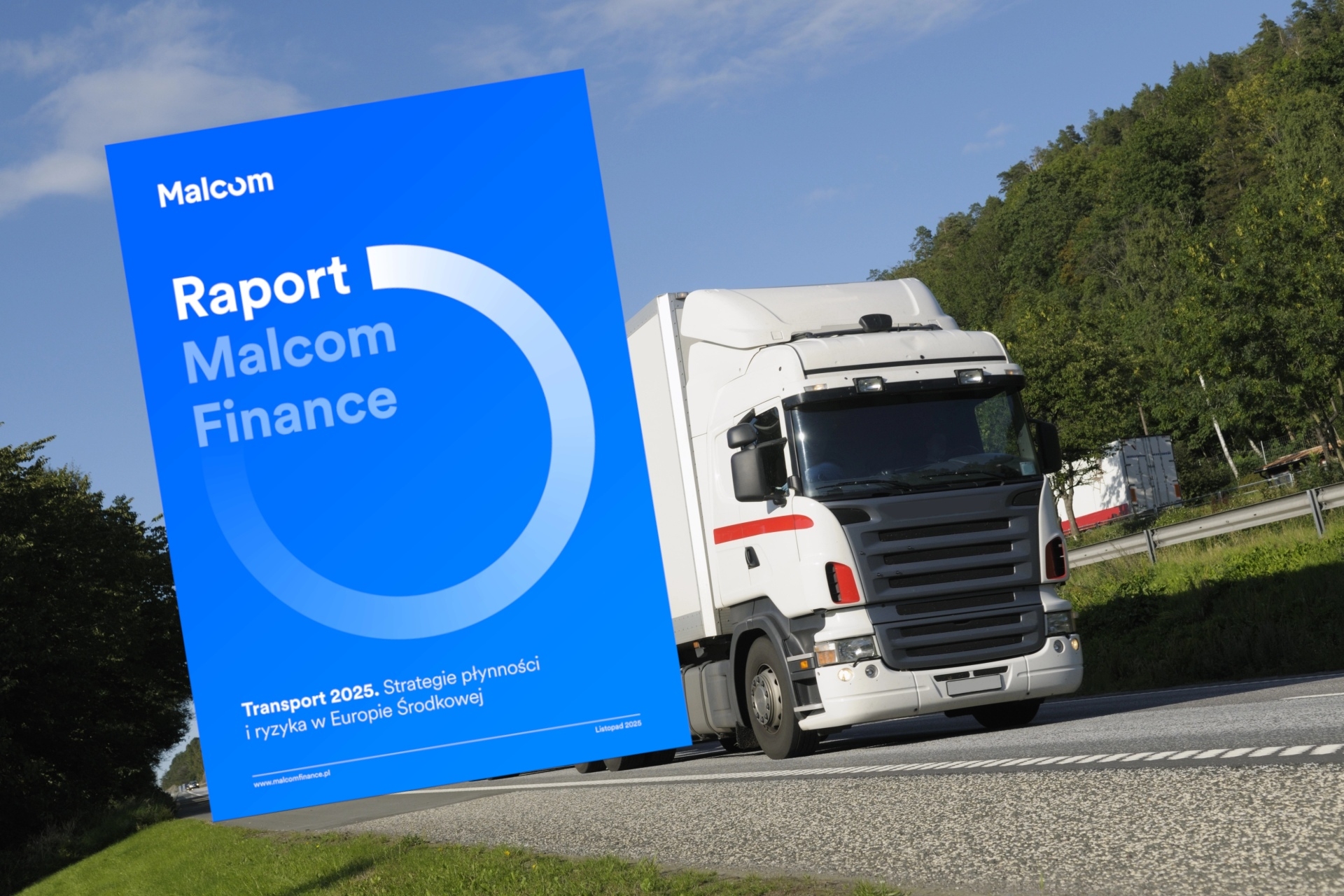
Four out of ten carriers from Poland, the Czech Republic, and Slovakia (40 percent) consider Polish clients to be the least financially reliable, and seven out of ten companies (71 percent) admit that payment delays directly influence their business decisions. The study “Liquidity and Risk Management Strategies in Transport Companies” conducted by the fintech Malcom Finance shows that financial liquidity has become the new currency of the transport industry.
Two out of three companies (66 percent) turned down a contract last year due to fears of non-payment, and every third company (34 percent) uses factoring to recover funds from issued invoices more quickly. Poland focuses on quick reactions and direct contact, the Czech Republic on analysis and relationships, and Slovakia on flexible financial tools. As the authors of the study emphasize, the region is moving from a stage of intuition and reaction to a stage of data and prevention, and transport companies are increasingly managing financial risk in a conscious and strategic manner. Unfortunately, four out of ten surveyed carriers from Poland, the Czech Republic, and Slovakia (40 percent) consider Polish clients to be the least financially reliable.
It is a paradox, but also a sign of market maturity. Polish companies do not idealize reality. They know the scale of payment bottlenecks and are not afraid to speak about it directly. This shows that the transport industry is beginning to manage risk in a professional way – not through intuition, but through analysis. At Malcom Finance, we operate according to the needs of carriers: fully online, providing clients with decisions almost immediately and funds for services rendered without unnecessary delay. We also support companies in verifying contractors – we manage a database of 88,000 transport clients from across the European Union, which allows carriers to make financial decisions faster and more safely
– comments Jaroslav Ton, CEO of Malcom Finance.
At the other end of these dependencies are data from the National Debt Register (KRD), which show how the lack of timely payments from clients affects the condition of the carriers themselves. Some transport companies, not receiving payment for completed orders, lose liquidity themselves and end up on the list of debtors.
At the end of September 2025, the total amount of liabilities of companies from the TSL sector entered into the KRD was 1.63 billion PLN, and the number of debtors reached 31.5 thousand enterprises – an increase of half a billion PLN compared to 2021.
The TSL industry is at a turning point today – its potential is enormous, but it is becoming increasingly clear that without stable finances, it is difficult to maintain the pace of development. The debt of transport companies has already exceeded 1.6 billion PLN, and there are over 31,000 enterprises on the list of debtors. This shows that some companies are still operating on very short liquidity, and payment bottlenecks are spreading through the supply chain. The biggest threat today is not the debts themselves, but their consolidation – which is why prevention, regular monitoring of contractors, and quick reaction before an arrearage turns into a structural problem are of key importance.
– says Tomasz Gadziński, Strategic Client Manager at the National Debt Register.
Paradoxically, the largest debtor of Polish TSL companies remains the TSL industry itself, owing 66 million PLN to each other. Subsequent places are occupied by wholesale and retail trade (55.9 million PLN), industrial processing (28 million PLN), and construction (17.1 million PLN). The scale of these arrears may, however, be much larger – many carriers, especially micro-enterprises, do not report their receivables, trying to recover them on their own or postponing the decision to formally register the debtor. As a result, they lose time and money – the longer they wait, the lower the chances of recovering the funds owed to them.
Liquidity instead of growth
For most carriers from Central Europe, financial liquidity has become a key condition for conducting business. More than seven out of ten companies (71 percent) admitted that problems with timely payments affect their operational decisions, and two out of three (66 percent) turned down a contract in the last year due to fears of non-payment. In an industry where average margins are only a few percent and one has to wait 50–60 days for payment, every invoice becomes a test of financial stability. In such conditions, maintaining liquidity often means the difference between growth and survival.
Poland: quick reaction and financial pragmatism
In Poland, carriers react to delays decisively. Seven out of ten companies (70 percent) immediately contact the contractor by phone, and almost as many send an email reminder. Every third (33 percent) hands over the receivable to a debt collection agency, and every fifth (20 percent) uses factoring to recover funds faster. More than half (53 percent) of the respondents admitted that they turned down an attractive order in the past year due to fears of non-payment, and one in three companies (33 percent) considered such a decision. Carriers are increasingly treating liquidity as a condition for doing business, not a one-time problem to be solved.
Polish companies are beginning to treat finances strategically, not operationally. They see that a quick reaction does not always mean conflict. Sometimes it is simply a way to protect stability.
– says Marcin Wawrzkiewicz, Country Manager of Malcom Finance in Poland.
When assessing the credibility of contractors, Poles pay attention primarily to reputation and payment history. Nine out of ten companies (90 percent) admit that negative opinions in the industry are a warning signal for them, and eight out of ten (80 percent) analyze whether a business partner is in arrears with payments to others.
Three countries – three approaches to risk
Although Poland, the Czech Republic, and Slovakia are connected by the same market and similar cost realities, the style of risk management is different in each country. Czech companies are more conservative – eight out of ten (78 percent) contact the contractor by email and less often resort to debt collection. Seven out of ten (70 percent) admit that they have turned down an order due to payment concerns, but these decisions are thought-out, not emotional. In Slovakia, a combination of caution and financial flexibility dominates. Eight out of ten companies (80 percent) remind about arrears by email, two-thirds (66 percent) call the contractor, and every third (34 percent) sells invoices to a factoring company to maintain liquidity. Two out of three companies (68 percent) admitted that they turned down a contract in the last year due to payment risk; for Slovak carriers, this is not a routine, but a conscious decision preceded by a contractor analysis.
These differences show that Central European markets are maturing at their own pace, but in the same direction. Poland is building an advantage through speed of reaction and increasing use of financial tools, the Czech Republic is consistently developing a culture of cooperation and risk analysis, and Slovakia is focusing on flexibility and data. These are three different models that share one thing: an increasingly conscious approach to liquidity management. It is clear that for carriers in the region, this is no longer a matter of reacting to a problem, but an element of financial strategy, comparable to planning costs or investments.
– assesses Jaroslav Ton, CEO of Malcom Finance.
This comparison shows that there is a common trend in the region: companies are acting on gut feeling less and less often, and are increasingly making decisions based on data.
The market is maturing
The Malcom Finance study shows that although carriers in Poland, the Czech Republic, and Slovakia differ in their style of operation, they are united by one thing – the awareness that liquidity is not just a matter of accounting today, but a daily management tool. The Central European region is becoming a laboratory of financial maturity: entrepreneurs are increasingly using data to assess the credibility of contractors, reaching for external financing, and learning to react not to the problem, but to its symptoms.
This is no longer an industry that waits for a problem to appear. This is an industry that knows how to prevent it. This report shows a change in thinking: from intuition to data, from reaction to prevention. And this is the most important sign of the maturing of the transport market in Central Europe.
– summarizes Jaroslav Ton, CEO of Malcom Finance.
About the study
The study “Liquidity and Risk Management Strategies in Transport Companies” was conducted by Malcom Finance in October 2025 among 111 transport companies operating in Poland, the Czech Republic, and Slovakia. The sample mainly included small and medium-sized companies carrying out domestic and international transport. The report can be downloaded at www.malcomfinance.pl
Source: Malcom Finance