











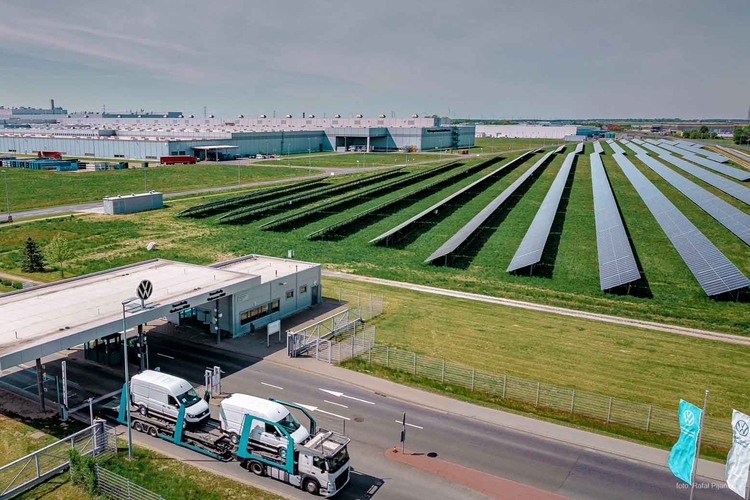
Over 31,000 photovoltaic panels, approximately 27 hectares of surface area equivalent to nearly 38 football pitches, 150 kilometers of cables, as well as a capacity of 18.3 MW, which on sunny days is capable of providing the factory with full energy self-sufficiency and covers 25 percent of the plant’s annual electricity demand – this is how one of the largest on-site photovoltaic farms in this part of Europe, built at the Crafter plant in Września, can be described in numbers.
The construction of the third stage of the solar installation at the Volkswagen plant in Września has been completed. The factory, which is the sole producer of the Crafter model in the world, uses exclusively green electricity (like all Volkswagen Group plants in Poland) and has been intensively developing its own green energy sources for three years.
We are consistently implementing the climate neutrality strategy for our plants. The completion of the next stage of the photovoltaic farm construction is an important step on this path – thanks to it, an increasing portion of the energy needed for car production is generated directly on our factory premises. This increases our energy independence and stabilizes energy prices, which translates into our competitiveness – says Stefanie Hegels, CEO of Volkswagen Poznań.
A green factory of the future is being built in Września
Construction of the photovoltaic farm in Września began in 2022. The first stage involved an installation on 4 hectares with a capacity of 2 MW, the second – with a total capacity of 13.2 MW and an area of over 18 hectares, and the recently completed third stage adds 5,300 modules with a capacity of 3.1 MW on an area of 4.3 hectares. In total, the farm now provides 25 percent of the plant’s annual electricity demand.
The photovoltaic farm that we built for Volkswagen Poznań has joined the ranks of the five largest “behind the meter” (on-site) installations in Europe – this is the result of long-term thinking about sustainable energy. A partnership based on trust and determination is crucial for projects of this scale. We are pleased that together with Volkswagen, we can carry out ventures that change the energy landscape and set new standards for the entire industry – emphasizes Piotr Grzybczak, CEO of Quanta Energy S.A., the company responsible for the construction of the installation.
In the coming years, Volkswagen Poznań plans further development of renewable energy sources at the Września plant. Roof and parking installations with a capacity of 14 MW (6.2 MW on roofs and 7.8 MW on parking lots) will be built there, as well as wind turbines. In the latter case, administrative procedures related to the construction of the wind turbines are currently underway. In parallel, in cooperation with the Poznań University of Technology, energy storage facilities are being planned, which will allow for the storage of excess generated energy. Thanks to these investments, by 2030, up to 60 percent of the electricity used by the Września plant is expected to come directly from its own RES.
The development of RES does not only apply to the Crafter factory. Next year, the construction of a 5.5 MW photovoltaic installation will also begin at the Volkswagen plant in Poznań.
Emissions reduced by over 82 percent
Volkswagen Poznań is consistently pursuing its primary goal, which is the decarbonization of production processes. The company aims to achieve a zero carbon footprint in the production process by 2040, and in the entire supply chain by 2050. Already today, comparing the level of carbon dioxide emissions from 2010 to the present, Volkswagen Poznań has reduced CO₂ emissions per car produced and per ton of components by over 82 percent. Let us recall that since 2018, the energy used in all the company’s plants has come exclusively from hydroelectric and wind power plants operating in Poland. Building its own renewable sources is the next step towards full climate neutrality. In parallel, other processes related to decarbonization are underway – for example, the company is developing green logistics – electric trucks, among others, are used for the transport of components.