











According to data from the end of July 2025, a total of 103,503 fully electric passenger and commercial vehicles (BEVs) were registered in Poland. Over the first seven months of this year, their number increased by 23,243 units, which is 65% more than in the same period of 2024, according to the Electromobility Meter launched by PZPM and PSNM.
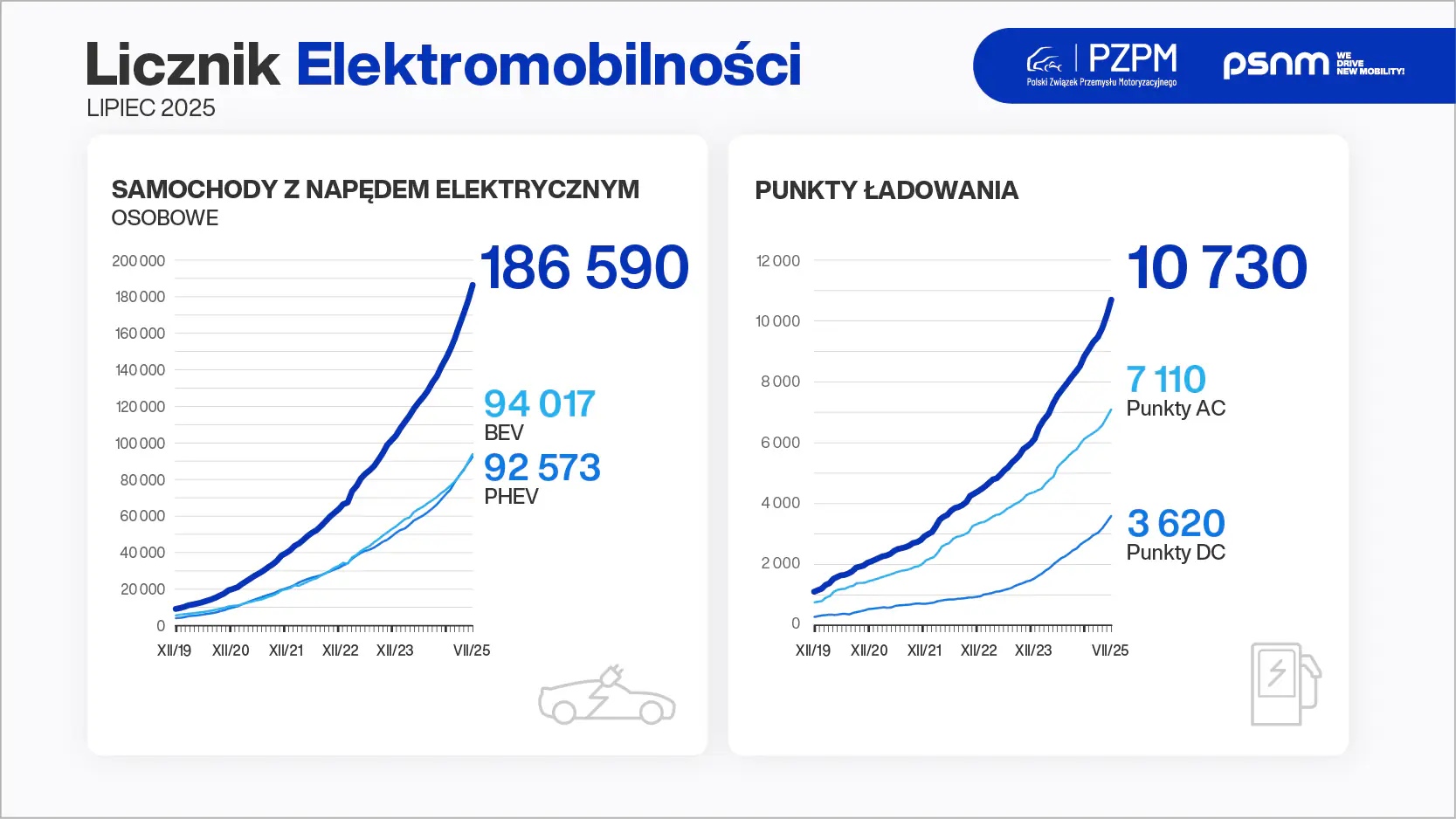
At the end of July 2025, there were 186,590 electric passenger cars on Polish roads. The fleet of fully electric passenger cars (BEVs, battery electric vehicles) numbered 94,017 units, and the fleet of plug-in hybrids (PHEVs, plug-in hybrid electric vehicles) totaled 92,573 units. The number of electric delivery and heavy-duty vehicles stood at 9,630 units. The fleet of electric mopeds and motorcycles is constantly growing, consisting of 26,236 units at the end of July, as is the number of hybrid passenger and delivery cars, which increased to 1,147,708 units. By the end of last month, the zero-emission bus fleet in Poland grew to 1,613 units (of which 1,507 were fully electric vehicles and 106 were hydrogen-powered).
Parallel to the fleet of electric vehicles, charging infrastructure is also developing. At the end of July 2025, there were 10,730 publicly accessible electric vehicle charging points in Poland. 34% of them were fast DC charging points, and 66% were slow AC charging points with a power of 22 kW or less.
July 2025 is a historic moment – for the first time in Poland, we have exceeded the number of 100,000 registered zero-emission vehicles. It is also worth noting that at the same time, there are already over 10,000 public charging points operating in the country. Soon, there will be 100,000 electric passenger cars and 10,000 electric delivery and heavy-duty vehicles of this type on our roads. We hope that the expansion of the “NaszEauto” program announced by the Ministry of Climate and Environment to include subsidies for the purchase of delivery vehicles, as well as the extension of the application period for subsequent months, will allow us to maintain the high growth dynamics that we have observed in the last few months. It is worth emphasizing that in the first half of 2025, the number of registrations of electric cars and plug-in hybrids increased by 80% compared to the same period last year.
– says Jakub Faryś, President of PZPM.
The current year is marked not only by very clear growth in the electric vehicle segment but also in charging points. The Polish e-mobility industry is definitely focusing on expanding fast DC infrastructure. The number of newly launched DC points in 2025 is very similar to the number of newly installed AC points. Ultra-fast points with a power of at least 150 kW are already operating in almost 350 locations across Poland. Furthermore, since January, the share of DC infrastructure has increased from 31% to 34%. This is a better result than, for example, in Germany, where fast infrastructure accounts for 25% of the entire network. However, it is worth remembering that due to the very long process of installing new stations in Poland, the growth currently observed is the result of investments that began many months earlier. In the future, the pace of infrastructure expansion will increasingly depend on the demand for charging services, especially since EU and national subsidy programs are to be gradually phased out.
– says Jan Wiśniewski, Director of the PSNM Center for Research and Analysis.
Source: PSNM