











The beginning of 2025 did not bring growth in the rail freight sector – only 52.19 million tons of cargo were transported in the first quarter of this year. Data on the structure of cargo reveal signals of deeper changes, which are related both to the condition of the national economy and European trends in logistics.
Energy transition, digitalization of logistics, as well as the growing importance of intermodal transport are influencing the restructuring of transport patterns. For Poland, this means not only the need for infrastructural and technological adaptation, but also the need for strategic management of transport in an international context. Efficient rail freight – regardless of economic fluctuations – remains a key element of both the national transport system and the climate and economic policy of the European Union.
– assesses Dr. Eng. Ignacy Góra, President of the Office of Rail Transport (UTK).
The data shows that the volume of transport has fallen, but the structure of the dominant cargo groups remained relatively stable in the first quarter of this year. Energy raw materials – primarily hard coal, lignite, crude oil, and natural gas – still have the largest share in rail transport. They accounted for over 31.2% of the total mass of transported goods. Hard coal reached a result of 15.87 million tons, which means a slight decrease compared to Q1 2024 (16.11 million tons). However, this result keeps the group of hard coal, lignite, crude oil, and natural gas (with a volume of nearly 16.3 million tons) in the leading position in terms of mass. In terms of transport performance, this group accounted for a 19.6% share in the first quarter.
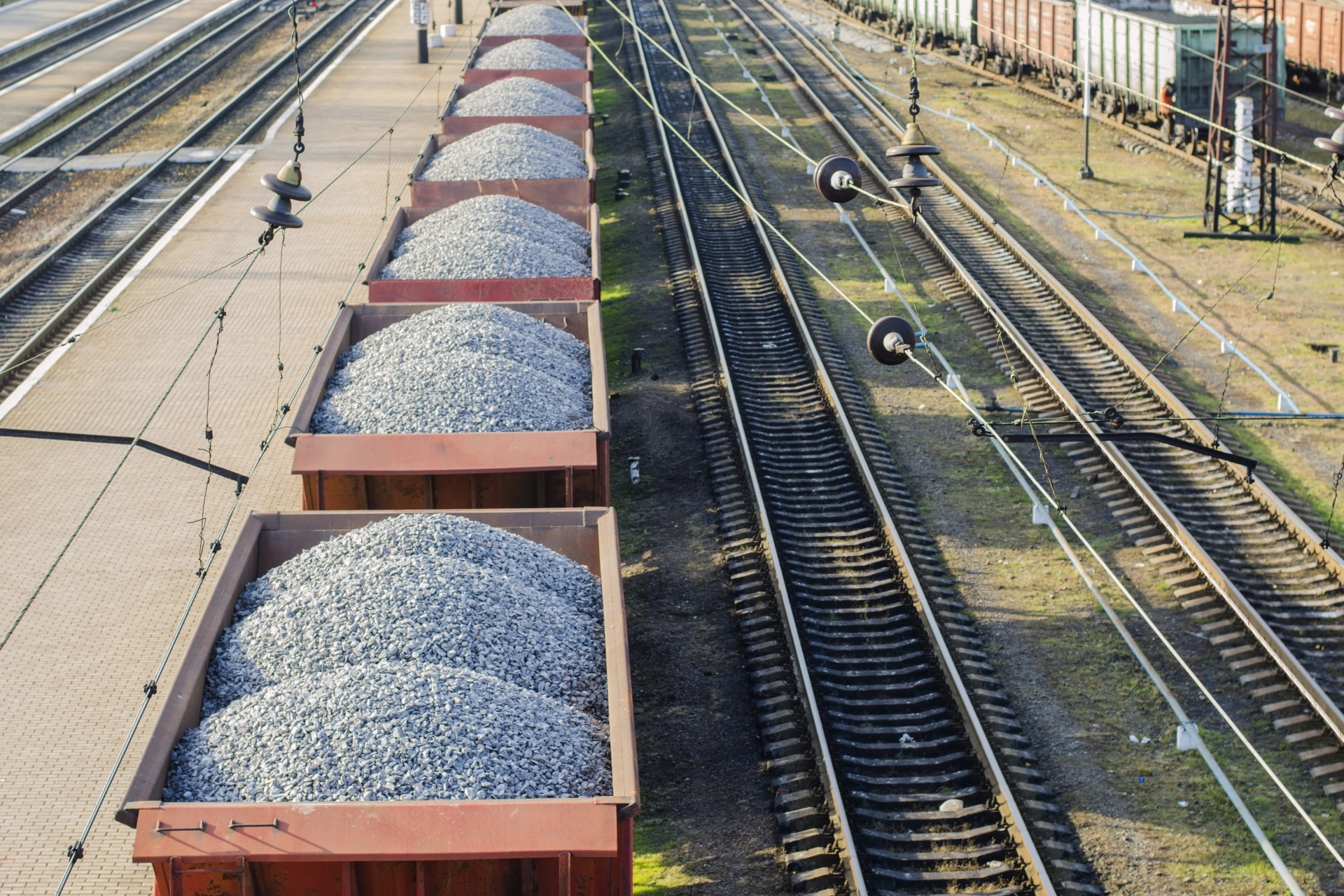
The second key category is metal ores and other mining industry products – 13.59 million tons, which accounts for over 26% of the total transport mass. This value is close to the result from the first quarter of last year (13.4 million tons). The group of metal ores and other mining industry products gained a 27% market share according to transport performance. In this group, in Q1 2025, 81% of the mass consisted of aggregates (including sand, gravel, clay) with a total mass of 11.01 million tons – this is over 2 million tons less than in Q4 2024. Lower transport of aggregates in the first quarter is a cyclical phenomenon (resulting from lower demand at this time of year), but such a large decline negatively affects the condition of the transport industry.
In the group of metal ores and other mining industry products, the mass of the iron ore subgroup maintains a stable level – for 4 quarters it has been about 1.5 million tons in each of them (1.55 million tons in Q1 2025).
Refined petroleum products and industrial gases accounted for 13.3% of the total transport mass in Q1 2025, reaching 6.94 million tons. This is a lower result than in Q1 2024, as well as at the end of 2024. Their share in transport performance is 19.6%. For the refined petroleum products subgroup, the results were similar to Q4 2021 and Q1 2022.
Stable transport groups
Recently, the group of chemicals, plastics, and nuclear fuel has shown relatively high stability – with a result of 2.73 million tons (compared to 2.78 million tons a year earlier). Importantly, the share of this category in transport performance increased to 6.45%, and in mass it exceeded 5% (5.2%) – similar to the first quarter of last year.
Also noteworthy are cargoes from the unidentified group – that is, those that cannot be clearly assigned to any classification, e.g., containers, groupage shipments, or intermodal cargo. In Q1 2025, 5.25 million tons were transported, which gives a 10.07% share in the total mass. Their share in transport performance amounted to as much as 13.13%. This is a stable share for this group.
Detailed information along with the full range of statistics on the subject of groups is available on the Railway Data website in the Freight transport, Cargo groups tab.
Source: UTK