











Every year, approximately 100 billion items of clothing are produced worldwide. However, a significant portion of this does not reach consumers, but ends up in landfills, polluting the environment. Network360 has created a system based on circular economy principles that helps prevent this waste. At its heart is the DSV – Global Transport and Logistics warehouse in Adamów near Warsaw, which serves as a global distribution hub.
The fashion for the secondary market
As many as 92 million tons of textiles end up in landfills every year. Among this “waste” are often unsold clothes and accessories that constitute excess stock, returns, or factory rejects that could otherwise find buyers. An alternative to wasting resources and discarding usable clothing and accessories is the secondary market, where excess clothing can be given a second life and reintroduced into circulation after proper selection and potential repairs.
For over 20 years, Network360 has been developing a system that allows fashion brands to turn surpluses, such as unsold collections, consumer returns, or factory rejects, into assets. As part of our operations, we collect this type of merchandise, sort it, and perform minor repairs if necessary, before reintroducing it to the market. In this way, we have managed to save over 150 million items of clothing from being wasted.
– says Philip Grech, CEO at Network360
Currently, Network360 collaborates with over 130 brands, many of which are the most popular clothing brands.
From a few tables to a global distribution hub
Logistics centers are a key element of Network360’s circular economy formula.
This is where clothing from partner brands is delivered, and where the entire process of preparing products for reintroduction into circulation takes place: from receiving into the warehouse, through selection, repairs, and cleaning, to preparation for shipment to the buyer.
Since 2016, DSV – Global Transport and Logistics has been the contract logistics partner for Network360.
At the beginning of the partnership, operations were carried out in a warehouse in Kopytów, in the Masovian Voivodeship. In the first few weeks, the scale of operations was quite modest.
When we started working with Network360, goods from one supplier were arriving at our warehouse. The entire process was carried out by a 5-person team, which used 2 tables to sort and label the goods before entering them into the warehouse. Today, there are nearly 7 times as many of us, and during peak seasons, the team is further expanded depending on the client’s needs.
– recalls Magdalena Szelenbaum, Co-packing Manager at DSV – Global Transport and Logistics, who has been involved in the project from the very beginning.
Over time, the number of goods arriving at the logistics center began to grow dynamically. As the scale of operations increased, a change of location became necessary. Currently, operations are conducted in Adamów near Warsaw, in a facility with an area of 11,000 square meters. In addition to classic warehouse space, a showroom has been created at the logistics center, where buyers from all over the world can personally familiarize themselves with the Network360 offer.
The journey we have taken with Network360 over the last 9 years is unique. From simple operations, we have jointly developed competencies in Poland that have made our branch a benchmark. Today, Network360 partners from all over the world come to us to see our team in action with their own eyes. This progress would not have been possible without the unique cooperation model of our companies. From the very beginning, Network360 representatives were constantly present at the distribution center and actively participated in the design and implementation of activities.
– says Anna Chojnowska, Customer Manager at DSV – Global Transport and Logistics.
The warehouse in Adamów serves as the main distribution hub for Network360. Through it, goods reach recipients in 78 countries on 5 continents.
A center for restoring value
The warehouse in Adamów is the heart of Network360’s operations, where clothing and accessories from written-off surpluses are turned into ready-to-sell products. What does this process look like?
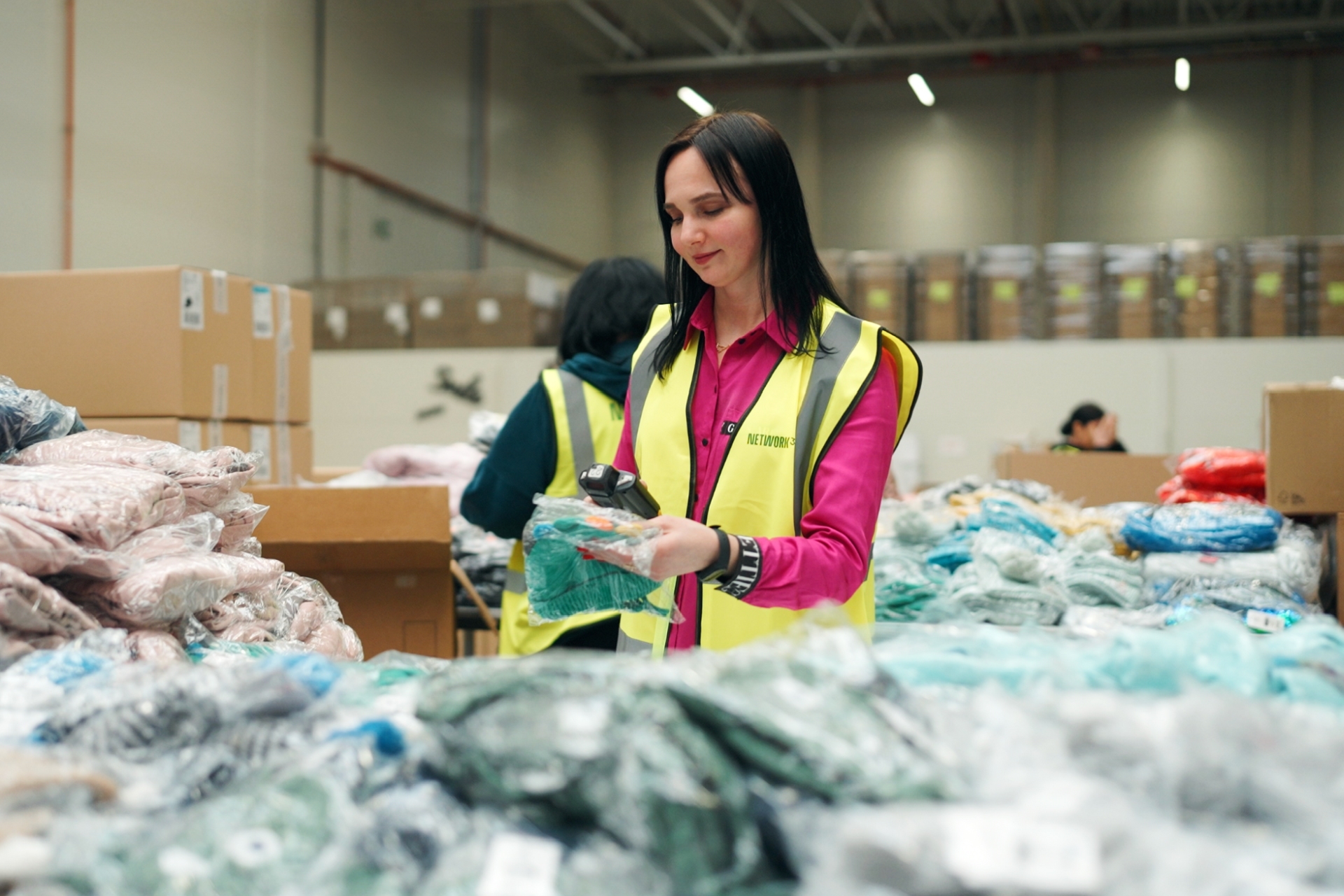
The first step is receiving the cargo – clothing from brands collaborating with Network360 arrives at the logistics center from all over the world. After unloading, it goes to tables where the quality control and sorting process begins. This is carried out entirely manually by specialized DSV employees.
Sorting clothes is a key element of the entire process, and although it may sound like a simple task, it requires great focus. The first step is quality control. Items are divided into full-value and sub-standard. The latter are further divided into those suitable for repair and those irreversibly damaged. Then, items are categorized by brand, gender, and season. The entire process is repetitive on one hand, but on the other, each pallet is unique – we deal with clothing brands from all over the world, and each one is unique. What we are proud of is a very low error rate, and in the years 2022-2024 alone, we processed approximately 23.4 million items of goods. This is the best proof of what a good team we have built.
– explains Magdalena Szelenbaum, Co-packing Manager at DSV – Global Transport and Logistics.
Goods that do not require further processing are packed onto pallets and transferred to the warehouse. In the case of items that require repair, they undergo the necessary renovation. The entire process is carried out locally by DSV. Once a Network360 client orders goods, they are picked and packed by DSV specialists and prepared for shipment according to guidelines.
Source: DSV – Global Transport and Logistics