











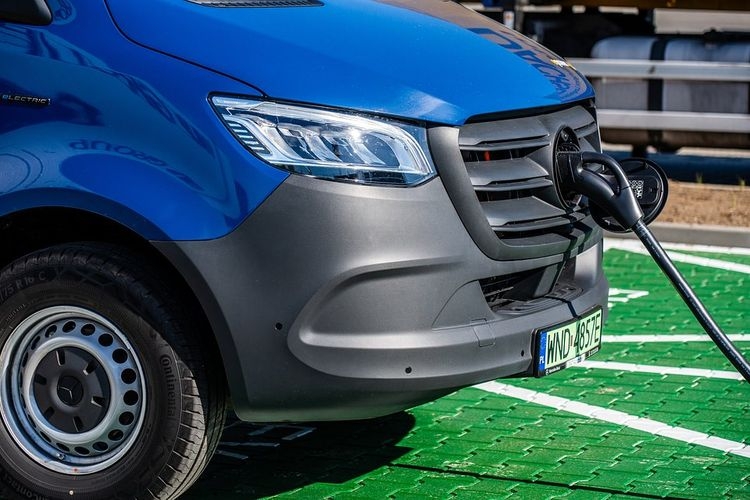
Road, sea, air, and rail freight transport currently accounts for approximately 8 percent of global CO2 emissions, and when logistics infrastructure such as warehouses and ports is included, this share rises to 11 percent, according to data from the Massachusetts Institute of Technology. The transformation of the transport sector is therefore crucial for reducing emissions, and one of the key actions for carriers is the electrification of their fleets. Logistics company DACHSER is introducing a sustainable concept of emission-free deliveries in Poland. The center of Warsaw is the first to join the program.
The goal of the DACHSER Emission-Free Delivery project is to launch zones in the largest European cities where distribution will be carried out using zero-emission vehicles. We have just implemented this solution in the center of Warsaw, where our customers will be served by a Mercedes-Benz vehicle. It is a quiet and emission-free vehicle that perfectly fits the idea of green logistics, says Wojciech Mikołajczuk, Project Coordinator at DACHSER, who is responsible for the implementation of DACHSER Emission-Free Delivery in Warsaw.
Green logistics in the heart of the city
DACHSER has been consistently committed to the development of e-mobility for years. It is developing the DACHSER Emission-Free Delivery program, which involves delivering shipments in city centers using, among other things, electric vehicles. Its goal is to reduce pollution and noise emissions in urban areas, as well as to promote sustainable transport. Currently, the program operates in over a dozen European cities. Warsaw has just joined this group, specifically its strict center – an area of approximately 5.7 square kilometers within the Warsaw clean transport zone.
Warsaw is a dynamic and demanding market, especially in the context of urban logistics; we have to meet a high concentration of customers and the assumptions of sustainable transport here. The city center was chosen for this project because it perfectly fit the assumptions of emission-free deliveries, explains Seweryn Zawko, Branch Manager European Logistics Warsaw at DACHSER.
New technologies support last-mile logistics
As company representatives emphasize, emission reduction is only one of the program’s goals. Another of its objectives is the optimization of transport processes – reducing empty runs, increasing load utilization, and integrating data into fleet management systems. In Warsaw, a Mercedes-Benz eSprinter 414 will be used for deliveries – a fully electric delivery vehicle with a range of approximately 267 km and a payload adapted to the needs of last-mile logistics.
Thanks to the infrastructure built at our branch, we managed to optimize battery charging time, which allows for effective use of the vehicle while maintaining high punctuality. Our systems support delivery planning and integrate this type of distribution with standard processes, explains Wojciech Mikołajczuk.
At the DACHSER Warsaw branch in Brwinów, which was the first in Poland to implement emission-free deliveries, modern fast DC chargers have been installed, allowing for the simultaneous charging of two electric vehicles with a total power of up to 184 kW. Routes are carefully planned, taking into account battery capacity, traffic intensity, and delivery deadlines. The entire process is supported by advanced IT systems, which translates into high operational efficiency and reliability of the services provided.
The biggest challenge was integrating this type of vehicle with our standard processes. We had to take into account the vehicle’s charging time and the driver’s work schedule. It was important to train the staff so that the entire process would take place smoothly and safely, thanks to which we created a system that we can develop and implement in other locations, assesses the coordinator of the DACHSER Emission-Free Delivery project in Warsaw.
Benefits for residents and the environment
DACHSER’s deliveries to city centers with zero local emissions help improve air quality and reduce traffic noise. Because electric trucks and cargo bikes do not emit any pollutants, they play an important role in maintaining clean air.
For our branch, this is an important step towards sustainable logistics. We want to show that we can reconcile operational efficiency with environmental protection requirements. We care about having a direct impact on reducing noise levels and exhaust emissions, which should positively translate into the quality of life for residents, emphasizes Seweryn Zawko.
European scale of the project
The DACHSER Emission-Free Delivery program was launched in Stuttgart in December 2018. Since then, over a dozen cities across Europe have joined it, including five in Germany (Berlin, Dortmund, Freiburg, Munich, and Stuttgart) as well as Copenhagen, Madrid, Oslo, Paris, Porto, Prague, and Strasbourg. By the end of 2025, the number of cities covered by the program will increase to 25.
We are implementing this model in subsequent districts of Warsaw and in other Polish cities. The interest of customers and the positive reception from the public show us that this is the right decision, announces the Branch Manager European Logistics Warsaw at DACHSER.
Fleet electrification as an element of ESG strategy
DACHSER’s program is part of a sustainable development strategy that more and more companies are implementing. This is of key importance in the transport of goods, which – according to data from the Massachusetts Institute of Technology – accounts for about 8 percent of CO2 emissions. For many companies in the logistics sector, using green transport is an important competitive advantage.
Customers are increasingly asking us about green logistics solutions, especially international companies. For them, low-emission solutions are not only an added value but also a requirement in the case of tenders and audits. More and more Polish companies are also including environmental goals in their business plans, and this trend will only strengthen, assesses Joanna Kowalska, Regional Sales Manager European Logistics at DACHSER. – Using these services allows for the reduction of the carbon footprint and is part of the implementation of our customers’ ESG strategies; it also has a positive impact on image, presenting the company as a conscious market participant. Most importantly, we carry out emission-free deliveries without compromises, meaning the quality and punctuality of deliveries are just as high as in the traditional service.
Ambitious goals by 2030
In accordance with the strategy, by 2030, the logistics operator plans to significantly increase the share of emission-free vehicles in daily operations, develop its own charging infrastructure, and deepen cooperation with partners in the field of green energy supply. The company also intends to expand zero-emission solutions beyond city centers – to regional and national routes.
Source: DACHSER