











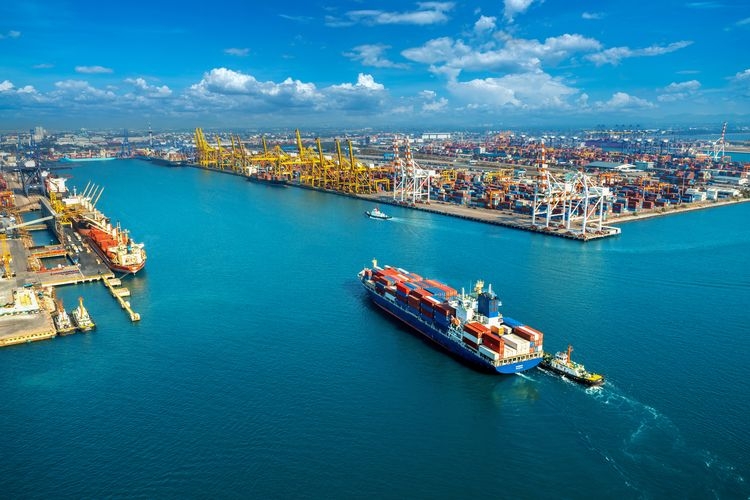
Experts from Accolade, an international investor in the industrial real estate market, have identified 10 European port cities that could play a key role in the transformation of supply chains, logistics, and industrial investments in the coming years. The material includes cities that combine developed infrastructure with an attractive location and openness to new investments. Among them are 2 ports from Poland – Gdynia and Szczecin–Świnoujście, whose potential is further strengthened by the government’s “Polish Sea” program.
The restructuring of supply chains, accelerating digitalization, the need for sustainable development, and new relocation strategies such as friendshoring and nearshoring are the main trends that will drive the development of ports in Europe in the coming years. The largest ports that have dominated global trade for decades – such as Rotterdam or Hamburg – are approaching their capacity limits. Global challenges and new supply chain strategies mean that investors, logistics operators, and manufacturers are increasingly choosing locations that were considered alternative until recently. Today, they are a natural direction for expansion. Ports such as Gdynia, Valencia, or Rijeka respond to these needs with flexibility, land availability, and openness to automation and pro-environmental investments. Their advantage is also their growing role in strategic trade corridors, from the Baltic to the Mediterranean – says Joanna Sinkiewicz, Managing Director of Accolade in Poland and Group Commercial Director.
Szczecin – Świnoujście (Poland) – approx. 400,000 inhabitants (agglomeration)
The second-largest port complex in Poland. Investments in deepening the fairway to 12.5 m, the expansion of the container terminal, and planned LNG and intermodal infrastructure make this region a key point for Baltic logistics. Transshipment in 2024 amounted to nearly 76,000 TEU. The proximity to the German border and access to the railway network connecting Poland with Germany, the Czech Republic, and Scandinavia increase its importance. Investors such as Accolade, which is developing several modern warehouse facilities here, are actively taking advantage of Szczecin’s potential as a port logistics and industrial hub.
Valencia (Spain) – 790,000 inhabitants
The fourth-largest port in Europe and the largest in Spain – it handles over 5.7 million TEU annually. It is becoming an alternative to the congested Barcelona and a new logistics center for the Mediterranean. Intensive investments in green energy, digitalization, and terminal expansion (including the Valencia Port 2030 terminal) are underway. The port has excellent connections with North Africa, Latin America, and France, and its development is also supported by the Mediterranean corridor. Accolade has already invested in two projects here: Accolade Funds Park Valencia Picassent, which was fully leased very quickly, and Park Valencia Alzira, a modern logistics center with the potential to build warehouses with an area of over 60,000 sqm.
We believe that ports will become key catalysts for modern industrial logistics across Europe. Their role is evolving from traditional transport hubs to strategic points that integrate sustainable development, digitalization, and supply chains. At Accolade, we view port cities as natural centers for future expansion, both for our portfolio and for our partners. Thanks to rapid infrastructure development and policy actions supporting the green transition, we are ready to deepen our presence in these locations by investing in smart, future-proof logistics parks that meet the requirements of the new era – said Lukas Repal, Chief Operating Officer, Accolade.
Rijeka (Croatia) – 105,000 inhabitants
A strategic location on the northern Adriatic with transshipment amounting to 600,000 TEU in 2024. Investments in a new container terminal and the modernization of the railway line to Hungary and Austria are ongoing. Rijeka has the potential to relieve the congested ports of Western Europe, and thanks to improving transport infrastructure, it is increasingly being chosen by logistics operators.
Bilbao (Spain) – 350,000 inhabitants
Located in the Basque Country, the port is developing as a modern logistics and industrial center of northern Spain. With transshipment at the level of 500,000 TEU in 2024, it has one of the most modern container terminals on the Atlantic coast. The port is investing heavily in decarbonization and digitalization, developing, among other things, LNG infrastructure and projects related to hydrogen energy. Thanks to its proximity to the French border and excellent motorway and rail connections, Bilbao is an important point on the trade route between Spain, France, and the rest of Western Europe.
Gdynia (Poland) – 240,000 inhabitants
The Port of Gdynia has long been considered one of the most dynamically developing logistics centers in the Baltic Sea region. In 2024, it handled a record 975,000 TEU. Currently, investments are underway in the Outer Port – a new deep-water container terminal that will significantly increase the port’s capacity and enable the handling of larger ships, including ocean-going container vessels. Gdynia also benefits from being part of the Tricity and good integration with the rail and road network, handling a growing volume of cargo from Poland, the Czech Republic, Slovakia, and the Baltic states.
Polish ports, such as Szczecin–Świnoujście and Gdynia, are entering a crucial moment in their development. We see how dynamically their importance in regional and international logistics is growing, and now they will be additionally supported by the government’s “Polish Sea” program. This project assumes not only the expansion of port infrastructure but also investments in intermodality, green energy, and the development of the business environment around the ports. If these plans are successfully implemented, Poland could become one of the leaders of new, sustainable logistics in Central and Eastern Europe. For industrial investors and logistics operators, this is an opportunity to operate closer to end markets and fully utilize the potential of the Baltic – emphasizes Joanna Sinkiewicz.
Genoa (Italy) – 580,000 inhabitants
Genoa is a starting point for goods destined for Italy, Switzerland, and southern Germany. A multi-year infrastructure transformation is underway (the “Nuova Darsena” project), and after the reconstruction of the Morandi bridge, the city’s accessibility will increase even further. The intensification of investments in railway infrastructure is intended to increase its intermodality. The port handled 1.8 million TEU in 2024.
Constanta (Romania) – 270,000 inhabitants
The largest port on the Black Sea, which handled nearly 1 million TEU in 2024. It is gaining importance in the context of grain exports from Ukraine and Central Asia. EU investments in the modernization of railway infrastructure and container terminals are currently being implemented. Via Carpatia could play a key role in the future, strengthening the port’s position as a key logistics hub connecting the Black Sea with Central and Northern Europe. Modern road infrastructure will facilitate the transport of goods from, among others, Ukraine, Asia, and the Middle East, increasing the port’s competitiveness against Western European maritime terminals.
Koper (Slovenia) – 25,000 inhabitants
A small but dynamic port with transshipment of approx. 1.1 million TEU in 2024. Thanks to a new railway line to Ljubljana and the expansion of terminals, it has become an alternative to Trieste and Rijeka. It serves the markets of Austria, Hungary, the Czech Republic, and southern Germany. It stands out for its operational efficiency and high level of digitalization.
Piraeus (Greece) – 1.5 million inhabitants (Athens agglomeration)
The port handles approx. 4-5 million TEU annually. Although it is already one of the largest in Europe, its potential is still not fully utilized. Since being taken over by the Chinese COSCO group (67% stake), Piraeus has been intensively modernized – solutions in the field of automation, digitalization, and sustainable development are being implemented. A key point on the Asia–Europe route.
Porto (Portugal) – 1.7 million inhabitants (agglomeration)
The Port of Leixões, located near the center of Porto, is developing towards a smart container port. In 2024, over 700,000 TEU were handled here. The city benefits from relatively less congestion than Lisbon, as well as from the growing importance of maritime tourism and investments in green technologies, such as solar panels and the automation of port operations.
The material was prepared by Accolade experts based on an analysis of market data, investment plans, logistics and industrial trends, and conversations with industry partners. It is for informational purposes, and all mentioned ports have equivalent development potential.