











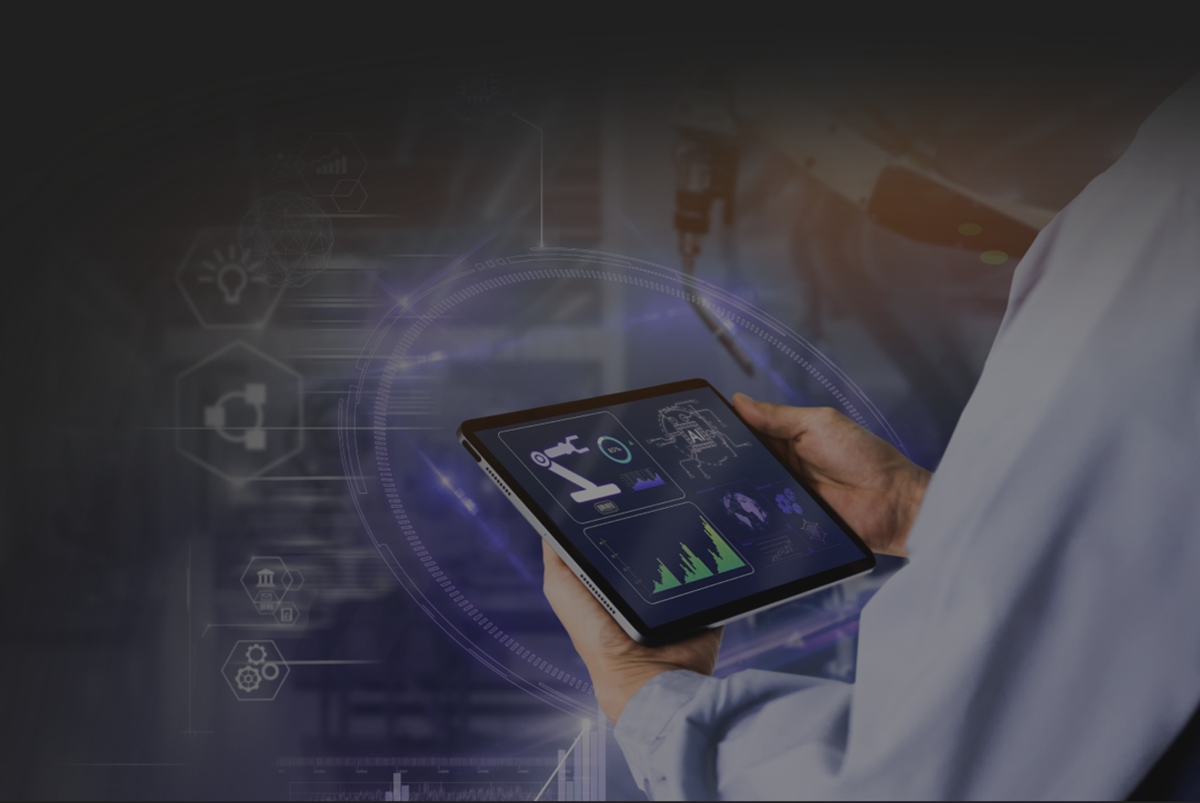
A factory that improves its layout in the virtual world before reconstruction even begins? Or perhaps a city whose infrastructure predicts its own failures? Imagine a world where every physical object – from a single machine to entire metropolitan areas – has its digital counterpart, reacting in real-time to changes, predicting problems, and optimizing processes. This is not a science fiction movie scenario – this vision is becoming reality! All thanks to projects like digital twins, which are revolutionizing the way we design and manage infrastructure. The importance of this technology across various economic sectors is growing – according to Fortune Business Insights, the global digital twin market was valued at $17.73 billion in 2024 and is expected to grow to $259.32 billion by 2032. What does it involve, and what role do Polish experts play in this revolution?
What is a digital twin?
Digital twins are a technology that involves – in simple terms – creating counterparts of physical objects, systems, and processes.
We take a chosen real object “to the workshop” – for example, let it be an airport. We create its digital twin, which is a virtual copy that, thanks to a connection with data from sensors and systems in real-time, shows us what is happening there on a 2D or 3D model.
– explains Damian Dembek, Practice Director at IT company SoftServe Poland, which, in cooperation with NVIDIA, develops these innovative technologies, integrating and implementing them for end clients, who can be, for example, the aforementioned airports, but also companies from various industries, factories, warehouses, data centers, or the public sector, and even entire cities.
On such a digital twin, we can not only conduct monitoring and data analysis. We can also simulate various situations and scenarios, check their effects, and thus optimize processes or look for the best solutions. All this in a very safe way, because if something goes wrong in the digital twin, nothing bad will happen in reality, but if we manage to improve something in this digital twin, there is a high probability that it will also work in the real object. That is not the end, because for such a digital twin, one can also build a special AI model that will help us make decisions regarding the implementation of various changes, suggest how to deal with failures, control processes, and even train new employees in this virtual space.
– adds Damian Dembek from SoftServe Poland.
Technologies versus climate change
The importance of such projects, however, goes far beyond increasing efficiency and development in various branches of the economy. It is said that these technologies have the potential to help us face the most serious challenges humanity is currently facing, including climate change.
One initiative in this direction is Earth-2 – a digital twin of our planet, which is intended to help in modeling and predicting climate change, allowing scientists to simulate various climate scenarios and test, for example, strategies for mitigating the effects of global warming. In the case of cities, digital twins can not only enable the monitoring of urban infrastructure but also, for example, optimize energy consumption, and in industry, they can help companies reduce their carbon footprint by optimizing production processes, reducing waste, and using resources more efficiently.
The future begins now
A digital twin of our planet may seem like a rather distant idea, so let’s get back to earth. The digital twin technology is already being successfully used – for example, by Continental, a German leader in the automotive industry.
Together, we have developed solutions that enable factory teams to increase the productivity of maintenance and upkeep processes. The company’s engineers can now conduct virtual inspections of production lines, monitor performance, and solve problems remotely thanks to physically accurate simulations.
– says Damian Dembek from SoftServe Poland.
The results? Continental has already recorded an increase in efficiency and a 10 percent reduction in maintenance costs and downtime.
So, are digital twins the future of business and industry? At the moment, it is not yet a common solution, but considering its potential, we can expect this to change. Estimates suggest that the implementation of digital twins could increase by as much as 36% over the next five years.
When robots appeared about 30 years ago, many people thought it wouldn’t catch on, and now most companies have them, and automation is a production standard. It mainly consists of replacing humans in activities like assembly, moving objects to different locations, etc. Digital twins are a different area of automation – they are meant to relieve humans in analysis and decision-making, thanks to which we will be able to better plan or optimize costs. I think this technology will also become a standard over time, only – as in the case of the aforementioned robots – people have to be convinced of it. The arguments for it are strong, because digital twins are no longer a futuristic concept, but a real technology that brings measurable benefits.
– concludes Damian Dembek from SoftServe Poland.
Projects of this type not only change the way companies function but also open up new opportunities for Polish IT specialists. Thanks to their involvement in such ventures, they gain access to innovative solutions and tools before they hit the market, giving them the chance to develop and simultaneously shape the future of global technologies. They also strengthen Poland’s position as an important player in this industry, and in the future, who knows – perhaps they will even contribute to solving the greatest challenges of our time?
Source: SoftServe