












The CEP (courier, express, parcel) industry, being one of the key segments of the Polish economy and a pillar of e-commerce, may be seriously burdened as a result of the implementation of the EU directive on platform work. Inaccurate or overly broad implementation of the new regulations concerning digital labor platforms could lead to market destabilization, increased operating costs, and reduced service availability for customers.
Experts call for reasonable implementation of the Platform Work Directive
Directive (EU) 2024/2831 of the European Parliament and of the Council entered into force on December 1, 2024. This is the so-called Platform Work Directive, which aims to improve working conditions for people employed through digital labor platforms. The directive assumes a presumption of an employment relationship between the platform and the person providing services, which guarantees employees the ability to exercise their labor rights. The criteria justifying this presumption will be determined individually by each EU member state, which has two years to implement this solution.
The activity of digital labor platforms is associated with offering services such as food delivery, passenger transport, or cleaning. Opinions have appeared in the public sphere about the possible extension of the Directive’s scope to entities that are not digital labor platforms, i.e., far beyond its content and the assumptions of the European Commission.
According to the published report “The CEP industry in Poland. Risks associated with the implementation of the Platform Work Directive,” the implementation of these regulations in Poland carries the risk of inadequately including CEP operators, who do not function as digital platforms within the meaning of the directive.
The directive was created for entities that organize work using algorithms. The CEP industry operates in a completely different model – these are companies that rely on extensive logistics infrastructure, with clearly defined regulations and state supervision.
– emphasizes the author of the report, Prof. Arkadiusz Kawa from the Poznań University of Economics and Business.
Risk of market destabilization
CEP operators cooperate with independent carriers and subcontractors who have their own means of transport and organize their work in an autonomous and flexible manner. Imposing an obligation on these companies to hire couriers under employment contracts would not only be a restriction on the freedom of business activity but would also generate huge costs and organizational difficulties.
Implementing the provisions of the directive in relation to the CEP industry would be a legislative error that could have serious consequences for the market. Such a step would mean the need to rebuild the operational model, incur significant investment costs, and potentially limit the flexibility of operations, which would directly translate into the availability and prices of services. Neither independent carriers, who value the flexibility of their services, nor consumers, who do not want price increases, expect this. Including the CEP industry in this directive would therefore be throwing the baby out with the bathwater.
– says Wojciech Arszewski, President of the Express Carriers Forum.
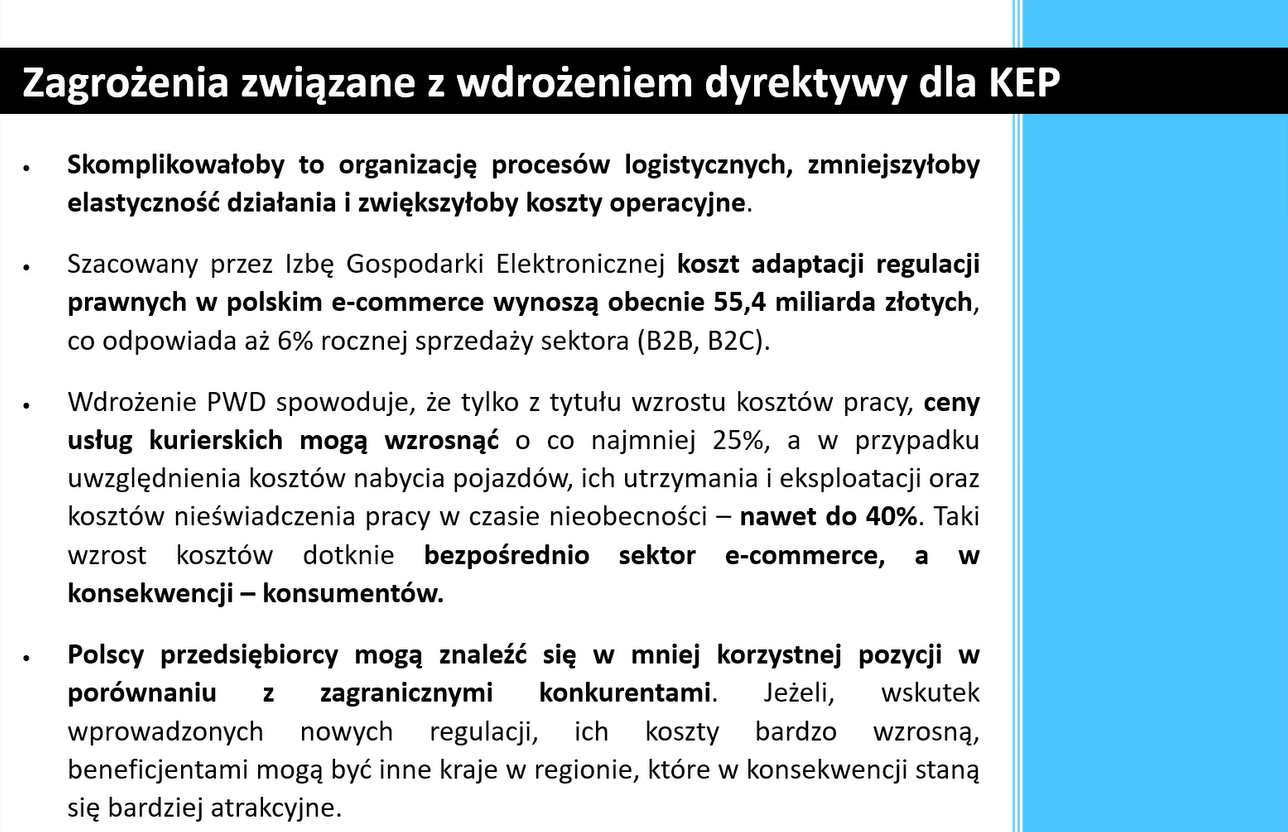
The report shows that due to the increase in labor costs alone, the prices of courier services could increase by at least 25%, and if the costs of vehicle acquisition, maintenance, and operation, as well as the costs of non-performance of work during absences are included – even up to 40%. Such an increase in costs will directly affect the e-commerce sector, and consequently – consumers.
Consequences for the economy
The CEP industry in Poland handles approximately 1.5 billion shipments annually, of which 1.2 billion come from online purchases. It generates revenues of 22 billion PLN and directly provides jobs for over 70,000 people. It plays a very important role in the economy, supporting trade, especially e-commerce sellers, as well as distribution and production companies. Its importance lies in ensuring the continuity of the supply chain and serving hundreds of thousands of customers – both at the local, national, and international levels. Introducing regulations inadequate to the specifics of this industry may shake its stability and, consequently, negatively affect this very important sector of the economy.
In 2024 alone, the cost of adapting to legal regulations in the entire Polish e-commerce sector, estimated by the Chamber of Electronic Economy, amounted to over 55 billion PLN. This is equivalent to about 6% of the total annual sales value (B2B and B2C) in this sector. Further large burdens could weaken the competitive position of Polish companies on the European market and constitute an additional blow to many small and medium-sized enterprises, which are the backbone of the Polish economy.
– warns Arkadiusz Kawa.
Additionally, according to the report, imposing an obligation to hire drivers could have the opposite effect to the intended one and discourage many of them from further cooperation. The availability of courier services, especially during periods of increased demand, such as the so-called pre-Christmas peaks, could therefore be severely limited.
Call for legislative common sense
The so-called Platform Work Directive should be implemented in a manner consistent with its original intent and actual scope. The report contains specific recommendations, including: limiting the application of the directive solely to entities functioning as digital labor platforms; taking into account existing national and EU laws that regulate the activities of the CEP industry; and excluding CEP operators and carriers cooperating with them from the regulations.
We naturally want new regulations to be effective, adequate, and to take into account the specifics of the CEP industry. However, there is no justification for the solutions provided for in the Directive to be transferred to the CEP industry under national law. Primarily because the activities carried out by postal operators, carriers, and freight forwarders differ fundamentally from the activities of digital labor platforms and are already comprehensively regulated, both under international, European, and national law.
– concludes Wojciech Arszewski.
The full and abridged versions of the report are available at the link.
Source: Express Carriers Forum