












Polish fleet companies are systematically investing in new vehicles, keeping their average age below 5 years. In the case of passenger fleets, 74.7% of companies declare owning cars younger than five years, for light commercial vehicles it is 68.9%, and for trucks 73.2%. These data are presented in the latest DKV Mobility report regarding business challenges for transport fleets in Poland.
Road transport is a key sector of the economy, accounting for as much as 6-8% of GDP. To better understand the needs of our customers, we conducted a study of the fleet market. Its results allow for an assessment of the situation and the formulation of recommendations for the future.
– says Anna Biekionis, Country Manager at DKV Mobility Poland.
New vehicles instead of older models
Fleets in Poland are being regularly rejuvenated. More than 46% of companies have not changed the age of their fleet over the last five years, 18.8% have rejuvenated it, and 22.5% indicated a gradual aging of vehicles.
Fleet companies prefer purchasing new cars. In the passenger segment, 66.55% of enterprises choose brand-new models, among light commercial vehicles 52.83%, and among trucks 50.72%. Key factors include tax optimization, environmental standards, and operating costs.
Passenger fleets are renewing the fastest, which results from both tax benefits and the companies’ drive to minimize the maintenance costs of older vehicles.
– emphasizes Michał Wadowski, Sales Fleet Manager at DKV Mobility.
Operating costs and personnel challenges in transport
Companies are facing rising costs of fuel, service, and fleet financing. This is the main problem for 17.2% of passenger fleets and 17.9% of transport fleets. Additionally, difficulties in recruiting drivers are limiting company growth. According to Transport Logistyka Polska, the national economy is struggling with a deficit of 200,000 drivers, which increases operating costs.
Electromobility – the industry’s cautious approach
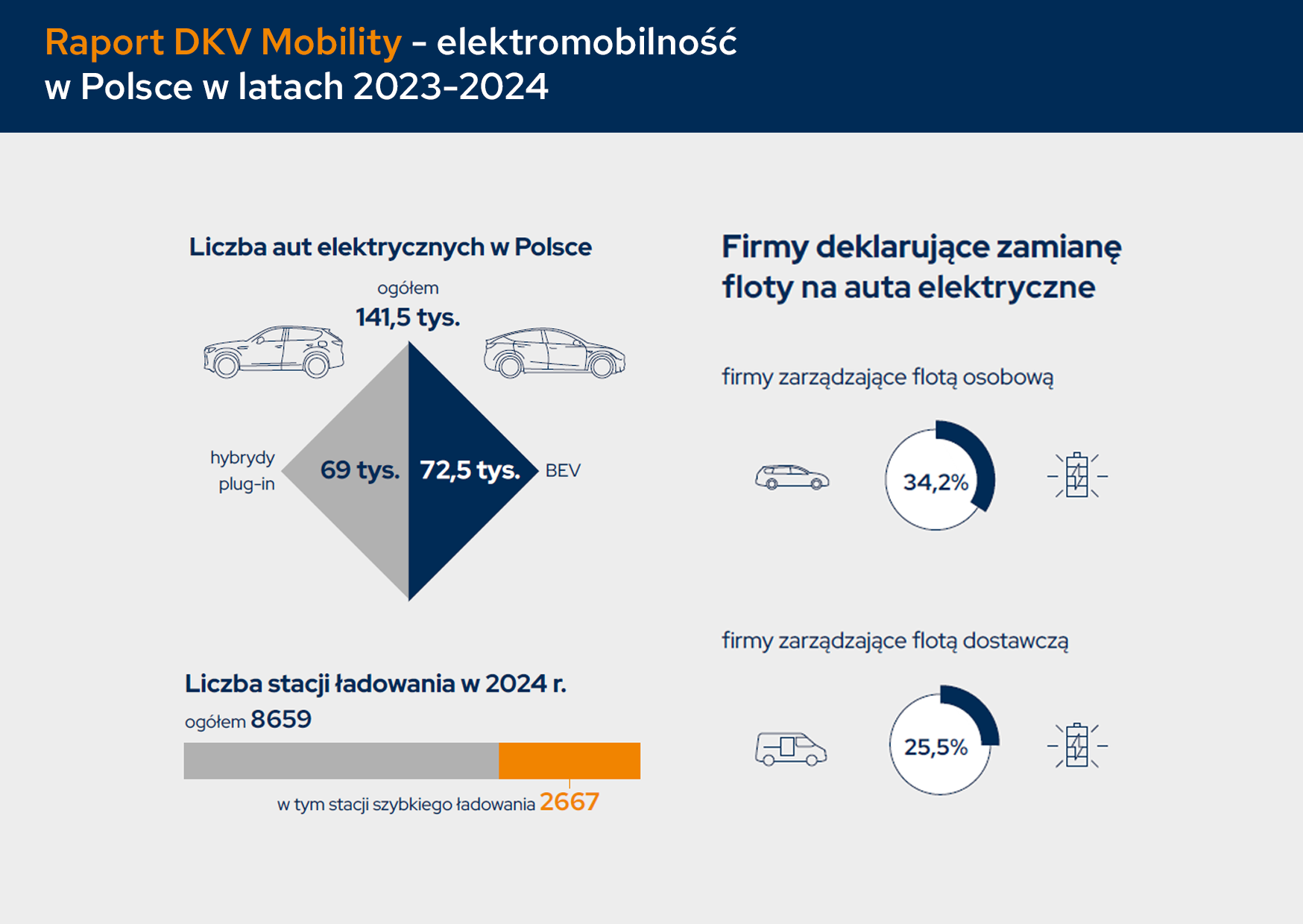
Despite the increase in the number of electric vehicles, most fleets remain with traditional powertrains. Among passenger fleet managers, 34.2% declare readiness for EVs, and 25.5% in commercial vehicles. In heavy transport, 53.6% of companies are not planning to change their powertrain, and 16% are considering hydrogen.
The transport industry is cautious about alternative powertrains. Investments in infrastructure and subsidies for EVs will be crucial for the future.
– points out Jerzy Jezuit, Area Sales Manager at DKV Mobility.
Road infrastructure in Poland – progress and challenges
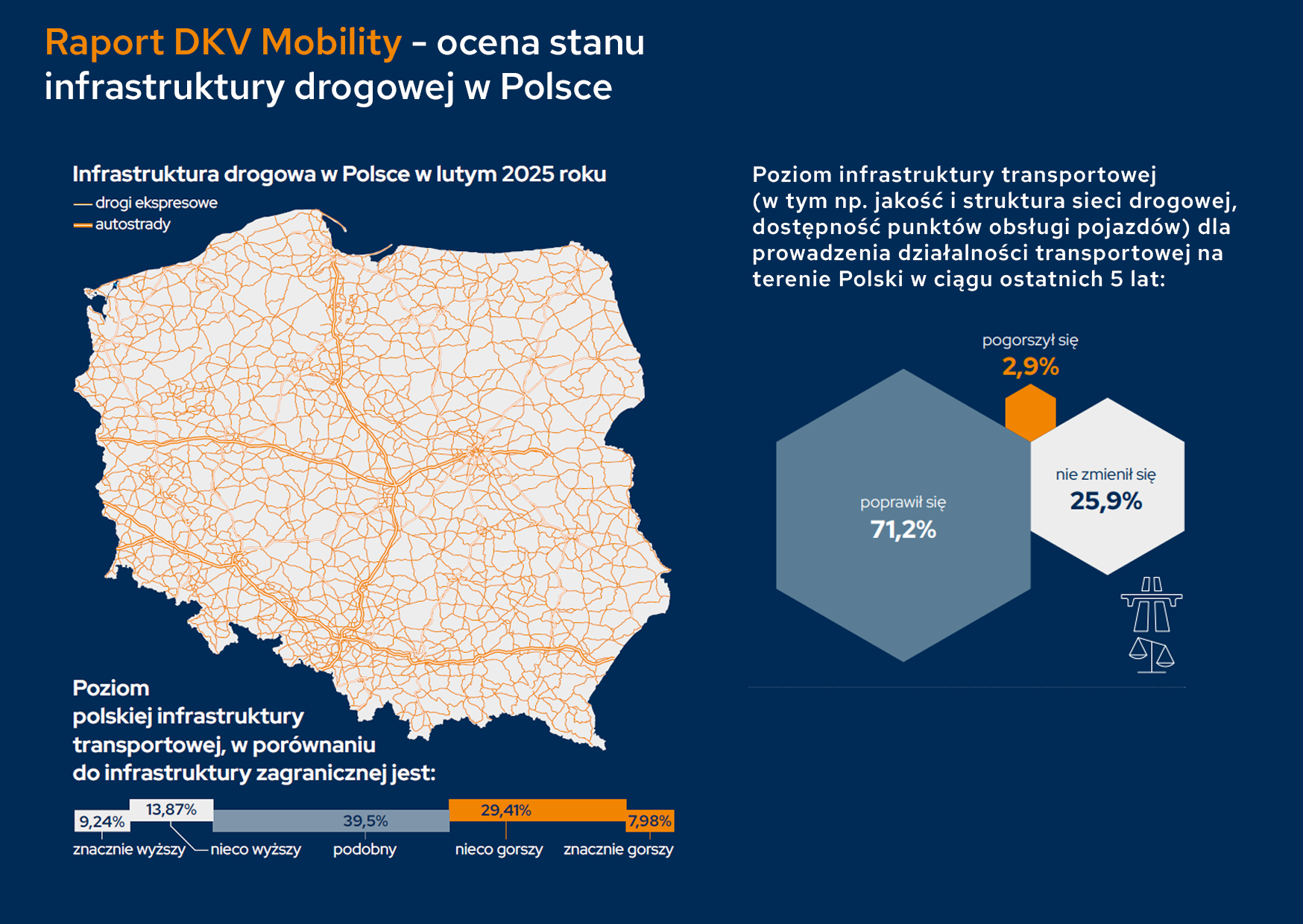
Fleet managers notice an improvement in the quality of road infrastructure, although 50% point to regional differences, and 14% rate them as significant. For heavy transport, Western Europe still offers better conditions – 43.76% of respondents believe so.
Among passenger fleets, 47.73% rate Polish infrastructure as comparable to European standards, 23.6% point to its advantage, and 30% consider it worse.
Polish road infrastructure is developing, but investments in the charging network and solutions supporting alternative powertrains remain key.
– concludes Anna Biekionis.
DKV Mobility study
The DKV Mobility report was developed based on a study conducted in November and December 2025 on a sample of 500 representatives of fleet companies operating in Poland.
Source: DKV Mobility