











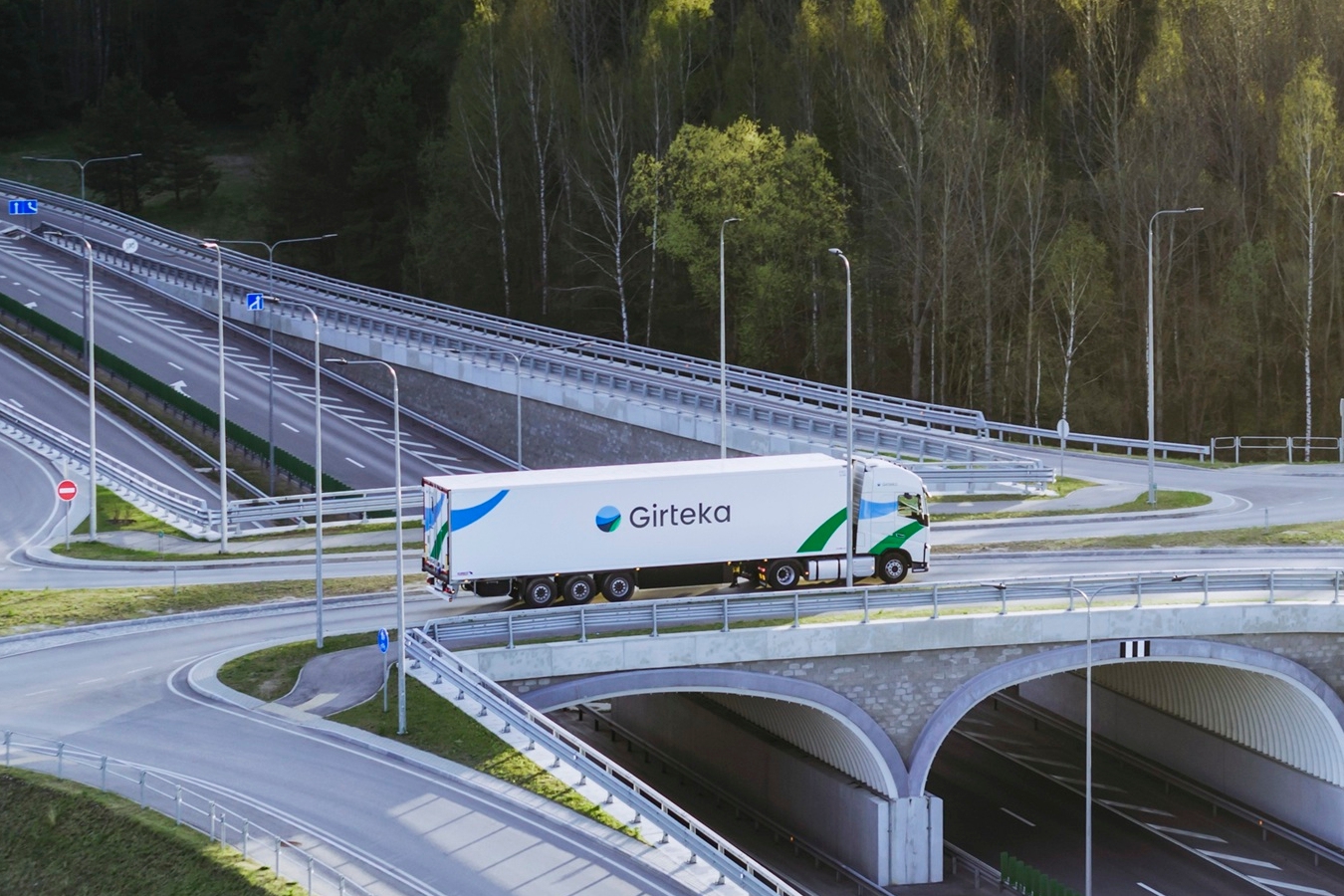
Preparing transport solutions that support sustainability in pharmaceutical logistics requires a skillful combination of environmental goals with the rigorous requirements of supply chain organizations. This was the foundation of a project carried out jointly by Girteka, Europe’s largest road carrier, and a German pharmaceutical company, in cooperation with Mercedes-Benz. As part of the partnership, the companies tested whether and how an electric truck could be used to design a sustainable supply chain. Now, they are sharing their conclusions.
The main goal set by the companies was to design a delivery and cargo collection route in domestic transport with minimal environmental impact. The implementation was based on detailed analysis, route optimization, simulations, and practical tests of an electric truck (BEV).
– This project allowed for a comprehensive check and examination of how the use of electric vehicles (BEVs) can be integrated into pharmaceutical logistics – explains Andrius Žukauskas, Head of e-Mobility at Girteka.
Analysis, optimization, and validation
The project involved Full Truck Load (FTL) transport tests using an electric truck (BEV) on a 300 km roundtrip route. The goal was to assess the potential reduction in CO2 emissions compared to traditional diesel trucks. The first stage involved conducting detailed analyses and simulations. Their results already confirmed the possibility of a 25% emission reduction, even when using electricity from the local grid.
- CO₂ emissions using a diesel truck: 408.3 kg per working day
- CO₂ emissions using a BEV (energy from the local grid): 300.7 kg per working day
- CO₂ emissions using a BEV (renewable energy): 0 kg per working day
Innovations in response to challenges
During the planning stage for implementing electric vehicles into operations, many challenges arose, particularly in the context of charging capabilities.
– The client’s facilities had limited grid capacity, so direct charging at both the departure and destination points was unfeasible. Together with the client, we analyzed several options, including the possibility of using publicly available stations near the depot, where charging would require disconnecting the trailers. Based on knowledge and detailed analysis, we prepared an optimized solution that allowed us to avoid such disruptions, maintain delivery schedule punctuality, and improve overall efficiency – explains Andrius Žukauskas.
This challenge alone showed the significant role played by partnerships with key stakeholders. In cooperation with one of the largest car manufacturers, Mercedes-Benz, Girteka prepared a solution tailored to the specific requirements of this route. The Mercedes-Benz eActros 600 with a 621 kWh battery was considered the best vehicle to test how theory would translate into practice.
The tests conducted allowed for further improvements. The choice of this BEV truck model optimized route planning, eliminating the need to charge and disconnect trailers during the journey. In turn, the use of solar-powered charging infrastructure further increased efficiency, allowing for a total reduction in emissions.
Over five days, the Mercedes-Benz BEV was subjected to rigorous tests on a 300-kilometer route. The key conclusions are:
- Fewer stops: utilizing mid-route charging capabilities eliminated the need to disconnect the trailer at a charging station near the warehouse.
- Greater operational efficiency: process optimization allowed for significant time savings, eliminating additional stops and increasing efficiency during driving and loading.
- Energy efficiency: the tested vehicle achieved a range of up to 550 km on a single charge, which exceeded initial assumptions, with lower energy consumption than expected.
- Environmental impact: the use of public solar-powered charging stations allowed for a total reduction in CO₂ emissions, which confirmed the viability of BEVs in pharmaceutical logistics in line with environmental goals.
Summary
The project carried out by Girteka and its client shows how crucial a co-creation and innovation-based approach is when developing sustainable solutions for pharmaceutical logistics. Only by combining the unique knowledge of all stakeholders, including manufacturers, carriers, clients, and suppliers, is it possible to design solutions that comply with the rigorous requirements of the pharmaceutical industry and environmental goals.
Girteka, as a carrier, played a key role here in adapting basic operational requirements, such as delivery punctuality and maintaining appropriate cargo transport conditions, to environmental goals.
Logistics solutions must also be economically justified for all parties involved. The project confirmed that integrating BEVs into logistics networks provides environmental benefits while maintaining cost-effectiveness, reliability, and high service quality. At the same time, this model of cooperation can be a blueprint for future partnerships that combine profitability, operational excellence, and environmental responsibility.
Source: Girteka Group