











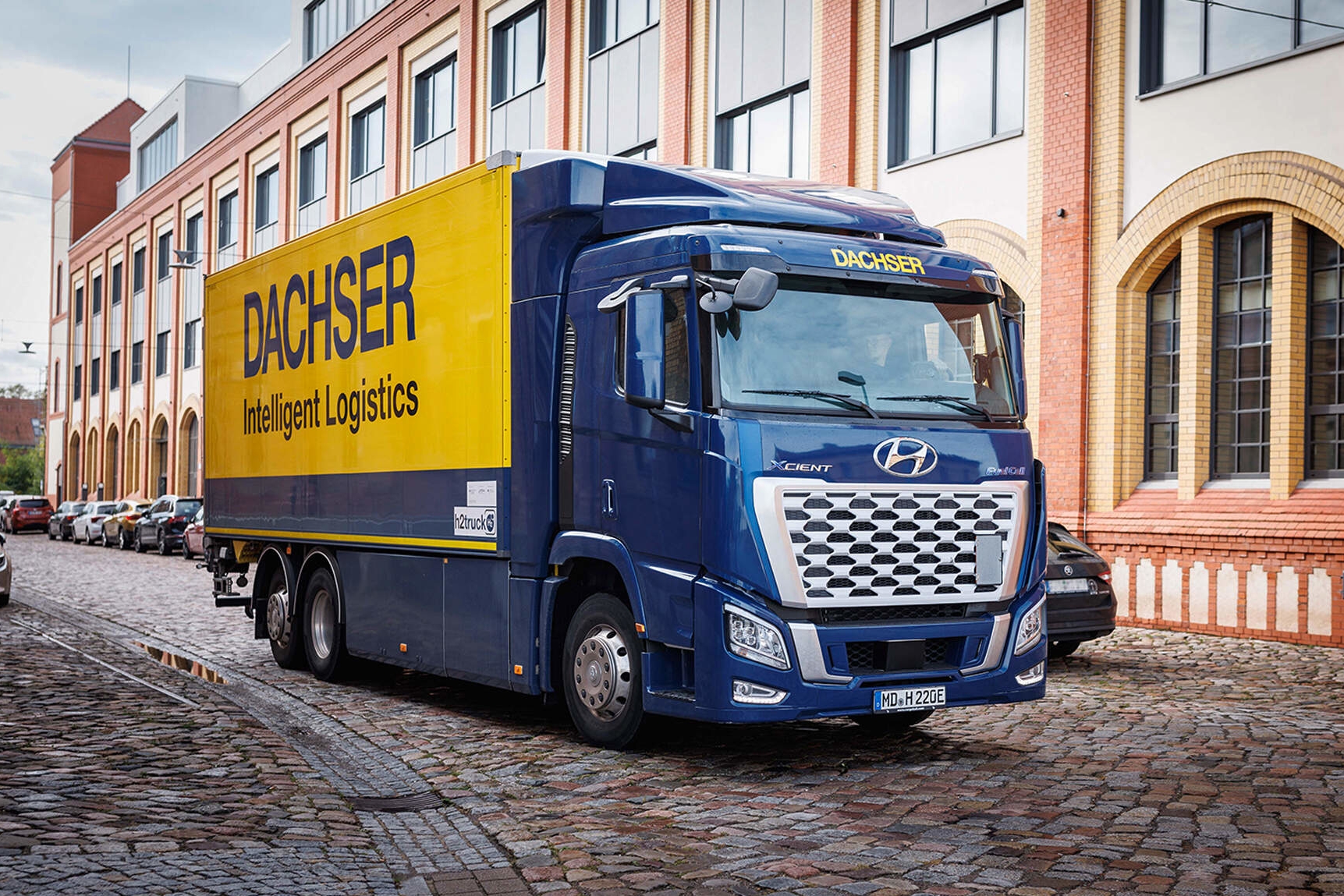
For over a year and a half, DACHSER has been using a hydrogen-powered truck at its Magdeburg branch. With zero local emissions, this vehicle proves its utility daily in short- and long-haul transport on a two-shift basis.
Daily operations at the DACHSER logistics facility in Magdeburg require precise maneuvers. At gate 11, where space is limited, Stefan Heinze, one of the drivers, routinely performs complex reversing maneuvers. However, his truck, a Hyundai XCIENT Fuel Cell, stands out due to its almost silent operation. When reversing, only a warning signal is audible, which contrasts with traditional, noisy diesel engines.
This 27-ton truck looks like a standard DACHSER vehicle with a dark blue cab and a yellow-blue box trailer. However, the “h2truck” sticker and the logos of technology partners indicate its revolutionary technology. The letter “H” in the name stands for hydrogen, referencing the Greek word for “water-former.”
Eco-friendly technology
The Hyundai XCIENT Fuel Cell is the first mass-produced heavy-duty vehicle with a hydrogen powertrain. During the day, the truck covers over 180 kilometers in local distribution, and at night, with a food transport trailer, it forms a 42-meter combination, covering 290 kilometers between Magdeburg and Berlin-Schönefeld.
“Big Guy,” as the drivers affectionately call it, is an electric vehicle powered by two fuel cells. Through the chemical reaction of hydrogen with oxygen, electrical energy is generated to power the 350 kW (approx. 480 hp) motor.
– We see potential in hydrogen technology, which is why we want to support its development and test it in everyday logistics – emphasizes Alexander Tonn, Chief Operating Officer (COO) Road Logistics at DACHSER. Since 2018, the company has been implementing a climate protection strategy, investing in vehicles with alternative drives, including battery-electric ones used in the DACHSER Emission Free Delivery program for urban areas.
Practical applications and challenges
A breakthrough moment was the opening of a public hydrogen refueling station near the logistics center in Magdeburg, which enabled the start of field tests. Cooperation with H2 Green Power & Logistics GmbH and H2 Delivery Truck Pool GmbH & Co KG allowed the program to launch on May 2, 2023.
– Driving a hydrogen truck requires a slightly different approach – says Stefan Heinze. – You have to accelerate gently to avoid slipping and plan refueling, taking into account station locations and the type of hydrogen available (350 or 700 bar). Hydrogen cannot be carried in canisters, so an empty tank is a big problem – Refueling takes about 20 minutes and requires filling seven pressure tanks holding 31 kg of hydrogen.
Currently, there are 265 hydrogen refueling stations in Europe, 40% of which also serve trucks. Infrastructure development remains a key challenge for the wider adoption of this technology.
Acceptance and prospects
The field test is also a test of technology acceptance by drivers and customers. Heinze often answers questions about the hydrogen truck: “Driving is more comfortable and quiet, and emissions are reduced to zero – it is an ideal solution for urban low-emission zones.” Customers, such as an organic juice producer, appreciate the eco-friendly technology, requesting transports exclusively using this vehicle.
Source: Dachser