








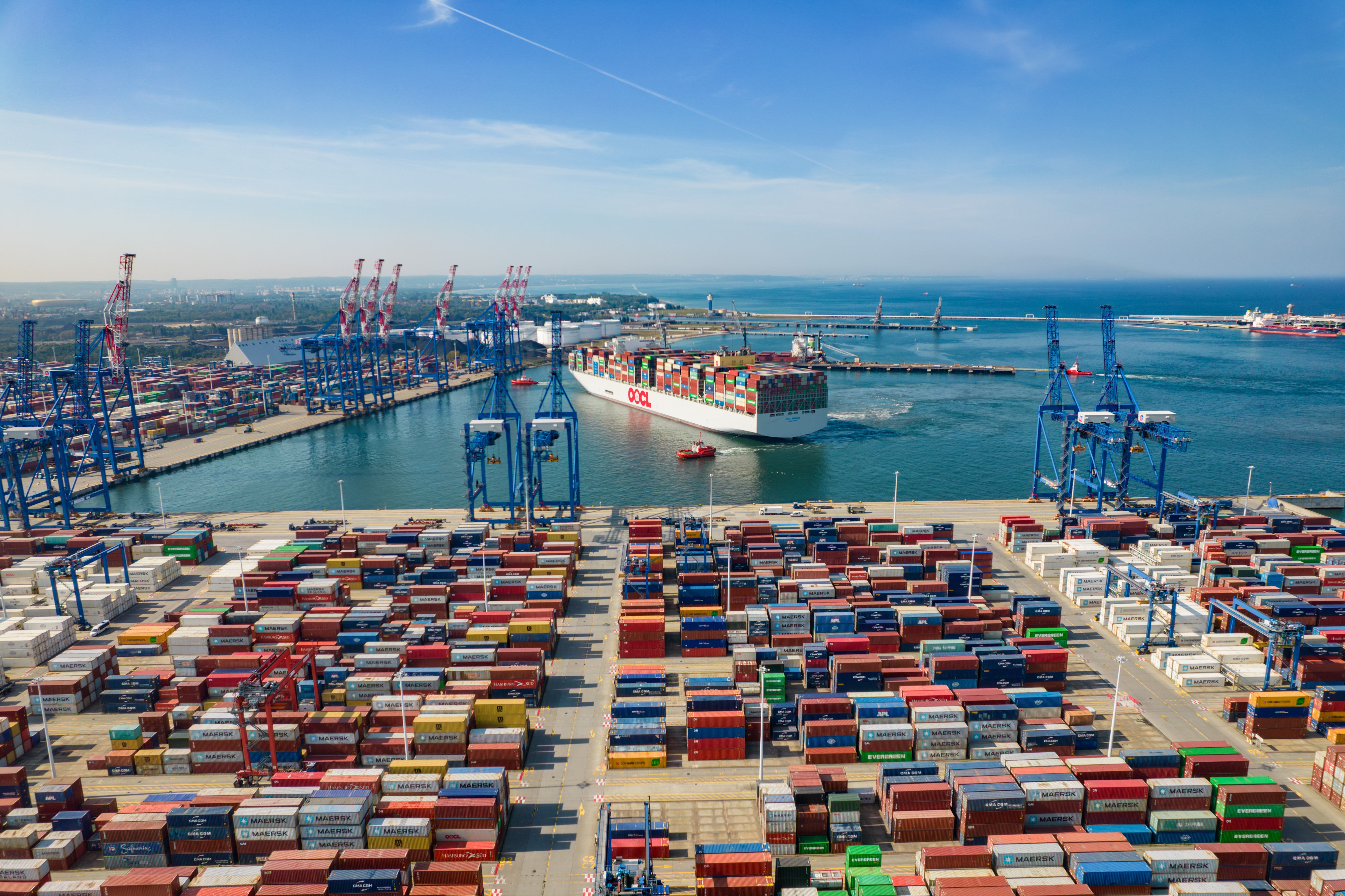
Record-breaking transshipments, new investments, and consistent implementation of development plans. Baltic Hub summarizes 2024. The largest container terminal on the Baltic Sea is focusing on further infrastructure development and responding to the current challenges of the logistics industry.
For Baltic Hub, 2024 was an intensive year due to the level of advancement of construction works at the T3 terminal and other concurrent projects. The Baltic Hub container terminal operating in the Port of Gdańsk recorded record transshipments in 2024.
The terminal’s operational result for 2024 exceeded the previous year’s and amounted to 2,242,401 TEU (Twenty-foot Equivalent Unit is a standard unit of measurement in maritime transport and logistics, corresponding to the volume of one 20-foot container, used to determine the capacity of container terminals and ships). In 2024, Baltic Hub handled 642 vessels, including 147 ocean-going vessels, and a record number of transshipments during a single vessel call was recorded in July, amounting to as many as 20,459 TEU.
T3 investment milestones
On June 5, 2024, a cornerstone laying ceremony for the construction of the third terminal, T3, took place at Baltic Hub. This was an important moment not only for commemorating the investment but also for the maritime economy of Poland and the Baltic region, which is why the ceremony was attended not only by members of the management board and supervisory board of Baltic Hub, shareholder representatives, key stakeholders, customers, and contractors, but also by representatives of local and state authorities. The new quay and storage yards at the T3 terminal will strengthen the position of Baltic Hub, increasing handling capacity to 4.5 million TEU per year.
The new T3 terminal will be semi-automated, meaning that operators will be able to remotely control equipment from ergonomically designed stations, which will ensure a safe, efficient, and modern working environment throughout the year.
In October 2024, four modern STS cranes arrived at the quay of the new T3 terminal. The cranes will enter service in the first half of 2025. Each machine weighs 2,000 tons, is 96 meters high (140 m with the boom), and has a lifting capacity of up to 65 tons. The newly built T3 terminal will be equipped with a total of 7 state-of-the-art STS cranes and 20 aRMG cranes. Further STS cranes are already on their way to Gdańsk, and the expected delivery date of the cranes to Baltic Hub is the end of February 2025.
– The construction of the T3 terminal is an important stage in the development of Baltic Hub and an example of how Polish port infrastructure responds to the challenges of modern logistics. By investing in modern technologies and ecological solutions, we are creating space for the further development of both our company and the entire transport sector in Poland and among our partners in the Czech Republic, Slovakia, and Hungary – summarizes Charles Baker, CEO of Baltic Hub.
Fourth RMG crane at the railway siding
In July 2024, a fourth RMG crane was launched at the terminal’s railway siding. The crane is equipped with an OCR system, anti-collision system, and cameras supporting the operators. Innovative solutions have improved safety, efficiency, and work precision. The installation of the crane increased the capacity of the railway siding to over 800,000 TEU per year. This is a response to the growing demand for rail connections with Central and Eastern European markets.
Future plans
Baltic Hub remains a leader in providing innovative, sustainable solutions. For 2025, the completion of the T3 deep-water quay and its full integration into transshipment operations is planned. The T3 investment and its complementary projects are a response to market demand. Thanks to the new 36-hectare container yard and 717 meters of deep-water quay, which together add another 1.5 million TEU of handling capacity, Baltic Hub is ready for future growth. The company will also focus on improving energy efficiency, promoting sustainable development, and continuing efforts for social responsibility.
Source: Baltic Hub