











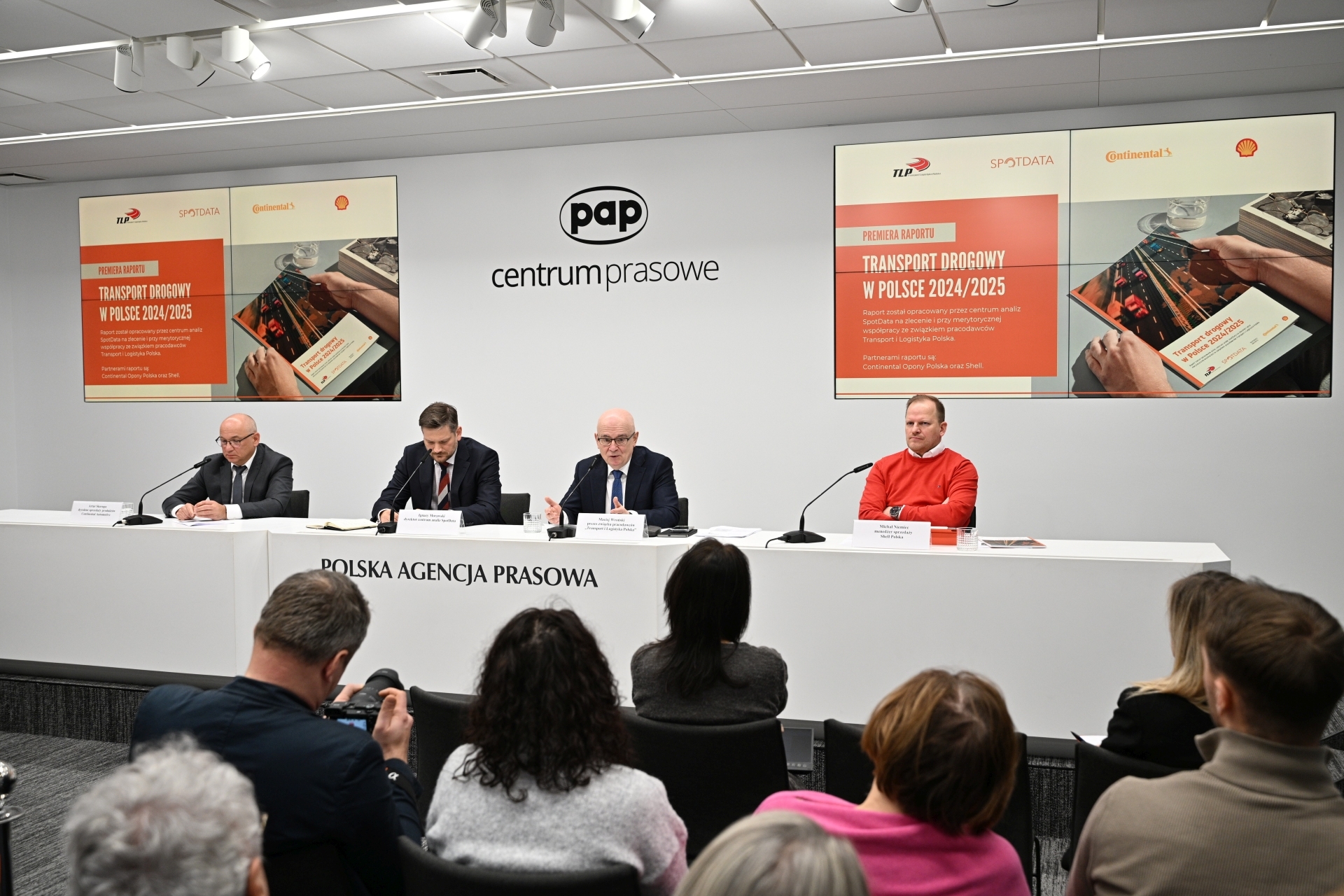
Since mid-2023, road transport has been experiencing a severe slowdown. More than half of the companies surveyed by TLP and Spotdata report a decline in revenue, and short-term forecasts are not optimistic. Paradoxically, however, many positive structural changes are visible in the industry – companies are counting on a return to growth and business profitability in the long term. Therefore, they are adapting to new conditions, increasing efficiency, investing in new technologies, and focusing on digitalization. These are the most important conclusions from the report “Road Transport in Poland 2024/2025” prepared by the “Transport and Logistics Poland” (TLP) employers’ association and the Spotdata analysis center, in cooperation with Continental Opony Polska and Shell Polska.
– In the opinion of Polish carriers, this is the most serious market crisis in over 20 years. A crisis that has forced many companies to reduce their fleets and employment, and in extreme cases, led to restructuring, liquidation, or bankruptcy – says Maciej Wroński, President of TLP. Data shows that many companies are facing serious financial difficulties. The share of road transport in bankruptcy and restructuring proceedings across the entire economy has increased from 5 percent in 2021 to as much as 13 percent in 2024.
Data from the Chief Inspectorate of Road Transport shows that in 2024, for the first time, the number of companies holding a community license for international transport decreased. Another indicator illustrating the recession in the industry is the first decline in the number of driver certificates issued to employees from Ukraine, Belarus, and Moldova.
This serious crisis is affecting an industry that has been one of the fastest-growing sectors of the Polish economy over the last decade. In 2004, when Poland joined the EU, our companies carried out 5 percent of European transport work. Today, they perform 20 percent and have overtaken Germany as the leader in transport work in Europe. Although a stabilization trend is slowly beginning to emerge from the data – as if 20 percent were a ceiling that is difficult to break through. Whether expansion can continue will largely depend on how companies and regulations adapt to growing structural challenges.
Digital changes in the industry
– As a provider of digital solutions for the transport industry, we are noticing intense changes in the sector of Polish road carriers. Faced with the biggest market crisis in over two decades, these companies must flexibly adapt to dynamically changing business conditions. Although short-term forecasts are not very optimistic, Polish carriers, as leaders of the European market, are investing heavily in digital technologies and looking for new, more efficient operating models. This is a response to growing cost pressure and changing legal regulations. These actions are aimed at maintaining their competitiveness and creating the foundations for further growth and improved profitability in the long term – says Artur Skorupa, Sales Director of Continental Automotive (CSV).
Despite the severe downturn, it is not only weak demand that is a challenge facing transport companies over the next five years. The TLP and Spotdata survey shows that labor costs, unfair competition, and high prices of fuel and other energy carriers are also among the biggest challenges. All are significantly related to regulations, both national and European. The Polish transport industry is gradually facing the general challenge that low costs are no longer the greatest competitive advantage allowing for an increase in market share in Europe. This is a derivative of many irreversible processes, including economic development and demographic changes.
– The continuous changes in law have a negative impact on the operating conditions of the transport industry. The implementation of subsequent pro-social solutions is certainly expected by employees, and the pursuit of regulating every aspect of transport operations meets the demands of weaker market participants expecting protectionism from the authorities – states President Wroński. – Nevertheless, politicians and public authorities should understand that the pace of change is too fast and excessive regulation can permanently lower our competitiveness, significantly increasing the costs of doing business.
Paths to decarbonization
Another broad challenge is the need for rapid decarbonization. Here, a growing gap is visible between the plans of the European Union and the capabilities of the industry. New EU regulations force the rapid introduction of zero-emission vehicles, while very few companies see the possibility of developing such a fleet. The TLP and Spotdata survey shows that only 10 percent of companies are considering developing a fleet of electric vehicles in the coming five years. The biggest challenge is the unprofitability of this type of vehicle and the low state of infrastructure development. – Decarbonization is an important factor affecting the transport industry. There is no single path that would allow achieving ambitious European goals. Electrification is an excellent solution for last-mile transport and distribution, but its effective application in long-haul transport remains a challenge. Currently, a real alternative for road transport is LNG, which until recently was supported by the German government. The next step is BioLNG, which enables a significant reduction in CO2 emissions in road transport – says Michał Niemiec, Sales Manager at Shell Polska.
The road transport market is in a cyclical recession, but it is absolutely not in stagnation or lethargy. Intense structural changes are taking place, companies are adapting to new conditions, increasing efficiency, investing in new technologies, and preparing for the fact that in the long term, growth and business profitability will return. 70 percent of companies plan to develop their fleet in the next five years, 54 percent anticipate the digitalization of processes, and 28 percent intend to develop new logistics services.
The TLP and Spotdata survey shows that the three trends with the highest projected dynamics are market consolidation, efforts to adapt a larger number of migrants, and the development of high value-added services. It is therefore clear that cost pressure is forcing companies to look for new ways of competing. – The report shows that Polish transport has very strong assets that will allow us not only to survive difficult times but also to return to the path of further development. Although we may have to adapt our Polish transport companies to completely different operating conditions – says Maciej Wroński.
The full text of the report “Road Transport in Poland 2023/2025” is available at the link.
Source: “Transport and Logistics Poland” Employers’ Association