











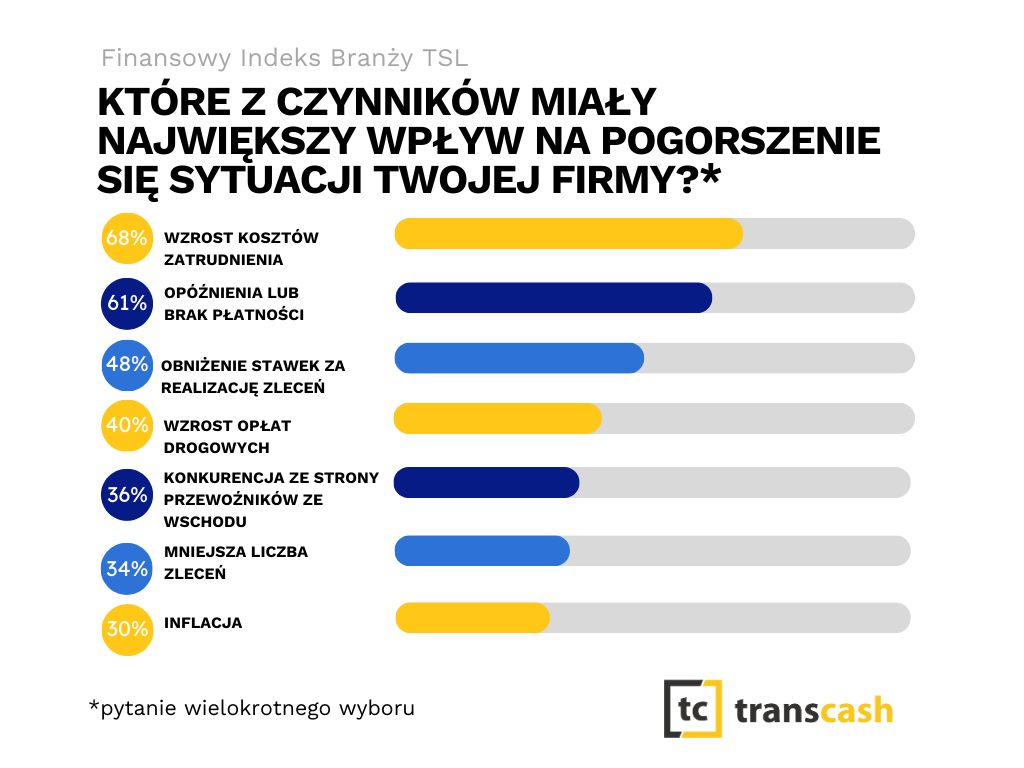
Almost 40% of TSL industry representatives surveyed by Transcash admitted that their company’s situation has worsened over the last six months. The primary reason for this state of affairs was the increase in employment costs, which was pointed out by nearly 70% of respondents. Another cause for the poor condition of TSL companies is payment delays from contractors.
The aforementioned conclusions were included in the TSL Industry Financial Index, the first edition of a cyclical study on the financial condition of companies conducted by Transcash.eu, a provider of financial services for the transport industry.
– As part of it, we asked representatives of the transport industry to assess the financial condition of their companies, including the factors that influence it the most, their attitude towards payment terms, or external financing. The results of the Index allow us to draw conclusions about the current situation of the industry and also serve as a barometer of its sentiment and the most pressing issues affecting the situation of the transport sector in Poland – explains Agnieszka Nosal, Marketing&Sales Area Leader at Transcash.eu.
Stable, but with concerns
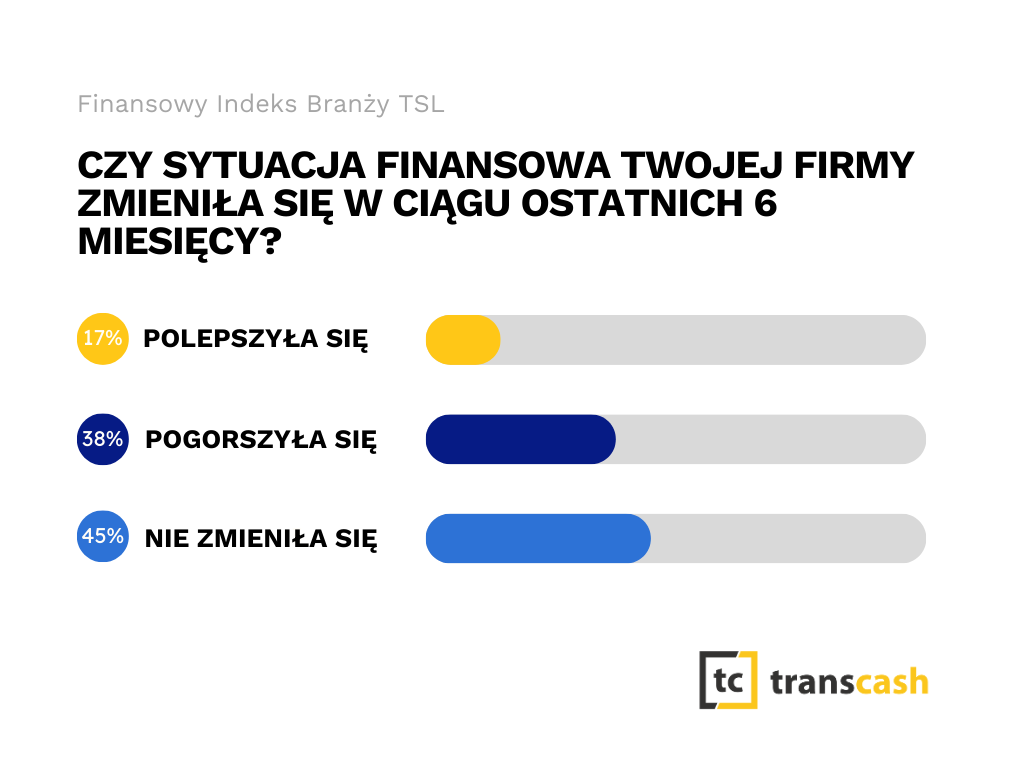
The study showed that the current situation of TSL companies is relatively stable. 45% of our respondents admitted that the condition of their companies had not changed in the 6 months preceding the study, but only 17% experienced an improvement in this regard. The others, i.e., 38%, declared a deterioration in the situation of their companies.
Record wage costs
Among the most pressing problems of the industry, the increase in employment costs comes to the fore. It was indicated by 68 percent of respondents who declared a deterioration in their company’s situation.
– In 2024, employment costs were driven by significant increases in the minimum wage, which reached 4,300 PLN gross. According to the government’s decision, in 2025 the minimum wage is to increase to 4,666 PLN gross. The second category of employment costs is specific to the TSL industry and concerns the necessity of equalizing the wage rate with that applicable in the country where the transport is performed. This is an obligation in the case of cross-trade and cabotage transport covered by posting regulations – says Agnieszka Nosal from Transcash.eu.
Foreign rates are definitely higher than in Poland and are subject to frequent changes due to inflation. Many issues influence their level, and a certain picture of the differences in this regard is provided by a comparison of minimum hourly rates in individual countries. In Poland, it is currently 30.5 PLN gross, while in Germany and Austria it is about 12.8 euros, and in the Netherlands – 13.3 euros. At this level, we are therefore talking about rates that are about 40% higher. Driver wage costs are also driven up by higher rates for weekend and night work.
Permanent orders and fast payment – this is what the TSL industry wants
The pressure of rising operating costs affects priorities regarding expenses. TSL companies primarily settle their obligations to financial and state institutions in order to maintain the ability to operate and continue earning.
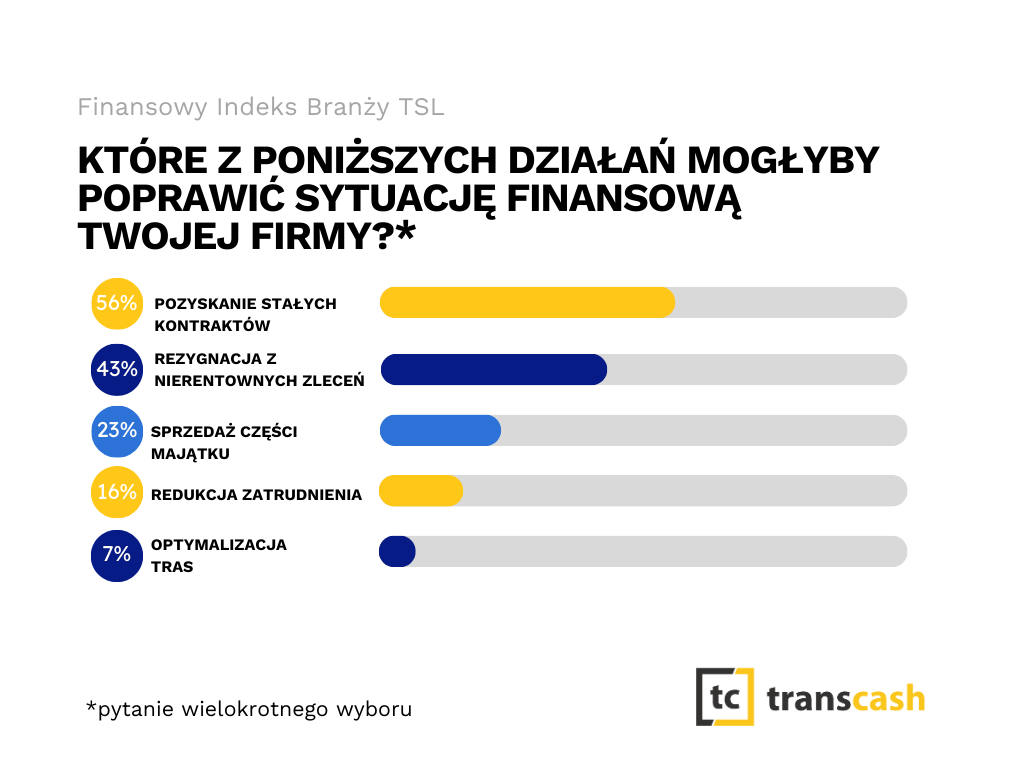
The lack of stability delays the improvement of the situation over time – a major problem is still the lack of permanent contracts and the dominance of spot orders. Among other factors that could realistically improve the industry’s situation, alongside permanent orders, is primarily a real shortening of payment terms.
With distance towards financing
High costs discourage entrepreneurs from using external financing. Those who do so mainly reach for quickly available products, such as factoring. 54% of our respondents declared using external financing, and the most frequently chosen ones include factoring, working capital loans, and leasing. Discount financing and standard loans are the least popular among the study participants.
Agnieszka Nosal notes that the reluctance towards bank financing is related to the policy of these institutions:
– In recent years, banks have tightened credit granting criteria almost every quarter, which are still the dominant source of funds for companies. The situation changed in the second quarter of 2024, when the first easing of credit criteria for large companies since 2017 occurred. In the third quarter of this year, it also covered the SME sector, and according to bank announcements, the easing trend should continue until the end of the year. This fact may translate into greater popularity of long-term liabilities in the coming months.
The Transcash.eu report “TSL Industry Financial Index” will be published in December 2024 and will include both aggregate data on the financial condition of transport companies and an assessment of the situation of carriers and forwarders, taking into account the specifics of their operations.
Source: Transcash