












According to the findings of the latest “Prologis’ 2025 Supply Chain Outlook Report,” conducted by the research firm The Harris Poll, businesses are preparing for a “polycrisis.” This term refers to the overlapping of a series of challenges, such as an unstable economic and political situation, high demand volatility, and climate change. A survey conducted among more than 1,000 senior executives in the USA, the UK, and Germany confirms that companies must be flexible and resilient to meet the challenges of the global market.
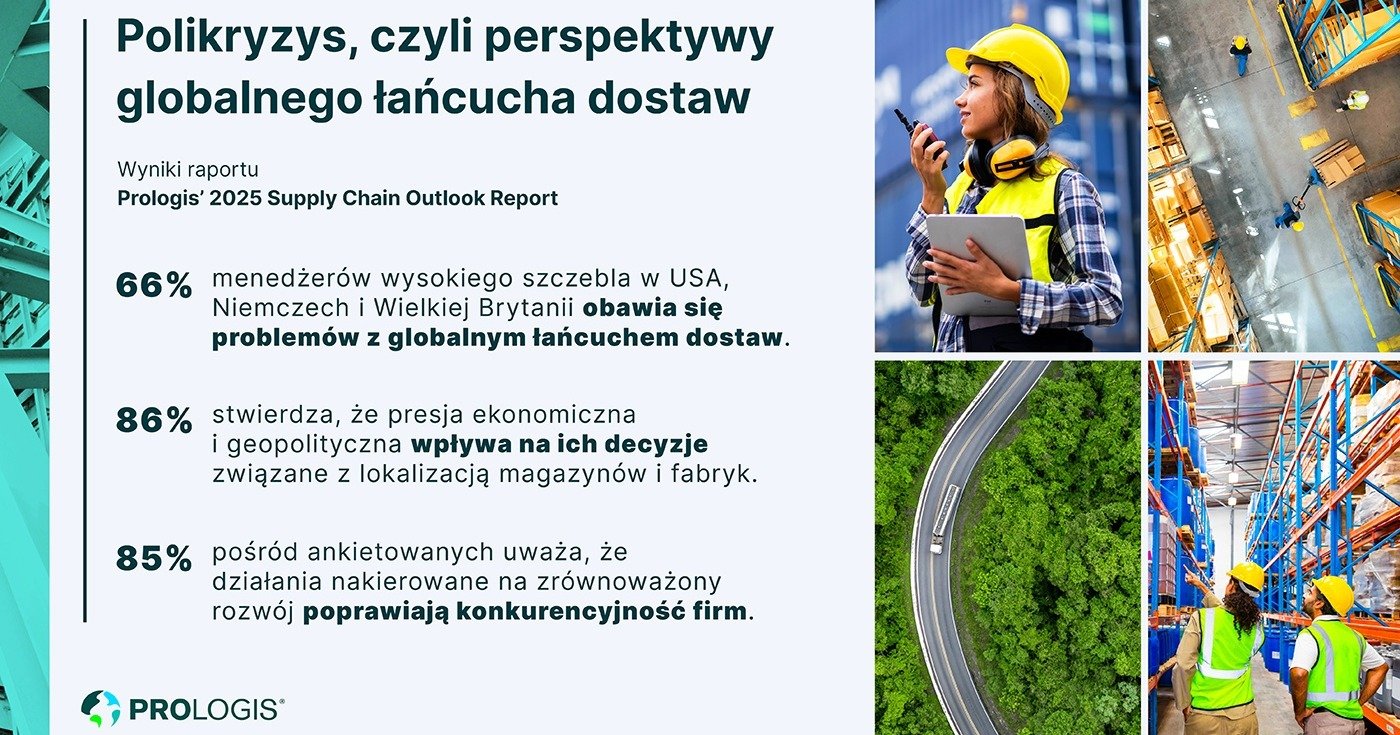
Two-thirds of senior managers in the USA, Germany, and the UK are concerned about global supply chain issues, and 86% state that economic and geopolitical pressures are influencing their decisions regarding the location of warehouses and factories, according to the report prepared for Prologis, a global leader in logistics real estate.
85% of those surveyed believe that sustainability-focused actions improve company competitiveness. Senior managers see enormous potential in robotics and AI.
87% of respondents stated that automation contributes to improving working conditions and reduces the risk of professional burnout.
Growing pressure on supply chains
The post-pandemic, uncertain situation is putting the entire logistics industry to the test. In the “Prologis’ 2025 Supply Chain Outlook Report,” two-thirds of managers (66%) indicated that they are worried about the prospect of supply chain problems. As many as 86% of respondents state that economic and geopolitical pressure influences their decisions regarding the location of production plants and warehouses. Moreover, 70% of those surveyed admit that it is currently difficult to choose the right location for supply chain investment to maximize company profits and limit risks.
Sustainability and shaping the future
One way to adapt business to changing conditions is to invest in sustainability. Companies that invest in environmentally and climate-friendly solutions not only improve their image but also increase their own competitiveness. The report prepared for Prologis indicates that 85% of managers see sustainability as an opportunity to achieve a market advantage, and 79% claim that the pace at which we are transitioning to alternative energy sources seems too slow to them – it needs to be accelerated within the next 24 months. It is worth noting that almost all respondents are keen for their organization to achieve its long-term sustainability goals.
– Companies are increasingly focusing on supply chain sustainability to strengthen brand reputation, achieve ESG goals, and meet the expectations of consumers and business partners. Growing environmental awareness among stakeholders and EU and national regulations impose obligations on businesses in this regard. We are hearing more and more inquiries from clients about energy-efficient warehouses. As Prologis, we decided several years ago that all our new facilities in Poland would meet the requirements of the BREEAM Excellent certificate. We are also modernizing existing buildings to meet the highest standards in this area – said Paweł Sapek, SVP, Regional Head for Central Europe at Prologis.
Automation and Artificial Intelligence
Automation is revolutionizing logistics, enabling companies to significantly increase efficiency and reduce costs. More and more enterprises are deciding to implement innovative solutions that not only streamline processes but also improve work safety and accelerate product time-to-market. According to the results of the survey commissioned by Prologis, as many as 87% of respondents believe that automation in the supply chain contributes to improving working conditions and reduces the risk of professional burnout by having machines take over tedious, repetitive tasks.
Another tool that enables businesses to actively respond to the dynamically changing economic and geopolitical environment is artificial intelligence. Thanks to advanced algorithms, companies can effectively predict future trends, analyze data in real-time, or build scenarios to better prepare for future challenges. Nearly 80% of respondents claim that “there is significant external pressure to implement AI to remain competitive.” However, despite numerous benefits, as many as 94% of company representatives admit that they encounter obstacles in implementing artificial intelligence. Among the main challenges, they mention ensuring data security, data quality, as well as the complexity of implementation processes and change management.
– In such dynamically changing times, companies in the logistics real estate industry must be able to provide their clients with value that goes far beyond just the warehouse building. As Prologis, we offer companies working with us solutions within the Prologis Essentials platform. Thanks to it, enterprises can receive tailor-made solutions that help adapt their business to changing conditions. The scope of services is very broad and supports clients at all stages of their operations in the warehouse – both during a move to a new facility and during daily work in the facility. These are services starting from the simplest ones, such as providing shelving systems in the warehouse, to complex projects, such as the implementation of intelligent process management systems, robotics, lighting modernization, or the installation of electric vehicle charging systems – lists Paweł Sapek.
The “Prologis’ 2025 Supply Chain Outlook Report” shows the profound transformation taking place in the area of supply chain management. According to respondents, artificial intelligence (81%), automation (81%), intelligent data analytics (80%), and sustainability-aligned solutions (79%) are key elements that are set to revolutionize supply chain management.
About the study
The study was conducted by The Harris Poll on behalf of Prologis from September 4 to September 19, 2024, on a sample of 1,025 executives who play a key role in their companies. It includes insights from 508 executives from the USA, 263 from the UK, and 254 from Germany, showing a diverse international perspective on the challenges and opportunities shaping supply chain management. The study includes respondents from companies with more than 250 employees. One-third of the study participants work in organizations with annual revenues exceeding $2 billion.
The report is available at the link.
Source: Prologis / Contrust Communication