












Only 16% of attempts to implement generative artificial intelligence in supply chains end up according to the original scenario. The rest of the programs are either redefined or delayed. Also, the level of successful implementations in enterprises is low, amounting to just 7%. The available data and opinions paint a picture of companies that undertake adaptation while being technically and substantively unprepared. However, the belief in the potential of intelligent algorithms is very strong, and most organizations would like to have such solutions in their own logistics operations.
You can never have too much initial enthusiasm
Not long ago, it was blockchain, then 5G networks, and then autonomous operations that were supposed to revolutionize and even completely redefine the global logistics sector. It is impossible not to notice that artificial intelligence (AI) has just entered the scene, and in many of its forms. The pressure for AI is growing every month, and as with previous technologies, one might even get the impression that without immediate implementation, companies will begin to lose their footing, market position, and customers.
Such a catastrophe will not happen, and certainly not one determined solely by delays in the AI area. Although the catalog of potential benefits and applications is truly impressive, little is said about the fact that putting AI algorithms, and especially GenAI, to work is very difficult, expensive, and even in the richest and most experienced companies, the first attempts to implement such solutions in logistics operations end in failure in more than half of cases. However, enterprises are still operating and continue to generate huge revenues. On the other hand, where applications have succeeded, implementations concern only a few carefully selected operational areas, and there is still a very long way to go and a huge amount of work to be done for broad integration.
Basic differences between AI models
To better understand how much potential lies in the various types of intelligent software used in transport, logistics, and more broadly in supply chains, it is worth looking at the main functionalities that distinguish and characterize the most popular models.
The fundamental difference between artificial intelligence (AI) and its generative version (GenAI) is that the latter is able to create completely new, previously non-existent forms, e.g., computer code, images, 3D models, text, audio, video, scenarios, and processes, or combine multiple modalities simultaneously. The resulting forms are fully readable, natural, and understandable to humans. It can be said that GenAI exhibits a certain “human” creative potential and simultaneously possesses the ability to learn.
For comparison, traditional AI algorithms have a more analytical and predictive character, work according to previously defined instructions, can identify irregularities, and automate processes. They are systems functioning based on rules without extensive capabilities for learning and creating new data.
It is also worth mentioning machine learning (ML), which enables software to learn from provided data and patterns, adapt to them, and generate decisions, trends, or forecasts. Machine learning, like traditional AI models, does not have the ability to produce new forms, but GenAI uses ML techniques for its own learning and creating new creative data.
Are intelligent algorithms in the supply chain already generating real advantages?
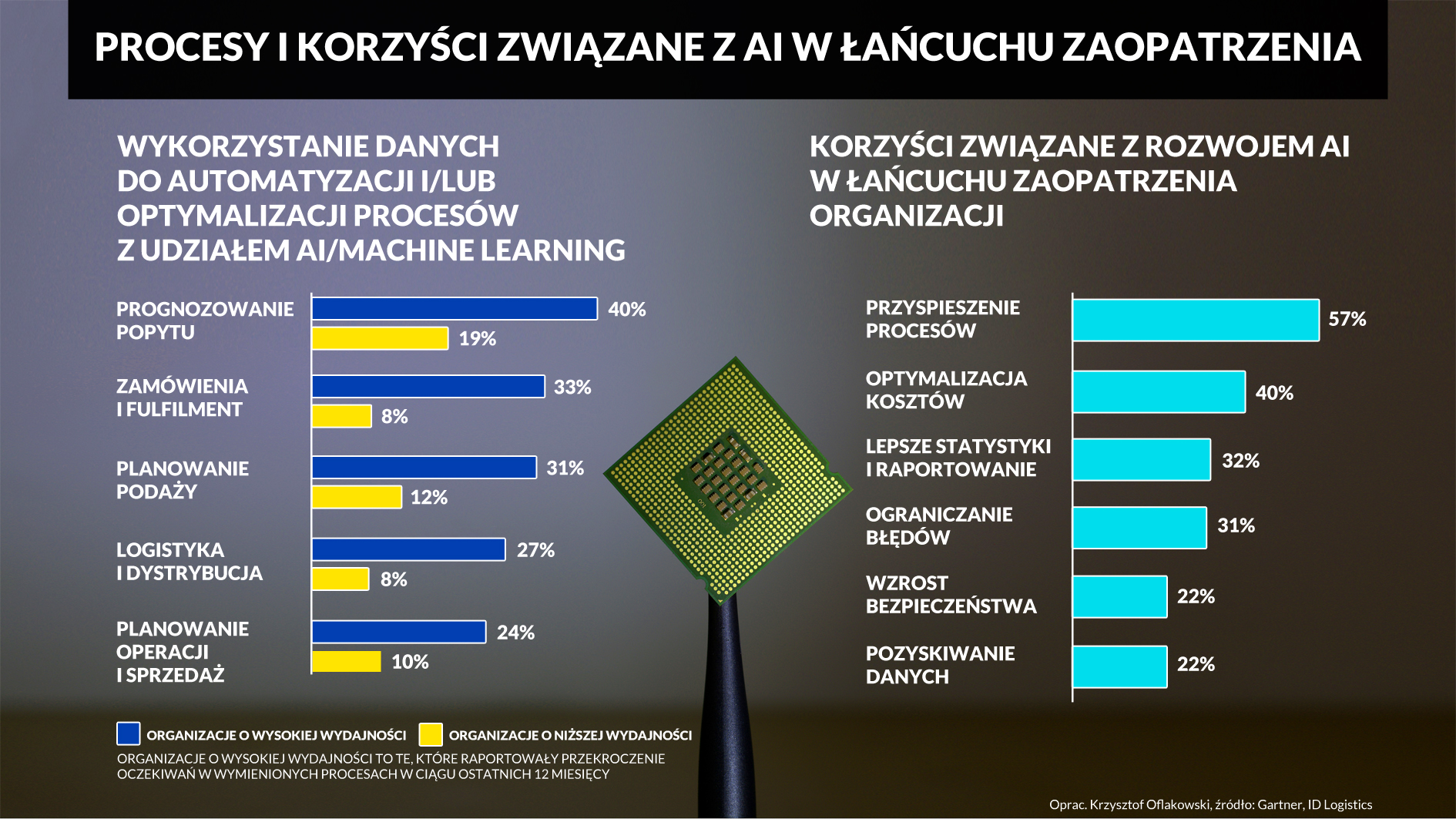
The results of analyses conducted by Gartner in Q3 2023 partially answer this question. A global survey of 818 geographically dispersed supply chain management professionals was intended to help understand, among other things, how the potential of digital resources is used to increase the productivity of enterprises using intelligent algorithms. In the course of the analysis, it was clearly shown that the most agile organizations use data and invest in artificial intelligence and machine learning solutions to automate and optimize their own decision-making processes at a rate more than twice as fast as their weaker competitors. These more agile companies were defined as those whose reported results from the last 12 months exceeded expectations in the 5 analyzed categories. It turned out that 27% of more agile organizations use intelligent algorithms to automate and/or optimize decision-making processes in logistics and distribution. At the same time, only 8% of underperforming companies do so. The same applies to demand forecasting, where the ratio is 40% to 19% in favor of those using intelligent tools. An equally large difference is visible in order management and fulfillment, where the disparity is 33% to 8%. A similar result was achieved in supply planning (31% to 12%) and sales and operations (24% to 10%).
Analyses regarding the benefits of AI implementations in logistics are also being conducted in Poland. A study by ID Logistics and K+ Research carried out in Q3 2024 among 400 managers responsible for supply chains shows that 36% of respondents conducting operations in the FMCG sector believe that AI can improve their logistics processes. In the retail sector, this percentage increases to 38%. Exactly the same optimism prevails in the fashion and beauty sector (38%), and slightly fewer indications come from e-commerce (34%). By far the most benefits are seen in accelerating processes (57%), cost optimization (40%), but also in obtaining more accurate statistical data and reporting (32%). Great potential is also attributed to reducing errors, which is pointed out by 31% of logistics management professionals.
– The potential to achieve specific benefits alone cannot decide the immediate implementation of every new technology appearing on the market. A responsible company, based on its own and its customers’ needs, and in the case of artificial intelligence solutions, also an appropriate technological background, should assess whether a specific solution has a real chance of generating the expected effect. This is not necessarily about a financial result, although ROI, or return on investment, should be an important factor determining the legitimacy of implementing specific IT tools. However, it is not always about money; sometimes the goal is, for example, to improve the quality of work, reduce the organization’s impact on the environment, or the local community. We see that companies often undertake attempts to implement individual solutions while being unprepared for it, without a background of knowledge, other necessary technologies, without tests, and even without a clearly defined goal and a plan that will enable its achievement – says Marcin Smoła, Chief Operating Officer at ID Logistics Poland, which provides comprehensive logistics and transport solutions, e-commerce handling, and supply chain management in 18 countries.
– All the more so, undertaking the implementation of artificial intelligence tools, and especially the generative variety, requires preparation, a very accurate calculation of what outlays will be necessary to finalize such an operation, and when they will pay off. One must also remember about people, their competencies, and their attitude towards such activities. One must keep in mind other advanced technologies with which AI will cooperate, as no innovation can work in a vacuum. In this particular case, every smallest factor matters, because we know that this is not an easy issue. We already operate many state-of-the-art solutions and are also looking at generative algorithms, but we know that one must invest in innovation primarily wisely – adds Marcin Smoła from ID Logistics.
Adapting intelligent algorithms in logistics, especially GenAI, is more difficult than it seems
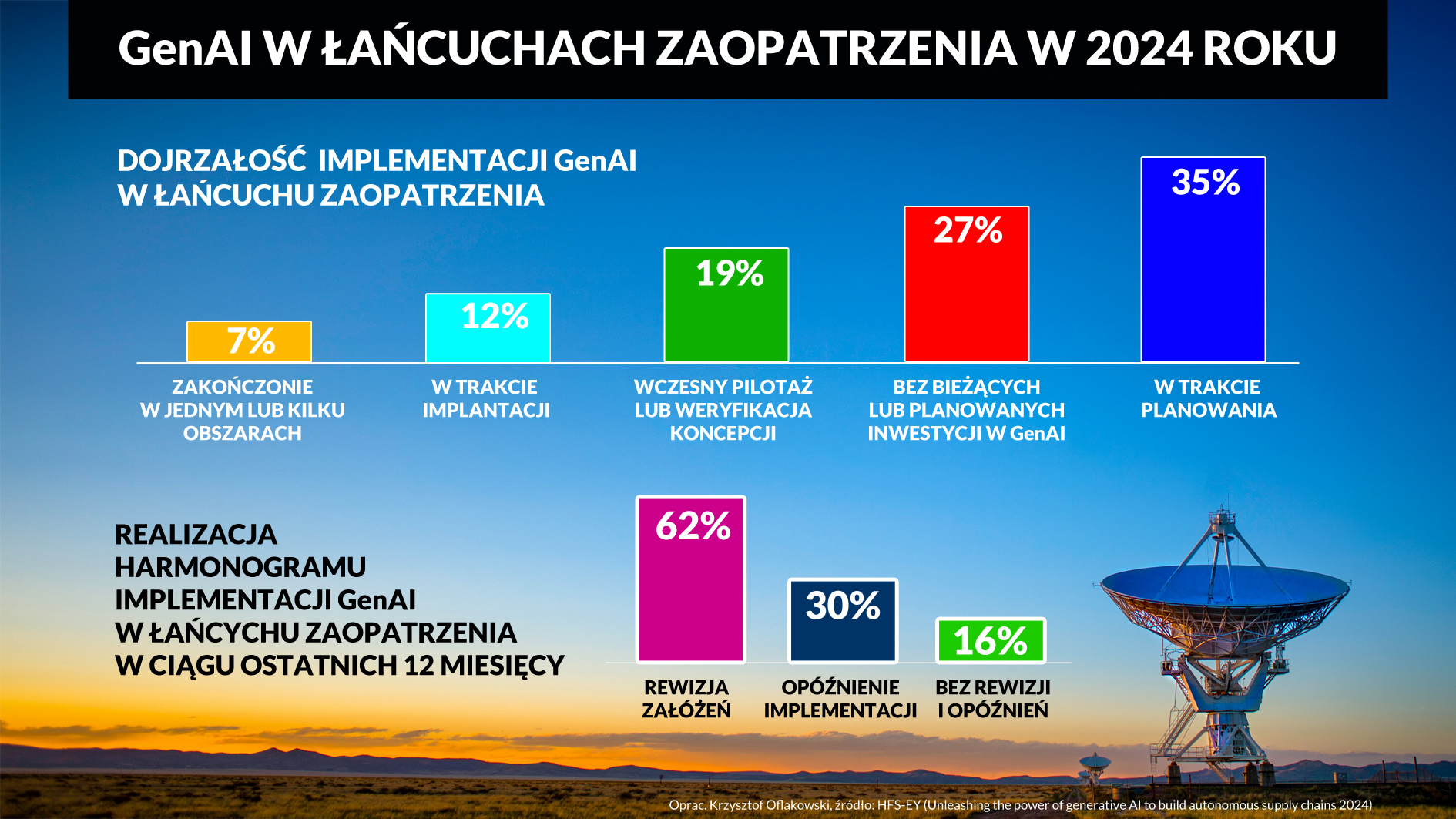
The fact that adaptations of generative artificial intelligence solutions are far more complicated than originally assumed scenarios is confirmed by analyses conducted in the area of logistics operations. Detailed conclusions about the problems and challenges regarding the use of the potential of artificial intelligence, and especially its generative form, are provided by, among others, HFS and EY in a study developed at the beginning of 2024. In a global analysis conducted among 460 high-level managers responsible for supply chains in organizations whose annual revenues exceeded $1 billion, it was shown, among other things, that only 16% of GenAI implementation attempts undertaken in the last 12 months were successful. This means that the implementation scenario was neither changed nor delayed due to encountered problems or risks. However, 62% of managers whose GenAI programs had to be redefined did not have such luck over the last year. In the case of 30% of organizations, it was also necessary to delay the implementation schedule.
Moreover, out of 73% of enterprises that are thinking at all about using generative algorithms in their logistics operations, only 7% managed to complete the implementation in only one or a few areas, and not in the entire subordinate chain. As many as 27% of organizations with revenues above $1 billion are not undertaking or even planning investments in GenAI in their logistics at all. It is therefore clearly visible that one can also function without such solutions, and in no case are generative algorithms an existential issue, at least for today. Over the next few years, however, the attitude may evolve, because 85% of enterprises believe that by 2030, GenAI will play a key role in the development of supply chains, and 80% of respondents see it as a force redefining the current supply model, which is moving towards autonomous networks with low human intervention. However, 7% of companies do not agree with such a statement, and 13% do not want to clearly indicate the success or failure of such a direction of change.
For now, we are observing a rather low level of maturity in the implementation of generative algorithms in supply chains. Not only have only 7% of companies recorded single successes, but 35% are only at the planning stage. Another 19% are conducting early pilots or verifying their concepts, and only 12% are in the implementation phase. All stages other than the completed application may still share the fate of the mentioned 62% of enterprises that had to modify their adopted assumptions due to encountered risks or difficulty. Based on earlier analyses, it can even be assumed that the probability of a successful implementation in the adopted scenario and schedule is currently 16%. Such low chances only confirm the high level of complexity of adaptation programs.
What generates the biggest problems and risks in the supply chain?
The answer is quite clear. Most complications are generated by issues related to data, and managers, when choosing from 3 key difficulties, most often point to problems with maintaining high-quality data (38%). Next, they emphasize insufficient employee skills and risks related to security (37% each). The challenge is not only quality but also access to appropriate data and the complexity of integration into existing systems, compliance with regulations, technological background, and the cost of implementation.
This last obstacle is a key barrier for Polish managers managing logistics in their enterprises. In the previously cited ID Logistics study, as many as 55% of indications concerned the high cost of implementations, but difficulties in implementing AI into existing processes (39%) and insufficient technological background (26%), misunderstanding (24%), and reluctance to take risks (20%) also had a significant share.
Large companies surveyed by HFS point to slightly different risk factors blocking GenAI implementations. They mention primarily regulatory issues regarding privacy, increased vulnerability to cyberattacks, the possibility of reputational damage, the danger of over-reliance on untested technology, and the increase in uncertainty about employment and a decline in employee productivity.
No one is waiting for problems to solve themselves, and new AI usage scenarios are lining up
Companies implementing intelligent algorithms are aware of the barriers and threats, which is why they are taking actions to increase the probability of their own success and minimize potential risks. They do this, among other things, by implementing GenAI first in those areas that ensure a quick return on investment (ROI), e.g., in terms of demand forecasting. Another way is also to have a virtual and scalable infrastructure that guarantees a rapid increase in the potential of successful implementations. A purely human factor, in turn, is the appropriate preparation of employees and equipping them with the best possible tools to reduce uncertainty and maintain high productivity.
In the analyses, it can be seen that maintaining employee productivity enjoys a high priority, and at the same time, its increase is quite often found among the benefits resulting from the use of artificial intelligence. The catalog of potential applications is becoming really long, and perhaps soon it will be easier to ask what AI or GenAI cannot do, and not the other way around.
What can artificial intelligence offer to logistics?
The British center Transport Intelligence (Ti), researching phenomena occurring in the global TSL market, in a report from June this year, cites the example of a predictive inventory management system, in which, based on orders made in the past, an intelligent algorithm is able to identify goods for which there will likely be demand in the upcoming or selected period. Going further, an AI-based system is also able to precisely calculate the required storage space based on dimensions, weight, and frequency of orders, while simultaneously suggesting the placement of goods in the warehouse, which will facilitate picking, and in a broader perspective, increase the available storage capacity.
Ti also highlighted the issue of robots using intelligent software. Such machines can not only move autonomously but also avoid obstacles and correct previously made mistakes, automatically increasing their own work efficiency. The same applies to precise inventory management. Robots with AI reduce the risk of shortages and predict future demand, facilitating replenishment. Those equipped with AI and sensors can monitor the operation of warehouse equipment, informing about potential failures or wear. Vision systems, in turn, can identify and pick up the correct goods even in a situation where they are partially obscured, dirty, or damaged in a way that prevents identification by traditional scanners. The same applies to visual inspection during the receipt or release of goods. In such a case, the systems look for dents, scratches, or damage to packaging.
Another British center researching, among other things, supply chains, namely Reuters Events, also added its two cents on the issue of possible AI applications. In its report from December 2023, it recalled an analysis conducted by the World Economic Forum, which showed that even 15% of the distance covered by European trucks takes place without a load, which can be improved through more precise route optimization. Of course, using AI. Another interesting aspect presented in the document is a calculation stating that due to regulations, the need for servicing, issues related to the employment of drivers, other employees, and the use of existing technologies, all together mean that in Europe, trucks are on the road for only 29% of the time, significantly lowering the potential of the industry’s existing resources compared to other sectors of the economy. On the other hand, autonomous vehicles based on AI can remain on the road for up to 78% of the time, which significantly improves the efficiency of road transport. A side effect of increased efficiency is, among other things, fleets with fewer vehicles, and consequently, lower pollutant emissions. There is still a very long way to go to autonomous freight transport in Europe, but not only regional TSL, but the entire global economy can benefit from AI. It is even known how much such a benefit can amount to. European Parliament forecasts indicate that by 2030, artificial intelligence could pump between $13 and $15.7 trillion into the global GDP.