











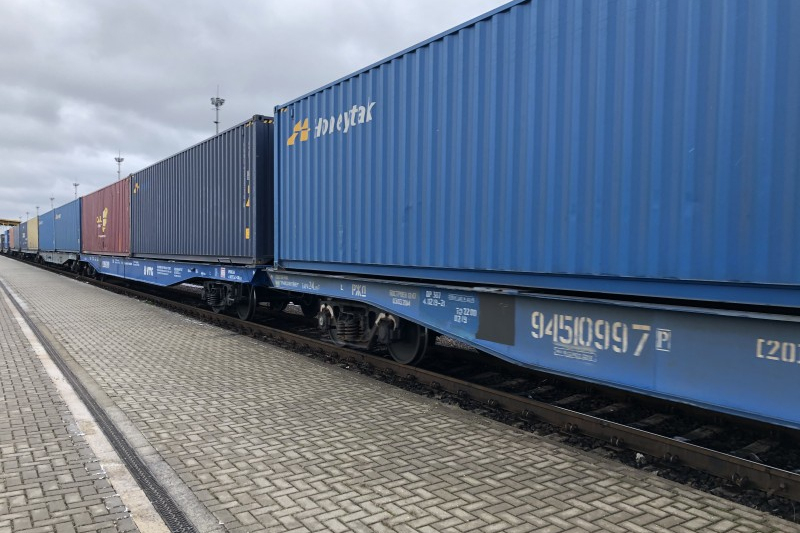
In the second quarter of 2024, railways transported 6.9 million tons of cargo in intermodal transport. The transport performance achieved over 2.3 billion tonne-kilometers. Compared to the data from a year ago, the results are significantly better.
Increases in mass and transport performance compared to Q2 2023 amounted to 19.2% by mass (+1.1 million tons) and 16.2% by transport performance (+0.3 billion tonne-kilometers).
From April to June 2024, rail carriers transported 421,000 intermodal units, which accounted for approximately 662,800 TEU. Compared to the second quarter of last year, the number of transported units was 13.2% higher (the increase in TEU was 17.3%).
In the first half of 2024, railways transported 13.7 million tons of intermodal cargo, with a transport performance of 4.6 billion tonne-kilometers. Compared to the first half of 2023, when the cargo mass reached 11.6 million tons and transport performance amounted to 3.9 billion tonne-kilometers, we are seeing a year-on-year increase of 18.3% and 19.8%, respectively. The number of intermodal units transported in the first half of the year was nearly 850,000. Compared to 770,000 a year ago, this is an increase of 10.4%. The increase in the number of TEU from 1.2 million in H1 2023 to 1.3 million in H1 2024 is 10.9% higher.
In the first six months of 2024, the share of intermodal transport in the rail market reached 12.4% (by mass) and 15.9% (by transport performance). In the first half of the year, transport services were provided by 32 carriers.
– The situation in freight transport remains complicated, but against the background of general market results, the growth in intermodal transport parameters can be considered optimistic. More containers were handled both in seaports and at terminals on the eastern border. This is reflected in the results of rail intermodal transport – its share in transport performance for total rail freight transport settled at nearly 16% after the first half of the year. The intermodal transport sector may soon support rail freight in emerging from the crisis. Solutions that support this branch – properly constructed reliefs or aid programs – are important for the goals set within the framework of sustainable development. It is important that these programs are based on a quality pillar, so that indicators of speed, punctuality, and last-mile principles are implemented. The market of carriers interested in providing services related to the intermodal transport sector is becoming increasingly larger – notes Dr. Eng. Ignacy Góra, President of the Office of Rail Transport.
When we compare Q2 and Q1 2024, we are dealing with results at a very similar level. A slight decrease occurred in the number of intermodal units transported – by 1.8%. However, in terms of TEU, mass, and transport performance, there is an increase – by 0.8%, 1.4%, and 1.3%, respectively.
Source: UTK