











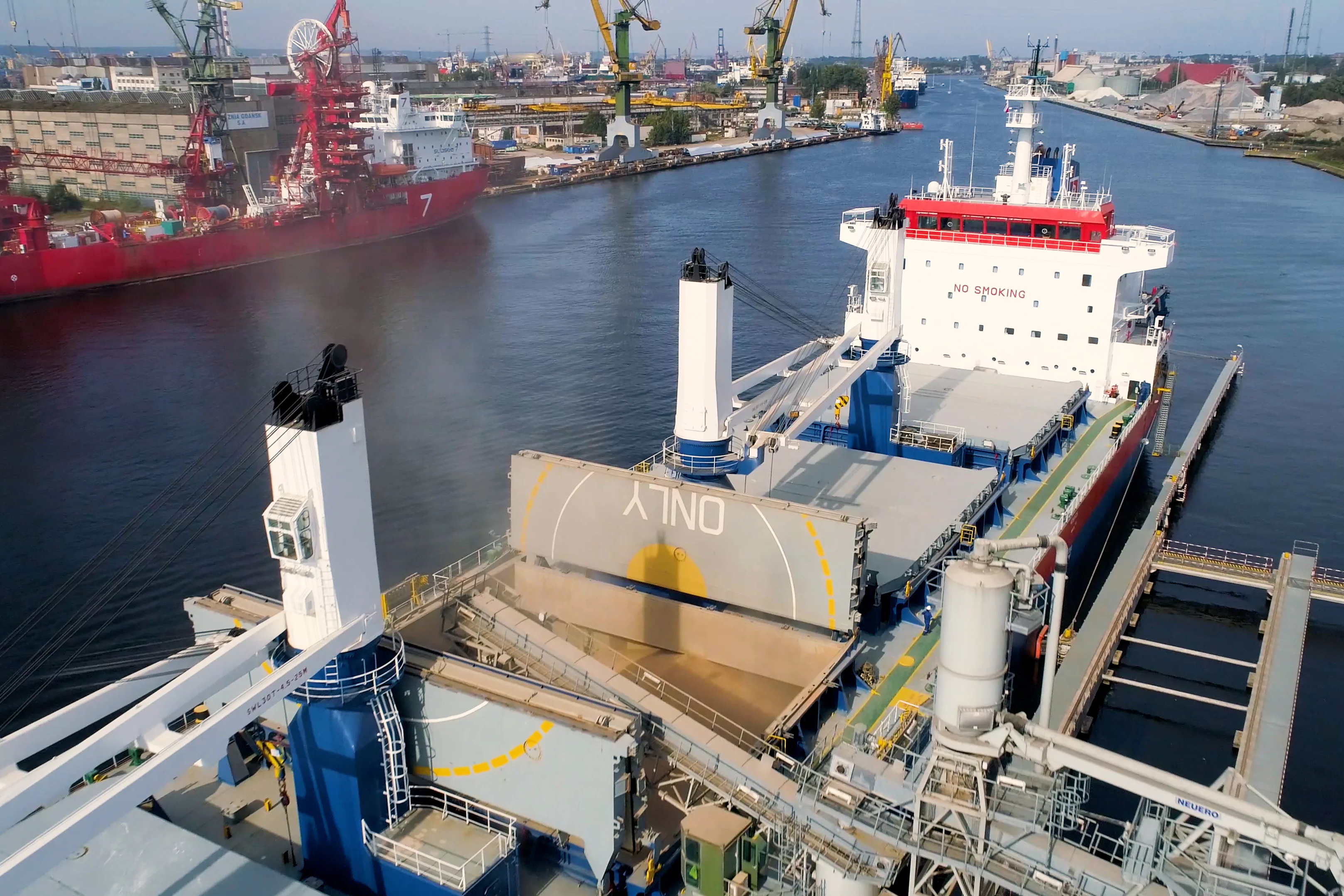
The harvest has already come to an end. In most provinces, yields are lower than last year’s. And the low supply of grain is affecting the operations of transshipment terminals in seaports. Those located in the Port of Gdańsk are prepared for increased traffic only after the corn harvest, which looks promising this year.
In 2023, despite strong competition in the global grain market, Poland exported a record 13.6 million tons of grain and grain products, with the majority shipped through ports (9.3 million tons of grain). In the Port of Gdańsk, turnover reached nearly 3.1 million tons. This was the highest percentage increase in transshipments last year (by 60 percent). Due to increased truck traffic, storage yards were paved and new parking areas were prepared. Canopies for grain samplers were installed in several parking lots.
This year, however, there is no sign of a “bumper crop” similar to last year’s. The last two months have shown that grain turnover on the market is low because farmers, dissatisfied with current prices, are choosing to store their harvests rather than sell them.
According to the Grain and Feed Chamber, in July of this year, grain exports from Poland by sea amounted to 238,000 tons, compared to 494,000 tons exported in June of this year and 748,000 tons exported in July of last year. Low exports are also expected in August.
And what is the situation in the Port of Gdańsk? – The grain transshipment sector is uncertain and fluctuating; there are peaks and troughs. This requires us to monitor market conditions and react accordingly from the port’s side – explains Piotr Borowski, Client Manager at the Port of Gdańsk. – The numbers show this. During the first 7 months of this year, grain transshipments amounted to nearly 1.7 million tons, which is almost the same as in the corresponding period last year. They remained at a high level until May (approx. 300,000 tons per month), but there was a clear decline in June. Since then, a downward trend has continued.
In the Port of Gdańsk, grain transshipments are carried out by seven operators. The largest of them is GBT – Gdańsk Bulk Terminal. Its average turnover is 110,000 tons per month. However, since June, it has been recording declines in grain transshipments, just like other operators.
But it is not only lower yields and farmers waiting for higher purchase prices that have influenced the decline in grain turnover in Polish ports. Smaller quantities of Ukrainian grain in transit have also contributed to this. Smaller, of course, compared to the previous two years. This is due to the operation of the Ukrainian Maritime Corridor. August 16 marked exactly one year since the first blocked ship left the port of Odesa using the temporary corridor for merchant vessels. Since then, Ukrainian ports have exported 43.5 million tons of agricultural products. A significant amount of Ukrainian grain also goes to the Romanian port of Constanța on the Black Sea.
Source: Port of Gdańsk Authority S.A.