











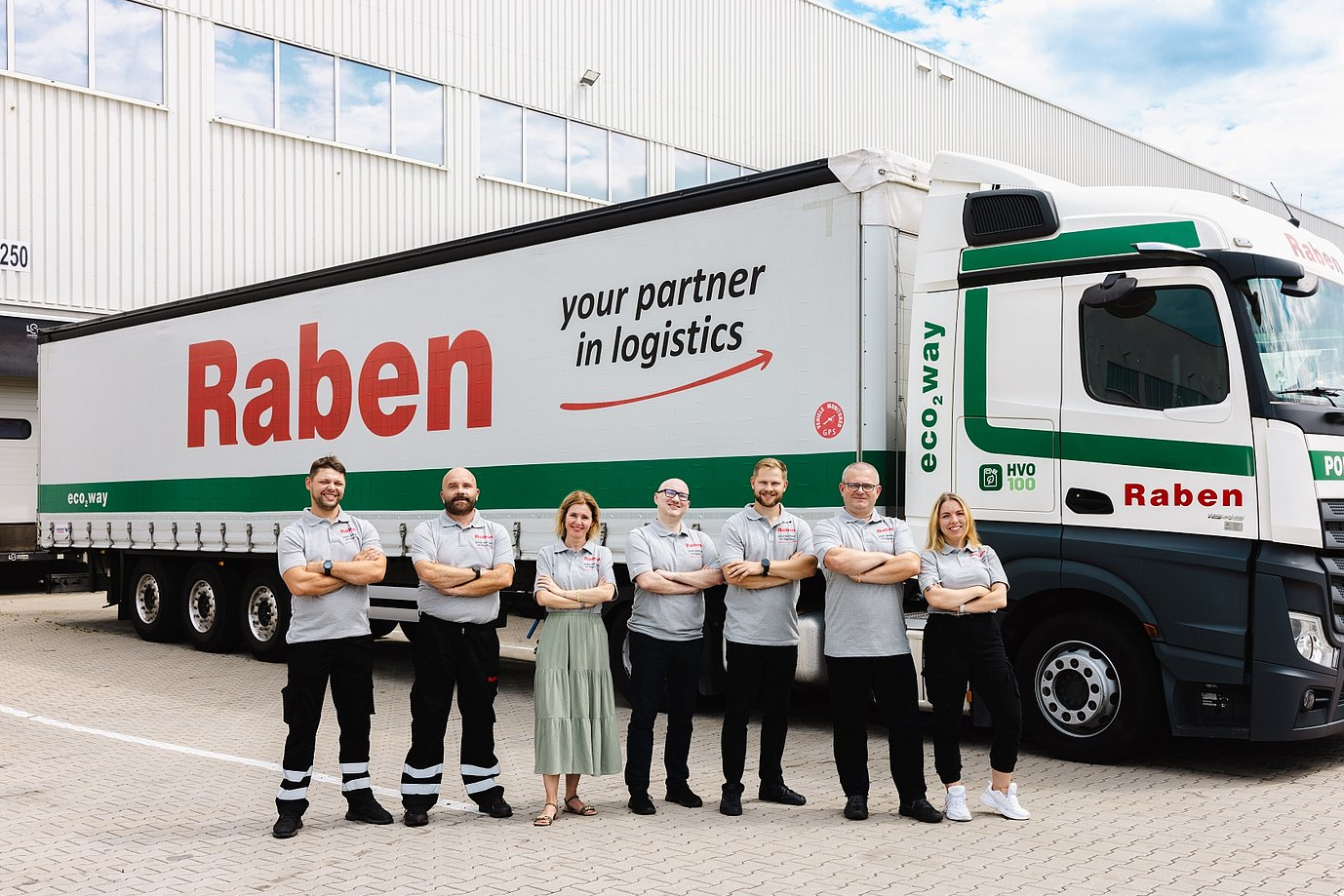
Raben Transport is the first company in the Raben Group in Poland to set a goal for 10% of its fleet to use alternative fuels by 2025. With this in mind, since February of this year, it has been testing HVO100 – a biofuel produced from renewable raw materials with a very high potential for CO2 emission reduction. Raben trucks powered by it are already covering routes in several European countries, and there is a chance that the scale of its use will continue to grow as availability increases.
A 10% share of vehicles powered by alternative fuels in the fleet by 2025, and an increase to 75% over the next five years – Raben Transport has truly ambitious plans to reduce its carbon footprint. These are intended to support the fulfillment of the entire Raben Group’s commitments, according to which the logistics operator will reduce emission intensity from transport operations by 10% by the middle of this decade, and Scope 1 and 2 emissions by 38.7% (SBTi target) by 2030 compared to 2020 values.
In search of solutions that will bring quick and measurable results, the company turned to HVO100 (Hydrotreated Vegetable Oil). Experts point to it as one of the two “green” and most low-emission, yet scalable tools – alongside electricity from renewable sources – that can play the greatest role in the decarbonization process. The Raben Group began testing this fuel in the second half of 2023 in the Netherlands, and the positive results led to the decision to refuel in other markets – Germany and Austria. Raben Transport has been testing HVO100 since February 2024, with two tractor units operating international routes participating in the pilot project. Currently, about 5% of the entire Raben Group’s own fleet uses the aforementioned biofuel, and this percentage is systematically growing.
– HVO100 is a low-emission fuel that makes it possible to reduce CO2 emissions into the atmosphere by up to 90%. It is an excellent substitute for traditional diesel, recommended by leading truck manufacturers for use in traditional diesel engines – emphasizes Joanna Górna, Key Account Manager at Raben Transport. – Its price is about 15–30% higher than the price of diesel fuel. However, considering the environmental aspect and the reduction potential, using it is beneficial and, in the near term, profitable for the climate. It is certainly a cost worth bearing.
Among the advantages of HVO100 is the fact that it contributes to reducing emissions without the need for additional investments: fleet replacement by carriers, vehicle modifications, or building special refueling infrastructure. Nevertheless, its large-scale use faces barriers – so far, it is only available in some European countries. However, there is a chance that by the end of 2024, a package of regulations will come into force in Poland that will provide a complete legal framework enabling the production and trade of this biofuel.
– Refueling with HVO100 at stations is done using traditional fuel cards, which simplifies the entire process. At the same time, it requires us to implement internal procedures and great diligence, which will allow us to monitor the environmental impact of the biofuel and emission levels in a credible way – explains Joanna Górna.
It is worth mentioning that using HVO100 is not the only path the Raben Group is following towards reducing emissions in transport. Electric vehicles are being tested in urban traffic, and since the autumn of 2022, a joint project with Volvo Trucks and Ikea Industry has been underway, in which three e-trucks powered by renewable energy regularly travel between two of the furniture manufacturer’s factories. Furthermore, where possible and business-wise beneficial, the logistics operator promotes intermodal solutions using rail.
Source: Raben Group