








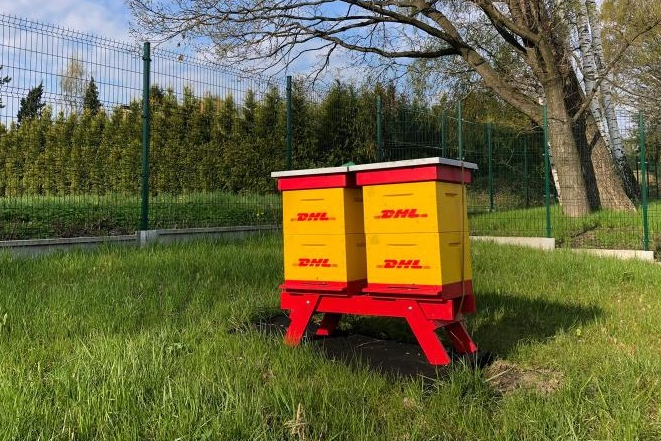
As part of its sustainability strategy and commitment to the natural environment, DHL eCommerce Poland continues the “PaczUle” project, which aims to protect bees and support biodiversity. In the company’s apiaries, approximately 250,000 bees produce unique honey that is cleaner than much of the honey produced in apiaries in rural areas.
The “PaczUle” program, which DHL has been running for several years, aims to support biodiversity and protect bees—insects that are crucial to the ecosystem—as well as produce clean, urban honey. Justyna Dąbrowska, spokesperson for DHL eCommerce Poland, notes: “The honey produced by our bees is special. It is distinguished not only by its exceptional purity but also by its richness of flavors, as the nectar needed for its production is collected from a variety of plants, including meadow flowers, garden flowers, and species found in botanical gardens or park complexes. At the main DHL headquarters, where our bees reside, there is a spacious garden, and within it, a wildflower meadow that we planned specifically for the residents of the DHL hives. Such an environment creates very favorable conditions for the bees.”
Bees in the city have limited contact with pesticides, which is why urban honey is cleaner and often healthier than honey from rural areas, where industrial agriculture uses mass-scale spraying. This is confirmed by numerous studies[1] and expert opinions. The DHL eCommerce Poland hives are located near a wildflower meadow, right next to the company’s main headquarters in Warsaw. This ensures the bees have an abundance of flowers needed to collect nectar, which promotes honey production. The company emphasizes that honey from urban apiaries not only delights the palates of employees and customers but is also healthier due to lower exposure to pollutants.
August 8th is National Bee Day. It is a good occasion to recall the crucial role these tiny insects play in our ecosystem. Pollination by bees is essential for the survival of over 4,000 species of vegetables and other crops. As a Greenpeace report indicates, the global economic value of bees’ work is as much as 265 million euros per year[2]. Bees are absolutely essential to our ecosystem. Without them, food production would suffer significantly, as manual pollination of plants is a costly and time-consuming process. Additionally, besides honey, bees produce wax, propolis, and royal jelly, which are used in the cosmetics and pharmaceutical industries, among others.
“PaczUle” is one of many pro-ecological projects by DHL eCommerce Poland. “We are committed to a comprehensive and multidimensional approach to activities that support the environment. We strive for the total elimination of emissions resulting from logistics operations. An important element of these efforts is increasing the share of eco-vehicles in our courier fleet. Furthermore, we use renewable energy from our own photovoltaic installations, optimize courier routes, and develop our OOH network, which helps reduce the number of kilometers traveled by couriers and, consequently, carbon dioxide emissions,” adds Justyna Dąbrowska. DHL eCommerce Poland is constantly investing in modern technologies and infrastructure that contribute to energy savings and more efficient resource utilization. “We are convinced that in the area of sustainable development, the impact of business is enormous, and through thoughtful and comprehensive initiatives, we can contribute to a better tomorrow for all of us,” concludes Justyna Dąbrowska.
[1] https://www.kalendarzrolnikow.pl/7037/czy-miejski-miod-jest-zdrowy-wyniki-badan-mowia-same-za-siebie
[2] https://www.greenpeace.org/poland/tag/pszczoly/
Source: DHL eCommerce Poland