












According to data from the end of March 2024, a total of 62,629 passenger and commercial battery electric vehicles (BEVs) were registered in Poland. Last month, their number increased by 5,916 units (8% more than in the same period of 2023), according to the E-mobility Counter launched by PZPM and PSNM.
At the end of March 2024, there were 108,331 electric passenger cars on Polish roads. The fleet of fully electric passenger cars (BEVs) numbered 56,270 units, and the fleet of plug-in hybrids (PHEVs) amounted to 52,061 units. The number of electric delivery and heavy-duty vehicles stood at 6,387 units. The fleet of electric mopeds and motorcycles is also steadily growing, reaching 19,953 units at the end of March, as is the number of hybrid passenger and delivery cars, which increased to 747,932 units. By the end of last year, the zero-emission bus fleet in Poland grew to 1,280 units (of which fully electric vehicles accounted for 1,226 units, and hydrogen vehicles for 54 units).
Parallel to the fleet of electric vehicles, charging infrastructure is also developing. At the end of March 2024, there were 6,490 publicly accessible electric vehicle charging points (3,583 stations) in Poland. 28% of them were fast DC charging points, and 62% were slow AC charging points with a power of 22 kW or less.
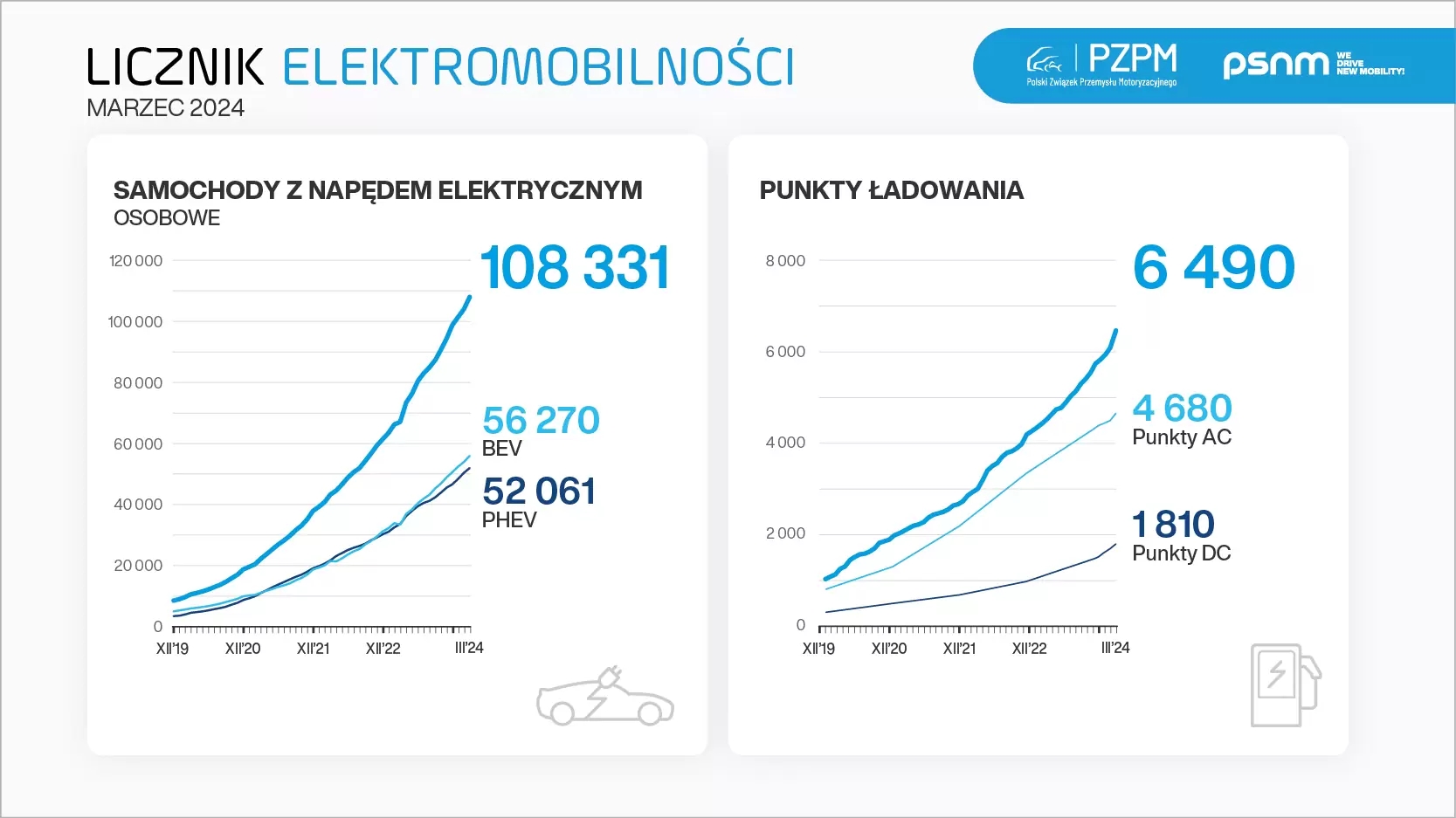
– In the first quarter of this year, nearly 560 new publicly accessible charging points were launched in Poland. More than half of this number were fast DC charging points, and the share of such devices is constantly growing. This trend is certainly pleasing, but these numbers are still far too low to meet the objectives of the AFIR regulation, the provisions of which have been applied in member states since April 13. Just as in 2021, when the introduction of AFIR was first announced, the industry’s needs remain the same today: shorter connection construction times, connection conditions better adapted to market realities, and effective support programs. Without fundamental changes in this area, Poland has no chance of meeting the regulation’s requirements on time – says Maciej Mazur, Managing Director of PSNM.
– The last few months, in terms of zero-emission vehicle registrations in Poland and across Europe, have unfortunately turned out to be worse than in previous years. The number of registered passenger cars and buses increased by a few percent month-on-month, while the number of electric delivery vehicles fell. Significant growth was recorded by zero-emission buses, motorcycles, and micro-vehicles. The category that recorded a nearly 50% increase in registrations is classic hybrids. These results show that it is essential to continue subsidies under the ‘My Electrician’ program – both for passenger cars, delivery vehicles, and their infrastructure. Furthermore, it is absolutely necessary to introduce as soon as possible the announced subsidy program for heavy-duty vehicles and dedicated infrastructure for these vehicles. It is worth emphasizing that the number of electric buses is growing, which is very pleasing because it means an improvement in air quality in our cities – says Jakub Faryś, President of PZPM.
Source: PSNM