











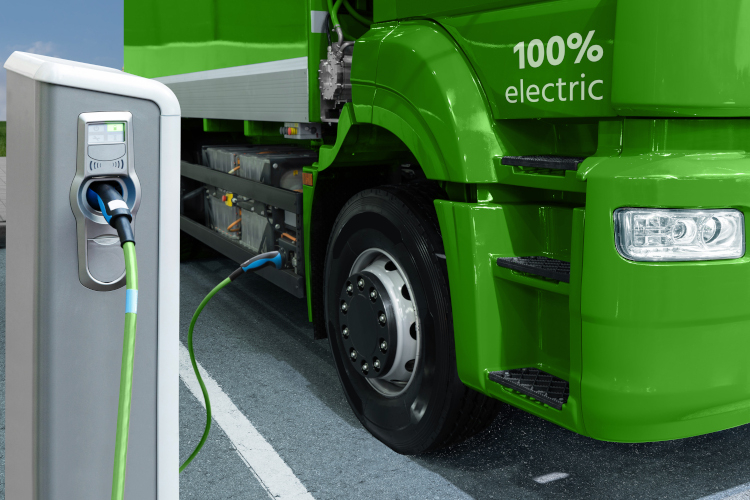
The National Fund for Environmental Protection and Water Management (NFOŚiGW) launched consultations today for the draft priority program “Support for the construction and/or expansion of publicly accessible charging stations for heavy-duty transport.” This comes less than a week after the announcement of another program draft, which provides subsidies for zero-emission heavy-duty vehicles of categories N2 and N3.
NFOŚiGW intends to allocate PLN 2 billion to support the expansion of charging infrastructure for eHDVs – twice as much as for electric truck subsidies. 80% of this amount will be allocated to grants for chargers located along the TEN-T core network, while 20% will go to subsidies for stations launched within logistics centers or intermodal terminals. The new program will be implemented between 2024 and 2029. Importantly, the application process is to be conducted on a competitive basis (rather than the controversial “first-come, first-served” principle that applied, among others, to the passenger vehicle infrastructure subsidy program). The draft regulations provide for qualitative scoring criteria such as funding efficiency, implementation timeline, and physical efficiency.
- The draft subsidy program announced today by NFOŚiGW provides PLN 2 billion in grants for electric heavy-duty vehicle (eHDV) charging infrastructure. The subsidy can cover up to 100% of the costs of building chargers. This comes less than a week after the announcement of another program draft, which provides subsidies for zero-emission heavy-duty vehicles of categories N2 and N3.
- We assess the program’s assumptions positively. Thanks to subsidies for infrastructure and electric trucks, Poland could become one of the countries setting the direction for the development of zero-emission heavy-duty transport in Europe. This is crucial for Polish transport companies and for maintaining Poland’s leading position in this sector – assesses PSPA.
- The organization, which has been advocating for support for the eHDV sector in Poland for many months, has submitted the program draft for industry consultations.
– Support will be provided in the form of grants for the construction or expansion of charging stations (also for capital installments in the case of financial leasing). The maximum grant amount will cover up to 100% of eligible costs. This is very good news, as investments in charging infrastructure for electric heavy-duty vehicles are counted in the hundreds of thousands, and often (in the case of hubs) millions of zlotys. It is worth noting that the government proposal assumes more attractive conditions than, for example, those provided in a similar program implemented until recently in Germany (where the maximum subsidy covered 80% of eligible costs) or in France (up to 60%) – says Piotr Ziółkowski, Coordinator of the PSPA Logistics and Transport Committee.
Entrepreneurs will be able to benefit from the program, and one applicant may submit several funding applications in a single call. Subsidies will cover investments involving the construction of a publicly accessible direct current (DC) charging station with at least two charging points with a power of at least 350 kW (in the case of investments implemented along the TEN-T road core network) or one charging point with a power of at least 350 kW (in the case of investments implemented at a logistics center – DEPOT – or an intermodal terminal). Grants will also be allocated for the reconstruction of charging stations, resulting in an increase in their power to the aforementioned level.
– This is a very important project not only for the new mobility industry but also for the entire Polish economy. Subsidies for eHDV charging infrastructure (along with the previously announced subsidies for electric trucks) can move Poland into the group of countries that will set the direction for the development of zero-emission heavy-duty transport in Europe in the coming months and years. PSPA has been advocating for the introduction of support for the electrification of this sector for many months. Today we know that the support proposal is very good in terms of direction. We assess the program’s assumptions positively; they will be subject to in-depth analysis. For this long-awaited move, we not only must but actually want to praise the public administration. The announced programs are of key importance for maintaining the competitiveness of the Polish TSL industry (which currently creates 750,000 jobs and accounts for 6% of GDP) and for fulfilling obligations in the eHDV area resulting from European regulations, in particular the AFIR regulation. Without subsidies, meeting these goals would not be possible – says Maciej Mazur, Managing Director of PSPA.
As PSPA points out, out of approximately 3,300 publicly accessible charging stations currently operating in Poland, not a single one is adapted for charging zero-emission heavy-duty vehicles. This situation will soon have to change due to the requirements of the EU AFIR regulation, the provisions of which will apply from April 13 of this year. AFIR provides for very ambitious and directly binding targets for each Member State regarding the expansion of charging infrastructure for eHDVs. The regulation’s assumptions include, among others, the requirement to cover at least 15% of the length of the TEN-T core network (in each direction of travel) with charging zones of at least 1.4 MW each by the end of 2025. By the end of 2027 and 2030, the requirements in this regard are to be increased accordingly. Analogous obligations apply to the TEN-T comprehensive network (with slightly lower requirements for 2027 and 2030).
– The announced subsidy programs are an absolutely necessary step on the path to starting the electrification of heavy-duty transport in Poland. The number of eHDVs on Polish roads today is very small – it slightly exceeds 100. Consequently, the demand for services related to charging heavy-duty vehicles is low, and operators are unable to carry out such ambitious investments provided for in EU regulations on purely commercial terms. This is why the financial impulse from the public administration is so important. However, the situation in the eHDV market may soon change. According to PSPA forecasts included in the “Polish EV Outlook” report, by 2030, a total of 40,500 electric trucks could be registered in Poland. For this to happen, however, subsidies should be accompanied by regulatory changes, including those leading to a significant streamlining of connection procedures for ultra-fast charging stations to the power grid. PSPA has already prepared specific proposals for changes to regulations in this area in the “White Paper on New Mobility” – says Jan Wiśniewski, Director of the PSPA Research and Analysis Center.
The draft of the announced support program will be the subject of broad industry consultations within the PSPA Logistics and Transport Committee.
Source: Polish Alternative Fuels Association