











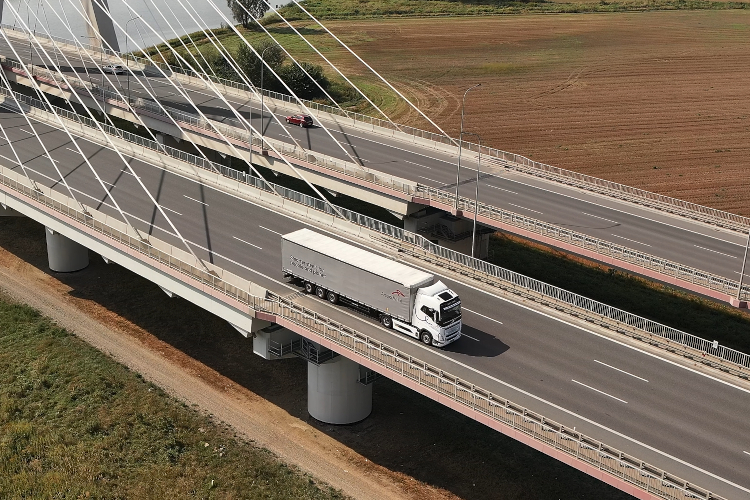
The first 200 tons of steel reached ArcelorMittal Poland’s customers on the wheels of an electric truck. The vehicle traveled between Silesia and Krakow and back, covering a total distance of over 1,000 km in 5 days. The week-long pilot program allowed for a reduction of the company’s land transport CO2 emissions by over 1.5 tons. This is the first test of its kind at ArcelorMittal in Europe.
The ArcelorMittal Group has set a goal to reduce its CO2 emissions by 35 percent by 2030 and aims to achieve climate neutrality by 2050. – Investing in changing the production process is one thing, but it is impossible to decarbonize our company while ignoring such an important factor as the supply chain. Road transport is an important part of this huge challenge, and with this test, we are proving that we are doing everything to be prepared for the change and the realization of CO2 emission reduction goals when electric delivery trucks become widely available – notes Grzegorz Kotarba, head of road transport purchasing for ArcelorMittal Poland, responsible for the pilot steel deliveries by electric truck.
In September, the truck leased for the tests operated for a week between the company’s branch in Krakow, from where it transported steel coils to ArcelorMittal Distribution Solution (AMDS) in Bytom – a branch of the Group dealing with the processing and distribution of products to customers, and the branch in Świętochłowice, from where it picked up products intended for further processing at the Krakow AMDS.
The Volvo FH Electric truck, equipped with eight batteries, made 10 trips over 5 working days and covered a total distance of over 1,000 km! – During this time, it transported over 200 tons of finished steel products to us – galvanized hot-rolled coils, which then went to external customers. The route from the branches to us was planned in such a way as to optimize battery consumption and the driver’s working time, which is why the truck made a “round trip” – explains Marek Dolina, President of the Management Board of ArcelorMittal Distribution Solutions Poland Sp. z o.o.
The route was optimized to the maximum, as the truck was almost constantly in use – the empty mileage within one “round trip” was only 5 km – this was the distance needed to travel from AMDS Bytom to the ArcelorMittal Poland branch in Świętochłowice. The vehicle used the driver’s mandatory break time to charge its batteries. Piotr Lech, Quality Manager at the ArcelorMittal Poland branch in Świętochłowice, familiarized the driver with the health and safety rules and those regarding loading on the company’s premises.
– In a few weeks, I am retiring. In my career, I have seen many changes that have taken place over the years in our company, but I did not expect that I would witness such a breakthrough event. I did not think that our steel would be transported by an electric truck and that I would be the first employee of our company to have the opportunity to sit in the passenger seat and accompany the driver during the first trips around our plant – says Piotr Lech.
ArcelorMittal Poland has finished the week-long tests, but it is possible that another pilot will be carried out in winter to test this type of transport in more difficult weather conditions, as well as using vehicles from other brands and with different battery configurations.
– Every step, even a small one, every test project or pilot brings us closer to success on the road to decarbonizing the steel industry. I am extremely proud of our Polish team, which was the first in the ArcelorMittal Group in Europe to take on this task and test the transport of our products with an electric delivery vehicle – says Wojciech Koszuta, CEO of ArcelorMittal Poland. – We have a long way to go before we can potentially switch to electric transport; we must remember the challenges we face in the area of energy or infrastructure, but I believe that electricity is the future in short-distance logistics and internal transport, which allows for maximum use of the capabilities of electric vehicles.
Deliveries using only electric transport are still a distant future. The new solution is currently very expensive, and public infrastructure for passenger cars must be used to charge trucks. However, in the horizon of the next few to a dozen years, this should be a more accessible option for industrial enterprises.
– This is a very bold undertaking that fits well with the development of sustainable ecological transport – says Prof. Magdalena Dudek from the Department of Sustainable Energy Development at the Faculty of Energy and Fuels of AGH University of Science and Technology in Krakow. – In the future, the challenge will be logistics and providing charging points for this type of vehicle, using electricity produced from renewable energy sources. Depending on how the transport sector develops, an interesting option for longer distances in the future may also be the use of hydrogen and fuel cells to build electric propulsion units. Of course, this depends on the direction of the development of the hydrogen economy, the prices of hydrogen and fuel cells.