











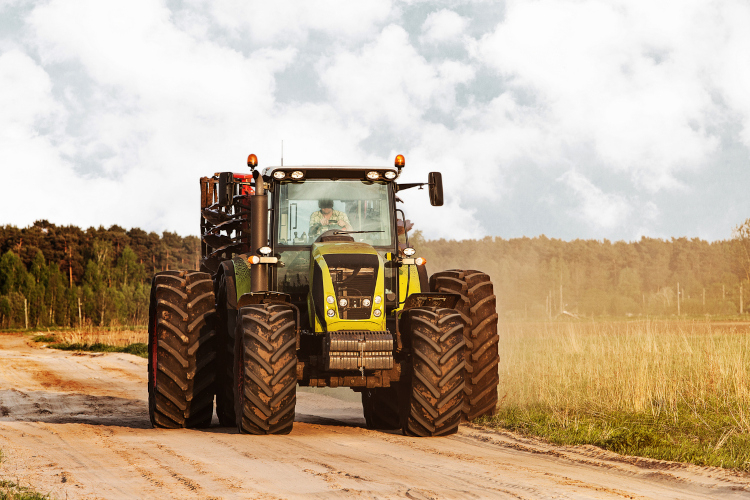
Among iconic Polish brands, the Warsaw-based tractor manufacturer holds a place of honor. It is largely thanks to its vehicles that domestic agriculture became mechanized. However, Ursus is not just a glorious heritage, but still a thriving company. It is therefore worth getting to know both the past and the present of this legend of local automotive and agricultural technology.
How did it start? The history of Ursus tractors
The history of the Ursus brand dates back 130 years. In 1893, three residents of the capital of the then-partitioned Kingdom of Poland, Ludwik Rossman, Kazimierz Matecki, and Emil Schonfeld, founded a company called the Polish Joint-Stock Society. The beginnings of the Warsaw residents’ activities were not easy. Capital was needed to establish it, which came from their daughters’ dowries. Because they had seven daughters together, the enterprise was called the “Dowry of Seven Maidens,” and the abbreviation P7P became the company’s first logo. The official name, however, was different and read the Joint-Stock Society of the Special Fittings Factory. Why that name? The factory did not originally produce tractors, but equipment for food processing plants.
The name that is still in use today appeared shortly thereafter, in 1907. The change was suggested to the owners by director Wiesław Januszewski. At that time, the Warsaw enterprise was producing Ursus engines, which is why this name was added to the existing one. The factory’s well-regarded products soon began to be used in the territories of the Russian partition, and later in other parts of the empire as well. During World War I, the Tsarist army destroyed the factory. Fortunately, this did not lead to the end of its operations. In reborn Poland, it continued to function, and the crowning achievement of the work of Ursus engineers and workers was the first domestic tractor. It was presented in 1922. Its maximum speed was 4.7 km/h, and the engine power was 25 HP at 575 revolutions per minute. The vehicle was powered by kerosene and gasoline.
In the Second Polish Republic, the Warsaw factory expanded its operations to include the production and sale of spare parts for tractors and other agricultural machinery. Shortly before the outbreak of World War II, the army commissioned the company to manufacture tanks and lighter armored vehicles. During the retreat in 1944, Wehrmacht soldiers dismantled the production lines, and the equipment was taken to Germany. Because they transported it to Lower Silesia, it was possible to recover a significant majority of it after the war and resume work. During the PRL (Polish People’s Republic) era, the enterprise was nationalized. For several decades, many successful models were constructed in Warsaw, which were used by farmers on state farms (PGRs). Until 1989, Ursus operated vigorously, but later, the difficult period of systemic reforms led to the company’s financial problems. After several changes of ownership, the enterprise still exists, although since 2011 the plant has been operating in Lublin, not the capital. Thanks to this, farmers can still enjoy high-class machines, many of which can be found on the website at https://www.mascus.pl/rolnictwo/traktory.
Classics from the PRL era – Ursus C-385 and C-360
Although one of the first post-war designs was the Ursus C-325 from 1957, it was not the one that gained the greatest popularity in Polish fields. That model was first the Ursus C-385, which entered production in 1969. Creating a large vehicle proved necessary because the tractors produced in the factory until then were not suitable for work on vast areas. Polish engineers used the help of their professional colleagues from across the southern border, who designed Zetor tractors, which were also valued in Poland. After six years of joint work, the vehicle went on sale. Subsequent, successively improved versions were assembled until 1983. They weighed an average of 3.5 tons, had engines with about 80 HP, and between 4 and 6 cylinders. It was possible to purchase versions with or without a loader and with either front-wheel drive or all-wheel drive.
The Ursus C-385 was not a fully Polish design, but the experience gained while working on it soon allowed for the creation of entirely domestic models. Farmers valued, among others, the C-360, the production of which was launched in 1976. Just like the semi-Czechoslovak machine (and not only that one), this tractor was available in many versions. It was lighter than the C-385, weighing just over 2 tons. It was equipped with a four-cylinder engine with 52 HP and a capacity of 3121 cm³, a transmission with 10 forward and 2 reverse gears, and an optional loader capable of transporting 1.2 tons of weight. The last C-360 unit rolled off the assembly line in 1994. Years later, it turned out that this was not the end of this model. A modernized version was produced between 2015 and 2017.
Modern Ursus tractor models
Although the turmoil of the systemic transformation caused many problems, Ursus constantly presented new tractors. Thanks to maintaining continuity, the company can offer many diverse models today. Wherever space is limited, the Ursus C-335 B will prove useful, with a turning radius of only 1.26 m to 1.6 m at a 56° angle. It is equipped with a 35 HP engine and a gearbox with 12 forward and reverse gears. It can travel at speeds of up to 26.4 km/h.
For larger spaces, the modern variant of the C-385 will be good. It features a transmission with 12 gears in both directions, all-wheel drive, and a unit allowing speeds of up to 40 km/h. A loader capable of lifting up to 3.1 tons can be purchased for it. On the other hand, where a powerful machine is essential, the Ursus C-3150 Power will come in handy. Its four-cylinder engine has as much as 150 HP. Thanks to it, it is possible to transport as much as 7.2 tons of material in the loader. The tractor has an advanced gearbox with 40 gears in both directions, half-gears, creeper gears, and an electro-hydraulic reverse.
The offer of the Lublin plant includes not only tractors but also other agricultural machinery. For sale are, among others, front loaders for all types of tractors. Interested persons can also buy trailers of various sizes, fertilizer spreaders, round balers, and straw transport platforms.