











According to data from the end of April 2023, a total of 40,926 fully electric passenger and commercial vehicles (BEV) were registered in Poland. In the first four months of this year, their number increased by 7,201 units, i.e., 71% more than in the same period of 2022, according to the Electromobility Meter launched by PZPM and PSPA.
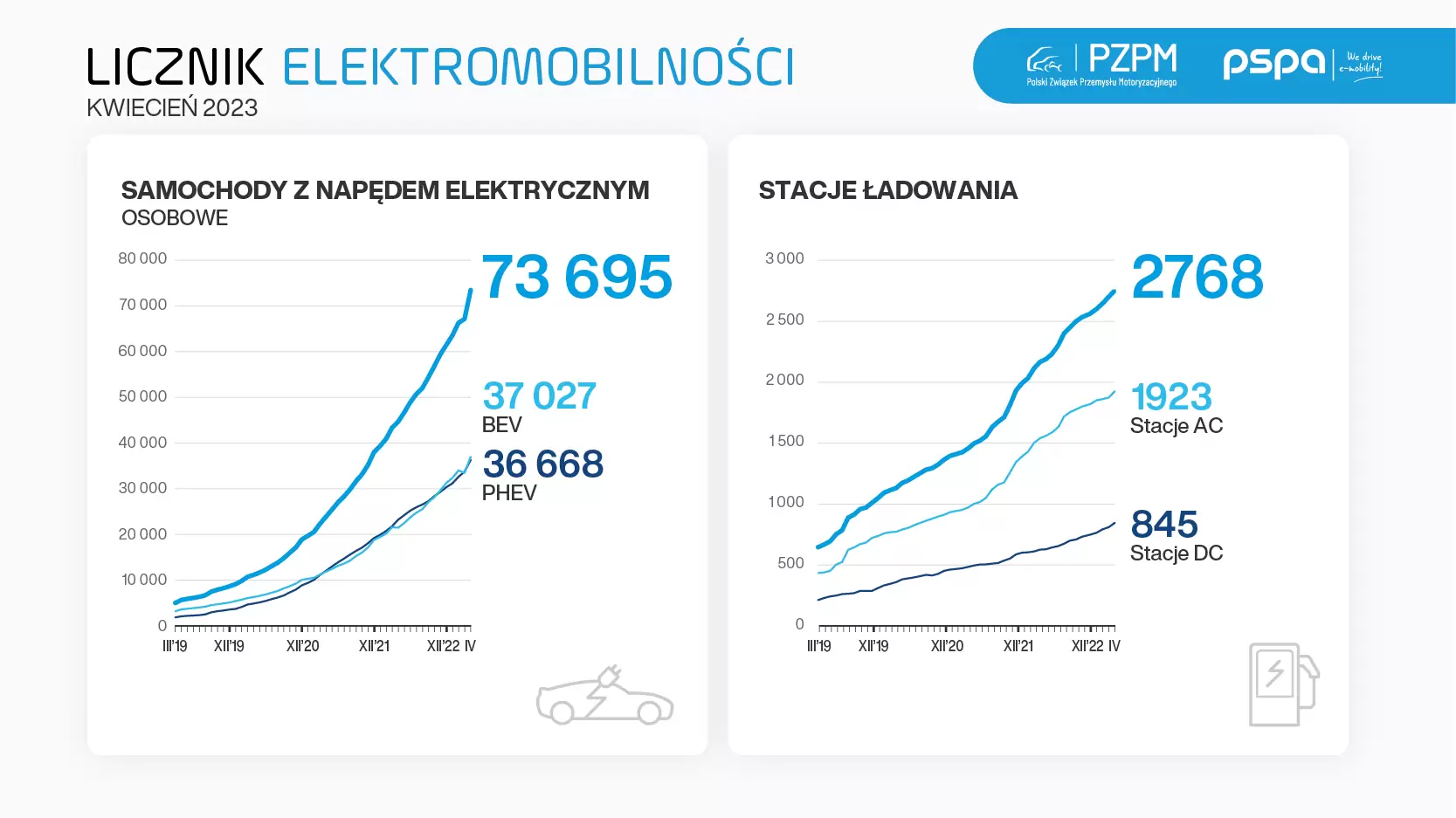
At the end of April 2023, there were 73,695 electric passenger cars on Polish roads. The fleet of fully electric vehicles (BEV) numbered 37,027 units, and the fleet of plug-in hybrids (PHEV) amounted to 36,668 units. The number of electric delivery and heavy-duty vehicles was 3,924 units, of which BEVs accounted for over 99%. The fleet of electric mopeds and motorcycles is also constantly growing, consisting of 17,097 units at the end of April, as is the number of hybrid passenger and delivery cars, which increased to 541,305 units. At the end of last month, the fleet of electric buses in Poland grew to 865 units.
Parallel to the fleet of electric vehicles, the charging infrastructure is also developing. At the end of April 2023, there were 2,768 publicly accessible electric vehicle charging stations (5,440 points) in Poland. 31% of them were fast DC charging stations, and 69% were slow AC chargers with a power of less than or equal to 22 kW. In April, 69 new publicly accessible charging stations (135 points) were launched.
– Recent months show that in Poland, plug-in hybrids enjoy interest comparable to battery-powered cars. One of the reasons for this interest is likely the fact that the charging network is still insufficient for the needs. The very good result in the registration of heavy-duty and, above all, delivery vehicles is related to the fact that many companies using fleets of these vehicles have their own charging stations located at their bases. Furthermore, due to the fact that more and more cities are deciding to close city centers to non-zero-emission vehicles, it should be expected that the number of electric delivery vehicles will grow very dynamically. It can also be assumed that if manufacturers had not continued to experience problems with semiconductor supplies, the number of cars delivered to the market would be much higher, because currently, the demand for these cars significantly exceeds production capacity – says Jakub Faryś, President of PZPM.
– It is worth noting that in April, a record was set in terms of the number of newly registered electric vehicles with a GVW of over 3.5 tons. More than 30 such vehicles hit Polish roads. This result is gratifying, especially considering the lack of subsidies in our country addressed to buyers of N2 and N3 category vehicles. In addition to implementing funding, the electrification of this sector on a mass scale requires the introduction of a number of regulatory changes, including, among others, exempting eHDVs from tolls on national roads or streamlining the process of connecting ultra-fast charging stations to the power grid. In the context of the rapidly progressing transformation of the transport sector in the EU, the existence of a comprehensive support system is a key condition for strengthening the competitiveness of Polish carriers and maintaining their leading position in the European TSL industry. As a reminder – we are talking about an industry that employs almost a million people in Poland, and its share in GDP is almost 6% – says Maciej Mazur, Managing Director of PSPA.
Source: PSPA.