











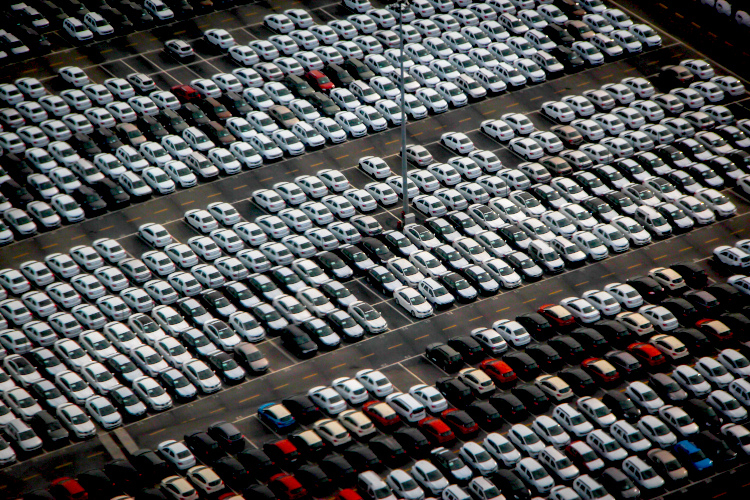
A T&E analysis shows that European car manufacturers have doubled their profits since 2019, while simultaneously claiming that EU plans to tackle toxic emissions are too costly.
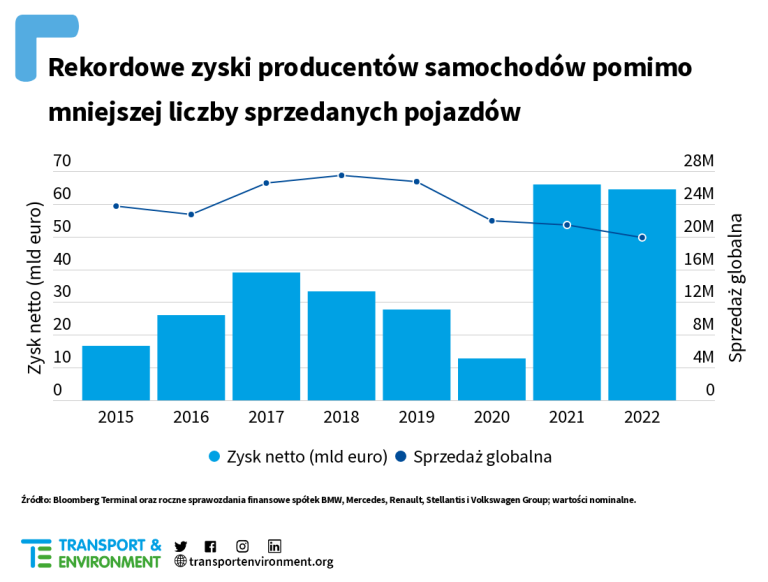
European car manufacturers claim that plans to lower air pollution limits would be too expensive, but a new analysis shows that they are making record profits and paying out unprecedented amounts to their CEOs and shareholders. Since 2019, the five largest car manufacturers in Europe have doubled their annual profits, reaching a total of 64 billion euros. According to the non-governmental organization Transport & Environment (T&E), the automotive industry’s fight against stricter pollution regulations shows that they are putting corporate greed before public health.
The current EU proposal to tighten air pollution regulations would cost them a maximum of 150 euros per car.[2] Legislators are debating the new Euro 7 standard, which sets limits on toxic emissions from road transport, as these currently cause 70,000 premature deaths annually. T&E advocates for stricter pollution limits, which would cost the largest European car manufacturer, Volkswagen, 5.7 billion euros over the entire duration of the regulation[3], which – as the analysis shows – represents only 37% of the group’s 2022 profits.[4] The European Commission has proposed very weak regulations that do not even reflect the recommendations of its internal experts and maintain emission limits set for gasoline cars over a decade ago. But the automotive industry opposes even this proposal, claiming it would be too expensive a solution.
Since the pandemic, the profits of the five largest European car manufacturers have increased – despite the fact that they have sold 25% fewer cars in total. BMW has nearly tripled, and Stellantis has more than doubled, their profit margin in 2022 compared to 2019, shifting from selling more cars in the mass market to fewer, but expensive, premium vehicles. T&E argues that because of profits, car manufacturers are scrapping more affordable cars, such as the Fiat Punto, while stubbornly claiming that EU air pollution regulations would make vehicles too expensive for ordinary drivers.
– We are not denying car manufacturers the right to record profits, but claiming that they cannot afford cheap solutions to improve pollution issues is simply a manifestation of corporate greed. The automotive industry is maximizing profits by selling more expensive premium vehicles while pretending that tightening pollution regulations will make cars unaffordable. EU lawmakers must put public health before the industry’s colossal profits – said Rafał Bajczuk, an expert at the Electric Vehicle Promotion Foundation.
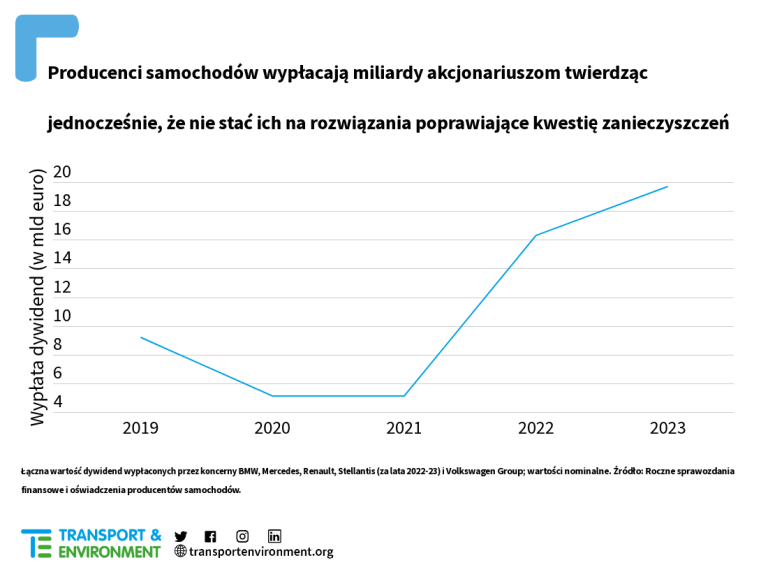
The five companies will pay out 19.7 billion euros in dividends to shareholders this year and 7.5 billion euros for share buybacks to increase their price. Stellantis plans to spend 5.7 billion euros on dividends and share buybacks – more than the total cost for the group to comply with the tightened air pollution regulations. According to T&E, this clearly shows that the car manufacturers’ claim that they cannot afford to invest in upgrading pollution controls because it would be equivalent to diverting investment from vehicle electrification is untrue.
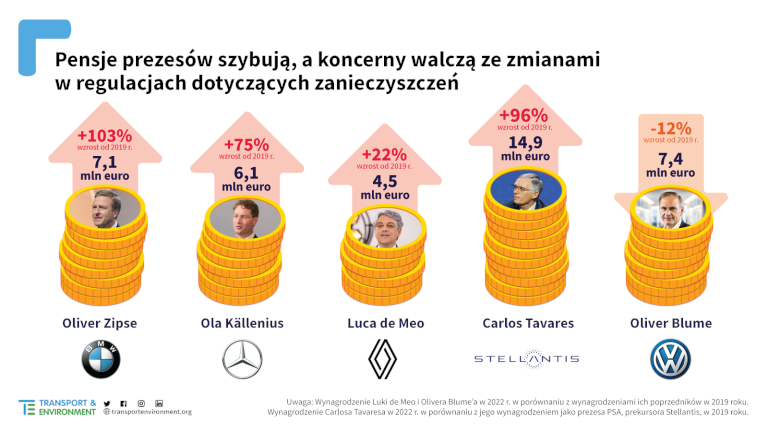
Automotive groups are prioritizing the sale of more profitable vehicles, and executive-level compensation has increased by an average of 50% since the year before Covid. Stellantis CEO, Carlos Tavares, received 14.9 million euros last year – almost twice as much as when he headed the company’s predecessor, PSA, in 2019. Mercedes CEO, Ola Källenius, earned 75% more last year than in 2019. Only Volkswagen boss, Oliver Blume, earned less in 2022 than his predecessor in 2019, but the company is already planning to increase his maximum compensation by a quarter.
T&E has called on the European Parliament and member state governments, which are debating the proposed pollution regulations under the Euro 7 standard, to take a more ambitious approach to this issue so that it is at least consistent with the EC’s internal assessment. The debate concerns regulations governing pollution levels from 100 million cars that are still expected to hit the market before the phase-out of internal combustion engines in the EU in 2035 – or perhaps even later if cars powered by e-fuels are sold.
– Car companies in excellent financial health should not be allowed to threaten public health while paying out billions to their shareholders. These are the last tailpipe pollution regulations that car manufacturers will have to comply with. This is also our only chance to limit toxic emissions from the 100 million polluting cars that the industry still plans to sell – said Rafał Bajczuk, an expert at the Electric Vehicle Promotion Foundation.