











After the post-pandemic stagnation, the robotics market has returned to a path of dynamic growth. In 2021, a record 517,000 industrial robots were installed worldwide. Poland was in the spotlight, recording an impressive growth rate—even higher than China’s (56 percent more installations than the previous year). Official global data for 2022 is not yet available, but growth may be in the single digits, with very strong sales in North America expected to compensate for stagnation in the Chinese market, which was affected by pandemic restrictions.
And what about the near future? What will this year be like—or rather, what trends will shape it? ABB, which looks at the coming months with optimism, presents its predictions for the global and Polish markets.
Trend 1 – Demand for robots will increase in response to the global labor shortage
Most sectors are struggling with staffing shortages, and this trend will continue over the coming months. It is estimated that by 2030, as many as 85 million positions could remain unfilled, which is expected to hinder economic growth and force companies to seek effective alternatives.
– This is a trend clearly visible in the Polish market as well, where companies must increase their flexibility to remain competitive – says Beata Syczewska, Business Manager of ABB Robotics in Poland. – On one hand, employees are expected to be interdisciplinary to an unprecedented extent and to acquire competencies quickly. On the other hand, potential employees, for understandable reasons, do not want to perform tasks that are burdensome, repetitive, and sometimes even dangerous. This is the moment when an employer looks toward robotization.
She adds that over the last two years, access to qualified workers has become much more difficult, and the time a company has to train them has shortened. Moreover, this applies not only to industrial companies. Automation resulting from staff shortages will become increasingly common in new sectors from the perspective of robotics, such as healthcare (automated sample testing at the University of Texas) or gastronomy (the Haidilao restaurant chain, where automation helps in meal preparation). This is facilitated by the rapid development of collaborative robots, which have long since left factory floors and started working side-by-side with humans.
Trend 2 – Artificial intelligence and autonomous technologies will facilitate the operation and integration of robots, which will take on more and more tasks
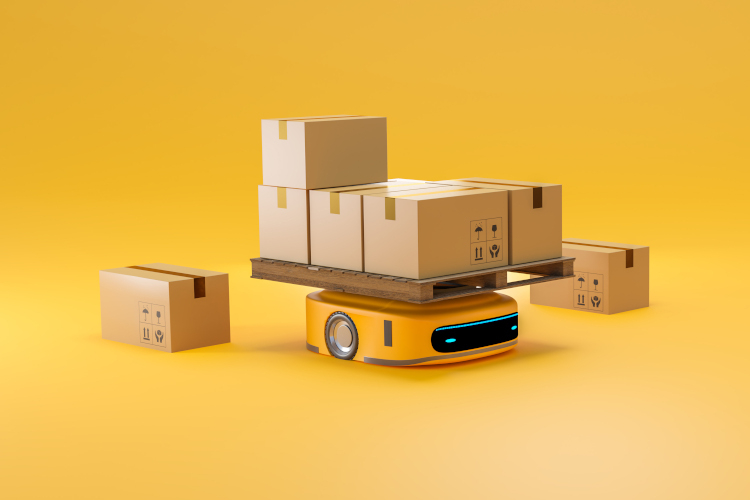
Autonomous technologies make programming and controlling robots easier and also help with their maintenance. Thanks to simpler operation, companies will be more willing to make their first investment in automation, especially when it does not require a seemingly complicated implementation with a two-armed robot in the lead role. An example is Autonomous Mobile Robots (AMRs), which are already improving logistics in many plants. This trend will deepen. Autonomous technologies will allow manufacturers to move away from the traditional production line toward integrated, modular production cells, while simultaneously optimizing component delivery.
This year, artificial intelligence will also play a significant role in the “adoption” of robotics. AI systems, developing, for example, a robot’s grip, or advanced vision systems, will help in performing more complex tasks with less effort (and time spent) on the part of the operator.
– Rapid programming for rapidly changing needs will also increase the scope of these tasks. Systems controlling the robot are constantly being simplified. Networks using open platforms will be created, enabling the integration of devices and software from different manufacturers – adds Beata Syczewska. – Robots are therefore becoming more “applicable” and scalable than ever before. As a result, we are receiving more and more inquiries from the consumer sector, including from startups investing in everyday products.
Trend 3 – Progressive cooperation between the industry and the scientific community
80 percent of education industry professionals believe that robotics and automation will shape the future of employment over the next ten years. More companies investing in robotic applications means a greater demand for qualified staff. “Qualified,” meaning what exactly? In what scope and how should they be trained to efficiently operate specific solutions in their natural environment? Schools and universities will not answer these questions on their own, which is why 2023 is set to be a year of strengthening cooperation between science and the robotics business.
– Companies in the industry are becoming increasingly involved in educational programs. As for ABB in Poland, we have launched an educational project for students based on our RobotStudio® software. At the same time, we are equipping lecturers with specialized knowledge by organizing meetings at our Robotics Solutions Center in Warsaw. We are also a partner in an IKEA Industry educational project, supporting our client in organizing educational classes at the training center in Zbąszynek. It is said that by 2035, about 30 percent of positions could be automated. The sooner we acquire the competencies that will allow us to efficiently operate these machines and systems, the better – believes Beata Syczewska.
Trend 4 – Reshoring in the Polish edition
74 percent of European and 70 percent of American companies are planning to relocate or reorganize their operations to improve supply chains in response to labor shortages, the need for more sustainable development, or the general landscape of uncertainty. This trend will not bypass Poland.
– For large manufacturers, having local suppliers is a matter of risk diversification. And moving production and logistics closer to the markets we serve often involves the need to build or expand plants – claims Beata Syczewska. – In the Polish market, we are seeing increasing interest in automation and robotization from companies that have found themselves in such a situation. The main argument in this case is the shortening of the supply chain and delivery times.
A good year after all
According to ABB, which is one of the largest players in the robotics market, despite the expected slowdown and uncertainty in the markets, 2023 will be—on a global scale—a time of further increasing productivity and efficiency levels by industrial companies.
– New technologies make robots more versatile, easier to operate, and easier to install – says Marc Segura, President of ABB Robotics. – At the same time, there are labor shortages, disrupted supply chains, and rising energy prices. In these conditions, more and more companies see robotic automation as a way to increase flexibility and independence.