











Since the beginning of 2020, forecasting the situation in the automotive industry has been extremely difficult. We have smoothly transitioned from pandemic-related problems to the turmoil associated with the war in Ukraine and the specter of an energy crisis. The industry performed quite well last year, but now the challenge will be to maintain profitability amidst rapidly rising costs.
Disrupted availability of semiconductors, inflation, rising energy and raw material prices, as well as broken global supply chains. All these factors significantly hindered the production of new cars in 2022, and consequently affected the parts manufacturers supplying them with their products. However, successive crises show that the automotive sector is not a monolith. In such circumstances, the aftermarket—distributors of parts for the secondary market or car repair shops—is performing much better.
Manufacturers are fighting to maintain profitability
Polish parts manufacturers showed good results in 2022 in terms of production volume. Trends in our market are consistent with the dynamics of spare parts trade in the EU (+3%), as well as the dynamics of passenger vehicle production. In countries with the largest production, solid growth was recorded, e.g., in Germany (+11%), the Czech Republic (+10%), and Spain (+7%).
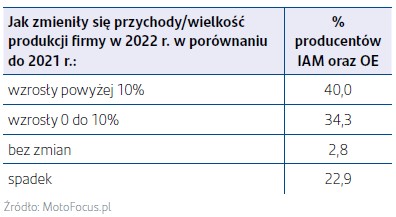
Almost 75% of surveyed parts manufacturers recorded an increase in production last year compared to 2021. Also, forecasts regarding revenue volume (IAM manufacturers) and production volume (OE manufacturers) in the first quarter of 2023 are quite optimistic. Almost 63% of respondents expect growth, with 1/4 hoping for an increase of over 10%.
Unfortunately, predictions regarding profitability in 2023 look more worrying. Already last year, the profitability of manufacturers was at low levels – it not only fell compared to 2021 but, above all, was significantly lower compared to levels from 2018-2019. Currently, only one-third of respondents expect growth. Almost half of the surveyed automotive parts manufacturers, on the other hand, expect a decline in profitability.
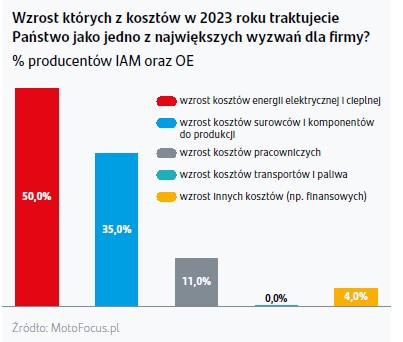
– It can be expected that the imposition of ever-new obligations and goals on the industry will cause a further decline in profitability. The economic environment and rising costs are also a challenge. During the 17th Automotive Industry and Market Congress, we asked parts manufacturers about the biggest challenges from the point of view of rising costs. Half of the respondents indicated rising electricity and heating prices as the main threat. Problems with the availability and cost of raw materials for production were also indicated as one of the fundamental challenges in 2023 – explains Radosław Pelc, sector analyst at Santander Bank Polska.
The previously used Just-in-Time model was effectively verified in the first year of the pandemic. Almost 40% of distributors increased their stocks of components and raw materials in Q4 2022 compared to the previous quarter. At the same time, stocks fell for over 25% of those surveyed, which may indicate that maintaining them in the current economic situation is not easy.
Distributors maintain good results
Both the 2009 crisis and the pandemic showed that in difficult circumstances, the aftermarket performs much better than vehicle or original equipment parts manufacturers. Therefore, the good results of parts distributors in 2022 are not surprising.
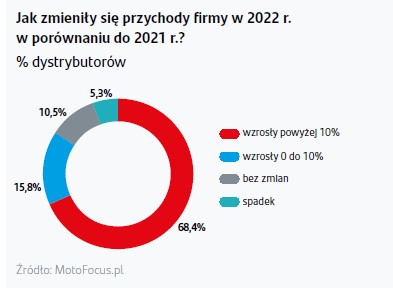
– The vast majority of them, over 84%, declared revenue growth compared to 2021, with 68% recording growth above 10%. A similar number of companies expect further growth in Q1 2023. It is clearly visible that parts distributors operating in Poland are able to find their way in difficult conditions and take advantage of emerging market opportunities – adds Radosław Pelc.
Despite increasing expansion into foreign markets, the study showed that for more than one-third (36.8%) of the surveyed distributors, the share of foreign sales in company revenue is no more than 5%. For more than half, this share is up to 20%. Thus, there is a high dependence of these companies on the domestic market; on the other hand, there is potential for further development in foreign markets. Several domestic players have already firmly established themselves outside our country. They are helped by their habit of dealing with very strong competition in the Polish market and skillfully operating in such conditions.
Workshops – the challenge of electromobility
In current market realities, running a business in the automotive industry, especially automotive workshops, is not easy. The difficult economic situation and rising costs are compounded by expenses related to digitalization and vehicle electrification. These changes require investment in training and new equipment. Often, automotive workshops wanting to repair and service modern vehicles have increasing problems with this because access to data is difficult.
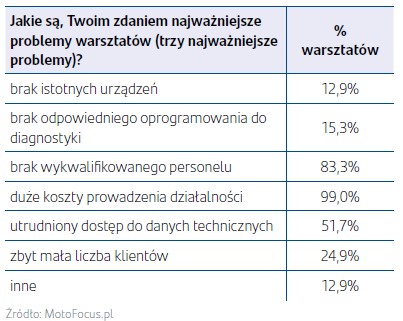
Among the biggest challenges, workshop representatives mention high operating costs. This answer was chosen by 99% of respondents. Also very common, which is particularly worrying for the industry, was the answer “lack of qualified personnel”. A major problem for more than half of the workshops is the lack of access to technical data necessary for carrying out repairs.
– It is worth noting that the problem of the car repair market in Poland is not a small number of customers. Most workshop representatives have not noticed that customers have limited the scope of servicing and repairing their cars. Moreover, more than one-third of those surveyed point to an increase in the number of customers last year. Most workshops do not currently have to actively look for customers, and this situation is unlikely to change if the forecasts regarding the decrease in the number of workshops in the coming years come true – believes Radosław Pelc, sector analyst at Santander Bank Polska.
It seems that most workshop owners know what solutions they should implement in their business to increase its scale. The most popular answer is expanding the range of services offered, chosen by almost 75% of respondents. A very large group of people (almost 64%) also pointed to having a replacement car as a sought-after service on the market. It is worth noting that lowering service prices is ceasing to be treated as the golden method for gaining more customers.