








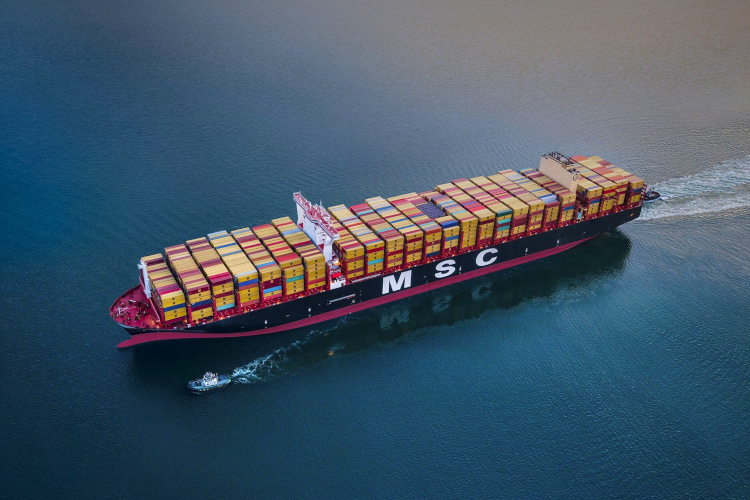
DB Schenker is expanding its eco-friendly ocean freight services. The company has signed an agreement with MSC Mediterranean Shipping Company, the world’s largest container line. It concerns the use of 12,000 metric tons of biofuel for all of its consolidated cargo, LCL (less-than-container load), FCL (full-container-load), and reefer containers.
The amount of biofuel purchased is sufficient to save an additional 35,000 metric tons of CO2 equivalent (CO2e) across the entire production chain (well-to-wake) on the market. The equivalent of approximately 30,000 standard containers (TEU) will be able to be transported with net-zero CO2 emissions, depending on how the fuel is used during the voyage.
The purchase agreement signed this month is one of the largest carbon-reduction biofuel transactions between an operator and a carrier. It involves the use of certified, sustainable second-generation biofuels – derived from used cooking oil – instead of conventional fossil-based marine fuel. The 12,000-ton biofuel component will be blended at a ratio of 20% to 30%, resulting in approximately 50,000 tons of blended biofuel, which will then be used by MSC container ships. Thanks to this agreement, DB Schenker can offer its customers a product that enables net-zero ocean transport.
Certified carbon footprint reduction for customers
This partnership is a significant example of DB Schenker’s commitment to clean logistics. It represents another important step toward the use of alternative fuels in the industry. Similar to “net-zero” flights with sustainable aviation fuel (SAF), customers can now book regular “net-zero” ocean transport and receive an annual emission reduction certificate for their carbon footprint. The latter means that every metric ton of biofuel is bunkered (i.e., refueled) in addition to legal mandates and established carrier fuel purchase orders.
– Together with MSC, we are offering our customers a convenient and clean solution using the latest generation of biofuel, which will help them achieve real, additional emission reductions. We are doing this because we believe it is the right thing to do, and that is why we are paying for the biofuel purchase upfront. One thing is certain: the more customers demand climate neutrality across the entire supply chain, the faster we will achieve clean ocean freight – says Thorsten Meincke, Global Board Member for Air & Ocean Freight at DB Schenker.
– Decarbonization of ocean freight cannot be achieved by a single player and requires cooperation between carriers, logistics companies, and their customers. The MSC Biofuel Solution is our first certified CO2 compensation program that reduces emissions in our customers’ supply chains. It thus accelerates the energy transition by creating demand for net-zero maritime transport and delivering direct CO2 savings. We are pleased to work with DB Schenker. We share similar climate ambitions on our common journey to net-zero emissions – says Caroline Becquart, Senior Vice President at MSC.
Biofuel can be used in regular ocean freight operations without the need to adapt ship infrastructure or the supply chain, making it a convenient solution. The MSC Biofuel Solution is intended to be a win-win approach that will allow moving from ambition to action. MSC bunkers sustainable biofuel, and customers benefit by reducing CO2, which generates value across the entire supply chain. This distinguishes this program from carbon offsetting initiatives outside of maritime transport, which focus on future emission reductions.
Biofuel and CO2 compensation: Additional information
Biofuel is highly regarded as a fuel for the decarbonization transition due to its high quality (in accordance with Annex IX, Part A+B, EU RED II) and the principle of additionality. The latter means that every metric ton of biofuel is produced and bunkered “in addition” to the baseline, thus representing an additional emission reduction in the overall carbon footprint and the actual avoidance of fossil fuels.
- The entire chain of custody for the CO2 compensation process is independently verified, and savings are certified by external certification organizations. They confirm the level of emission reduction from the carbon footprint generated in the transport of goods. The supplier also issues proof that this is sustainable fuel.
- Second-generation biofuel, also known as advanced biofuel, ensures at least an 80% reduction in CO2e emissions (well-to-wake). In the case of ocean freight, DB Schenker also guarantees no use of palm oil, including palm oil residues, and no phenomenon of so-called indirect land use change (ILUC).
- 100% emission reduction in container transport is ensured by the surplus fuel, which also offsets emissions generated during its production and transport. Thanks to this, DB Schenker can achieve net-zero emissions in well-to-wake mode by avoiding fossil fuels in ocean freight.