











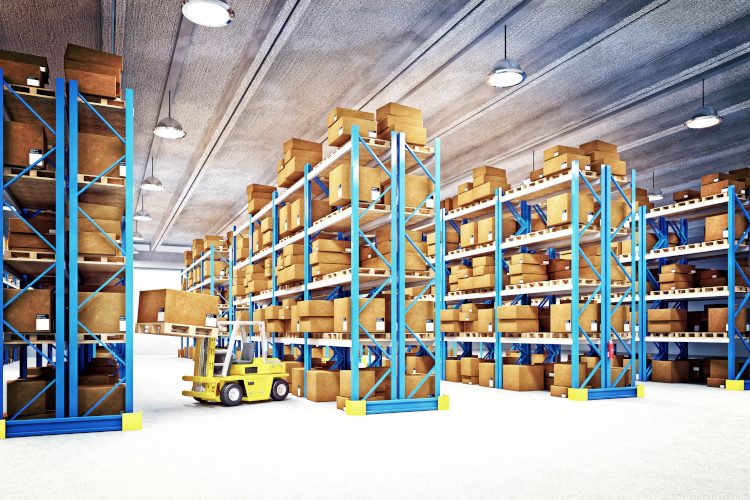
Following the commissioning of approximately 4.4 million sqm of warehouse space, which is the highest annual result in the history of the Polish market, the total warehouse supply at the end of last year reached 28 million sqm. Meanwhile, demand – at the level of 6.8 million sqm – was the second-best result. A better result (by 700,000 sqm) was recorded only in 2021.
The most new space was delivered in the Lower Silesian, Łódź, and Silesian voivodeships – 809,000 sqm, 626,000 sqm, and 541,000 sqm, respectively. The latter two also recorded the highest tenant activity – 896,000 sqm and 1.2 million sqm, respectively. More was leased only in the Masovian voivodeship – 1.4 million sqm.
– Over half of the total demand in 2022 was generated by logistics operators – exactly 56%. At the beginning of the COVID-19 pandemic, interest in logistics space from companies associated with the e-commerce sector increased significantly. Currently, these companies still generate relatively high demand on the market (7% in 2022), but to a lesser extent than a year ago. Tenants from the manufacturing industry (15%) also remain active – says Antoni Szwech, analyst in the Advisory and Market Research Department at Colliers.
Rents on the rise
– As you can see, demand for warehouse space remains solid, although 2022 brought a significant increase in rents, which had practically not changed for many years. The reasons for such jumps included, among others, the rise in fuel and construction material prices, the increase in project financing costs, and the deterioration of investment fund sentiment – explains Jan Barbasiewicz, Partner, Logistics and Industrial Department at Colliers, and adds: – A wave of rent increases was also recorded in other European countries. Against this background, Poland still remains a very attractive location for logistics and warehouses in Europe, and this is influenced, in addition to relatively low rental costs, by the proximity to sales markets, which is important in the context of nearshoring, access to qualified employees, and developing transport infrastructure.
The highest rents in 2022 were recorded in Warsaw. Base rates started from 4.40 EUR/sqm/month, and the highest exceeded the level of 6.75 EUR/sqm/month. Effective rates fluctuated in the range of 3.80-5.50 EUR/sqm/month. In other regional markets, base rates fluctuated in the range of 3.20-5.50 EUR/sqm/month, and effective rates 2.70-4.80 EUR/sqm/month.
More vacant space
Record supply caused an increase in vacancies by 0.2 percentage points (year-on-year) to the level of 4%. The most unleased space is located in the following voivodeships: Lublin (9.5%), Lower Silesian (6.9%), and West Pomeranian (6.6%), and the least in Pomeranian (0.8%), Lesser Poland (1.2%), and Masovian (2.6%). There are no vacancies in the Świętokrzyskie and Podlaskie voivodeships.
– In the first quarter of last year, the lowest vacancy rate in history was recorded at 3.1%. The increase to the 4% level does not herald a deterioration in the market, but quite the opposite. A vacancy rate higher by a few percentage points would allow for maintaining market balance and would enable tenants to meet demand faster – notes Maciej Chmielewski.
It is possible that in 2023 there will be even more vacant space. Currently, 3.4 million sqm remains under construction, of which approximately 46% is unleased space. It is estimated that by the turn of the second and third quarters, the total resources of the industrial and logistics market will exceed 30 million sqm.
– In 2022, the volume of space under construction remained at a relatively high level. On the other hand, since the beginning of last year, a quarterly decline in the number of newly started investments was visible, caused mainly by the increase in construction material prices, the deterioration of investment fund sentiment, and the increase in loan financing costs. In 2023, we expect stabilization in market development. The first signs of this include, among others, a change in the steel price trend, which, according to data from the Polish Association of Construction Employers, rose sharply from the beginning of March 2022, reaching its maximum at the turn of the first and second quarters of 2022, and is currently in a downward trend – it is about 10% cheaper than before February 2022. Some economists estimate that at the end of 2023, the reference rate may decrease by 0.25 – 1.25 p.p., while WIBOR 3M has been in a slight downward trend since November 2022. In 2023, we also expect greater activity from investors from Western Europe, the USA, and Asia, whom geopolitical uncertainty in 2022 partially deterred from increased investments in Poland. It is also worth emphasizing that Poland still remains one of the most attractive markets in this part of Europe, mainly in terms of its location, labor market, and warehouse space rental costs – explains Maciej Chmielewski.
“Green” warehouses on top
Colliers experts also forecast continued interest in ecological solutions in the industrial and logistics space market. Along with rising energy prices and the current ESG trend, tenants and developers are increasingly investing in green solutions for their buildings, and the first thing they ask about is photovoltaics. Unfortunately, one of the main problems limiting the possibilities of its installation on large-area facilities is the load-bearing capacity of roofs. Legislative changes are also needed regarding, among other things, concessions for the sale of electricity.
– Tightening the EU’s policy of decarbonizing Europe and looking for ways to save money by developers and tenants will cause the trend for ESG-friendly warehouses to constantly develop and enjoy high interest – points out Maciej Chmielewski.