








PKP Energetyka has signed a partnership agreement as part of the Europe’s Rail Joint Undertaking. The value of the projects to be implemented by the company by 2026 under this initiative is nearly 3.4 million EUR, and in the longer term (by 2031), it will be another 5.6 million EUR. The Europe’s Rail JU partnership creates and sets research and development directions for the railway sector within the Horizon Europe financial perspective for the years 2021-2031.
As part of the project, PKP Energetyka is primarily responsible for the use of energy storage in the railway ecosystem, both in terms of increasing the capacity to connect renewable energy sources and powering the railway with green energy directly. Furthermore, the goal will be to use storage systems to enable the construction and existence of communities around the railway (clusters, cooperatives, hubs, local balancing areas, etc.) that will benefit from green energy and the opportunities provided by the railway.
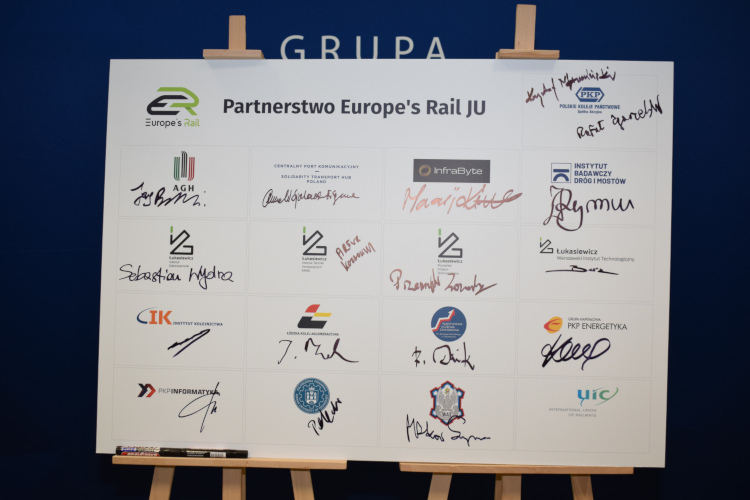
Preparatory work for building the Polish ecosystem within the Europe’s Rail Joint Undertaking lasted two years. On January 18, 2023, an opening meeting was held, during which 17 companies and organizations signed the partnership declaration in the presence of, among others, Deputy Minister of State Assets Maciej Małecki, Deputy Minister of Education and Science Wojciech Murdzek, President of PKP S.A. Krzysztof Mamiński, as well as deans and professors of scientific institutions.
The partnership provides funding from the European Commission over the entire Horizon Europe financial perspective. This guarantees the possibility of carrying out research and development work, within which the total level of eligible costs amounts to nearly 20.1 million EUR. These funds will be successively released in three competitions held between 2022 and 2031. PKP Energetyka will receive funding of up to 44.5% of the project value for its projects worth 9 million EUR.
The goal of the projects for which PKP Energetyka is responsible includes, among other things, verifying an energy storage model based on the idea of local cooperation between consumers and producers, building assumptions and participating in creating algorithms for the model, and launching demonstrators operating in the PKP Energetyka distribution network, serving to increase renewable energy generation capacity and improve the efficiency of local energy use.
– One of the planned demonstrators is to confirm the possibility of increasing connection capacity for renewable energy sources in the PKP Energetyka distribution network using energy storage. The second is to verify the possibility of energy storage systems working with other elements of the power supply system on an “energy hub” basis, reducing network losses and increasing the energy efficiency of the process of generating, distributing, and consuming electricity. Together with the energy storage facility in Garbce, which has been operating for two years, subsequent storage facilities will form the basis for building approximately 300 such profiled and adapted ecosystems in Poland – explains Piotr Obrycki, Director of the Research and Development Office at PKP Energetyka.
The detailed work schedule for the coming years assumes:
In the years 2023-2024:
- designing a set of domain-specific algorithms for energy storage, as well as accompanying infrastructure allowing for proper energy consumption balancing,
- designing an energy management system for the storage facility along with implementation,
- preparing requirements and ordering energy storage units for use in the implementation of work and preliminary tests;
In the years 2025-2026:
- construction and commissioning of demonstrators in the environment of two traction substations,
- conducting analyses and tests of the solution,
- obtaining data from the operation of the demonstrators for the purpose of supplementary simulations.
These tasks will be carried out in cooperation with domestic partners: Poznan University of Technology, the Railway Institute, and the EMAG Institute of Innovative Technologies, with ongoing cooperation also with foreign partners.
As the meeting organizers emphasized, tasks supporting ecology, greenhouse gas emission reduction, circular economy, and improving energy efficiency linked to increasing the use of renewable energy for powering railway traction and buildings are particularly important in this perspective. The work currently being initiated also assumes the development of standards for the hydrogen refueling interface for railway vehicles and ensuring the safety of this process.
In addition to PKP Energetyka, the ecosystem includes: PKP S.A., AGH University of Science and Technology, Centralny Port Komunikacyjny sp. z o.o., Infrabyte sp. z o.o., Road and Bridge Research Institute (POLTRIN network), Electrotechnical Institute (Łukasiewicz Research Network), Railway Institute (POLTRIN network), Warsaw University of Technology (Łukasiewicz Research Network), EMAG Institute of Innovative Technologies (Łukasiewicz Research Network), Łódzka Kolej Aglomeracyjna sp. z o.o., Ignacy Mościcki University of Applied Sciences in Ciechanów, PKP Informatyka sp. z o.o., Poznan University of Technology, Poznan University of Technology (Łukasiewicz Research Network), International Union of Railways (UIC), and the Military University of Technology in Warsaw.