








Warsaw intends to establish a Clean Transport Zone (CTZ) next year, in 2024, which will restrict the entry of the most polluting vehicles into the city. Starting today, residents can review the preliminary draft of the zone. Public consultations with residents will last for the next three months.
– 87 percent of Warsaw residents want local authorities to take action aimed at reducing air pollution, and 76 percent want a Clean Transport Zone to be created. It is also worth emphasizing that the creation of clean transport zones in cities with more than 100,000 inhabitants is one of the milestones of the National Recovery Plan. Warsaw takes its obligations to both residents and the law seriously, which is why we want to launch a clean transport zone in the capital in mid-2024 – says Rafał Trzaskowski, Mayor of Warsaw. – However, before that happens, we invite the residents of Warsaw to discuss the clean transport zone. We want to know their opinion on the specific solutions we are proposing – the Mayor adds.
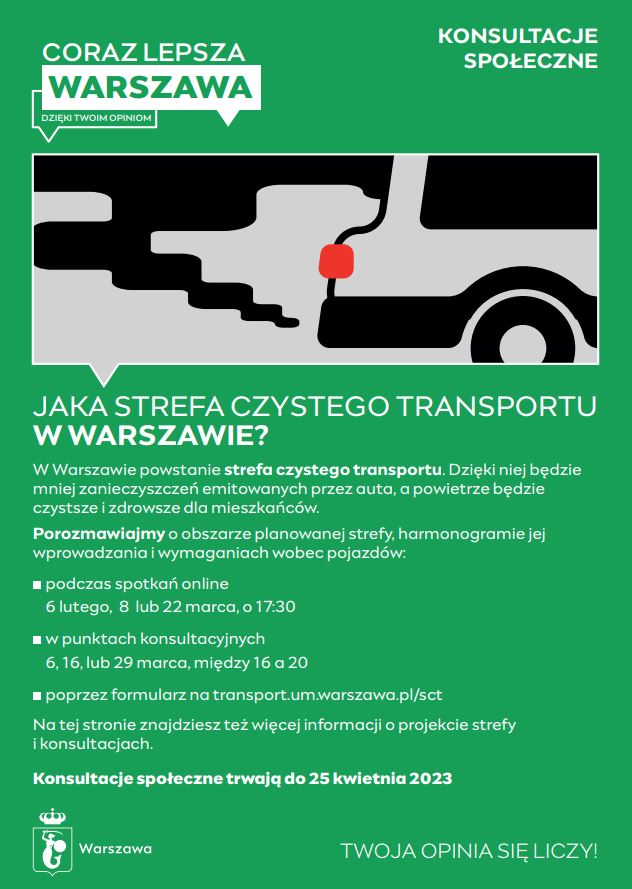
Both the area of the clean transport zone, the timelines for its implementation, as well as the requirements or exceptions for specific groups of people or vehicles will be the subject of public consultations, which began today, January 25, and will last for the next three months.
Following Europe, it is time for Polish cities
A clean transport zone is a designated area where only vehicles meeting specific emission standards (the so-called Euro standards, which are linked to the vehicle’s production date) can travel. The CTZ is a method used in Europe for years to improve air quality in cities and take care of residents’ health. There are already over 320 clean transport zones in Europe, with the most in Germany and Italy. In Poland, the Krakow city council has already adopted a resolution to create a CTZ – there, a mild version of the zone will come into effect on July 1, 2024. The authorities of Wrocław also presented their own CTZ project at the end of December 2022.
Invitation to consultations
The introduction of a clean transport zone is preceded by public consultations – their feedback will provide valuable knowledge needed to develop the final shape of the resolution. Therefore, as representatives of the Warsaw City Hall emphasize, the proposal presented today for the CTZ is not yet a finished scenario, but an invitation to Warsaw residents to discuss the final shape of the zone.
Public consultations for the clean transport zone begin on January 25. Residents’ comments are being collected via email: sct@um.warszawa.pl or through the form available on the consultation website. In the coming weeks, online meetings and consultation sessions will also be held in various districts of the city. The schedule of meetings is available on the consultation website https://konsultacje.um.warszawa.pl/sct. More information about the CTZ can be obtained on the City Hall website: transport.um.warszawa.pl/sct.
In the coming weeks, online meetings and consultation sessions will also be held in various districts of the city. Residents will be informed about their dates well in advance.
The center, but not only
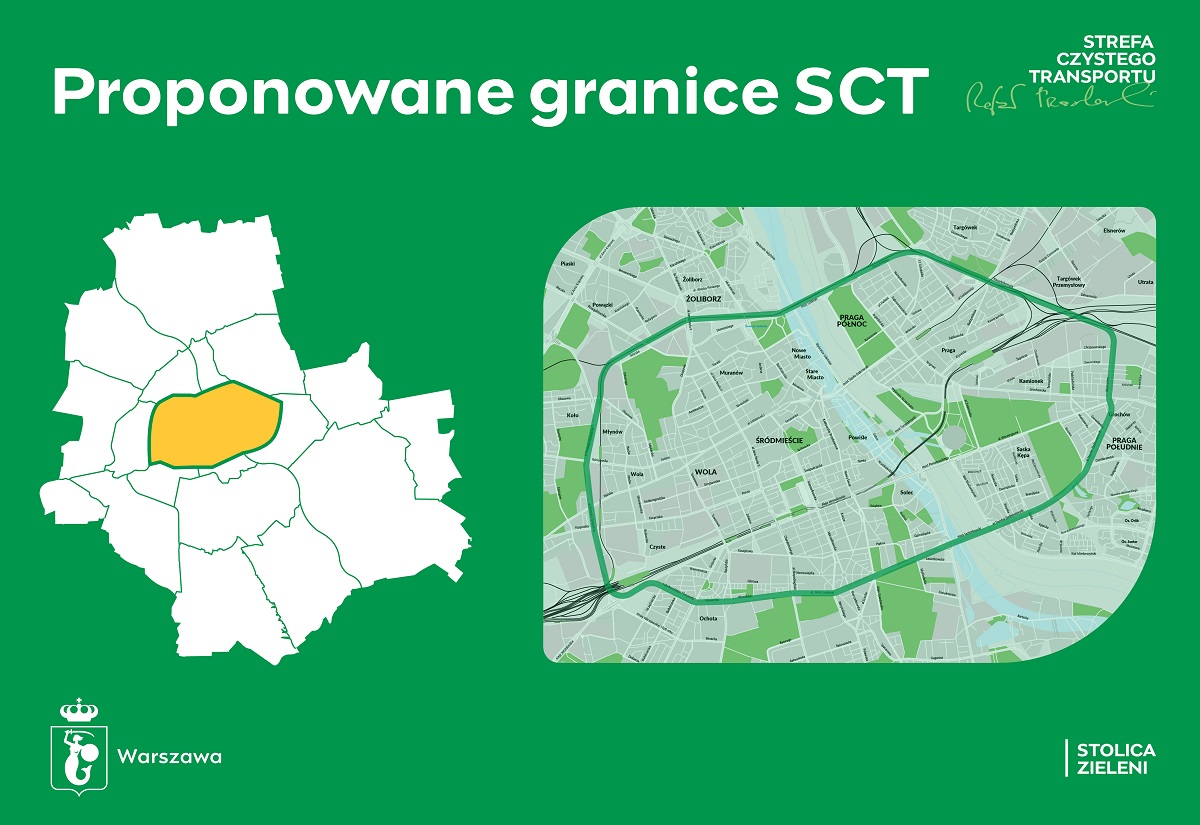
The zone will operate from July 2024 and will cover most of the city center (Śródmieście) and the adjacent parts of Wola, Ochota, Saska Kępa, Grochów, and Praga. The boundaries of the zone will coincide with major roads and railway lines that will not be included in the zone. These boundaries will be marked by: al. Prymasa Tysiąclecia, Al. Jerozolimskie, ul. Kopińska, ul. Wawelska, al. Armii Ludowej, al. Stanów Zjednoczonych, ul. Wiatraczna, and then the railway tracks along the northern railway bypass – up to al. Prymasa Tysiąclecia.
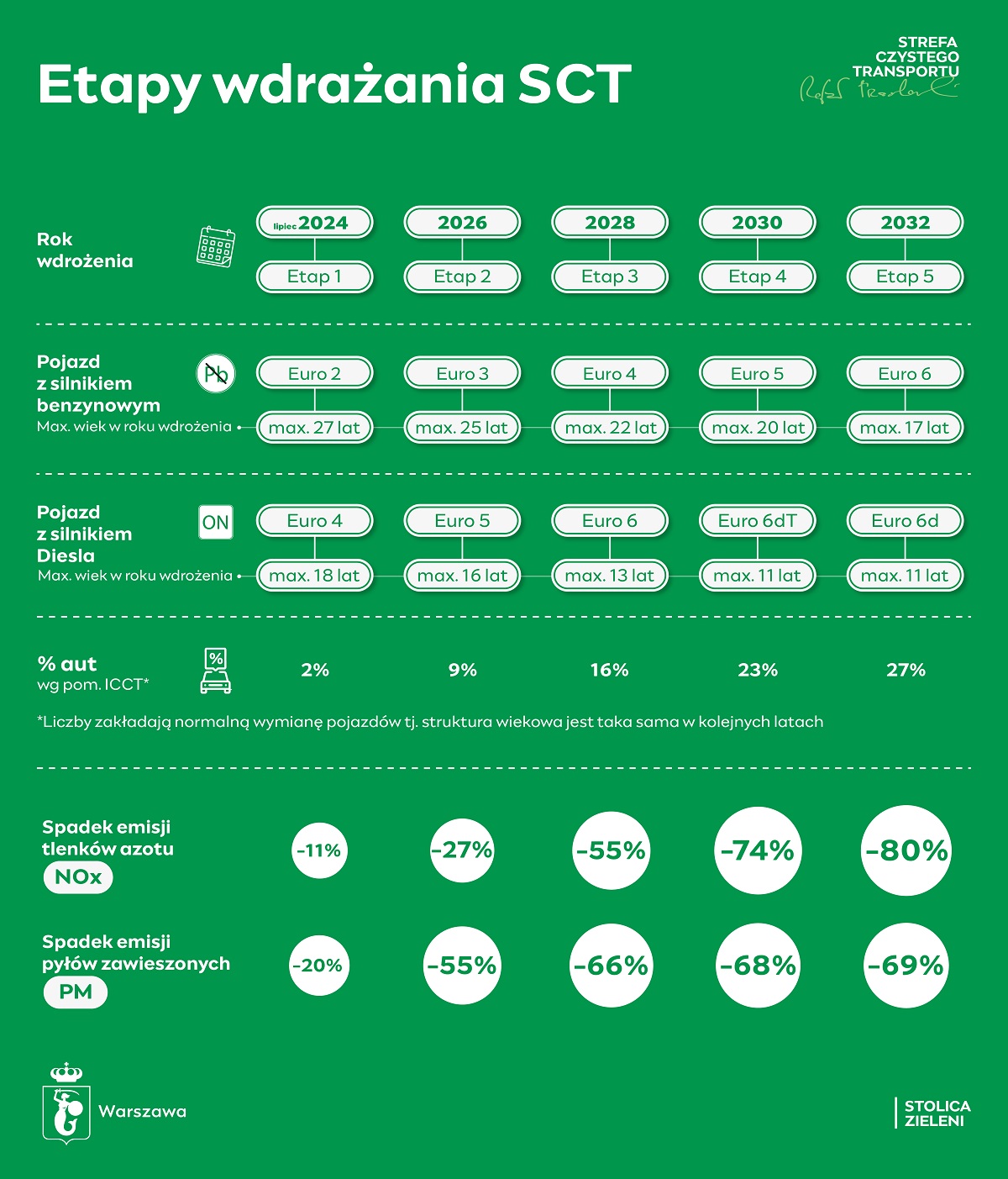
In the first stage, the restriction on entering the CTZ would apply to gasoline vehicles not meeting the Euro 2 standard (older than 27 years) and diesel vehicles not meeting the Euro 4 standard (older than 18 years). Later, consistently every two years, the requirements regarding exhaust emission standards for cars moving in the zone will be increased.
The City Council may also decide to expand the zone in the future – however, such a decision will require prior consultation with residents.
Why is a clean transport zone being created in Warsaw?
The capital will introduce a clean transport zone to reduce the amount of pollution emitted by motor vehicles. A 2014 NIK (Supreme Audit Office) report shows that road traffic is responsible for 63 percent of PM10 particulate pollution in Warsaw. Another NIK report from 2020 states that approximately 75 percent of nitrogen oxides (NOx) in Warsaw come from transport pollution.
The creation of such regulations by the Warsaw authorities is a response to demands for improving air quality, voiced by residents. This topic has been raised many times by non-governmental organizations and social movements dealing with health and quality of life in the city. Implementing the CTZ is also an obligation of the Warsaw authorities, resulting from the implementation of the Air Protection Program for the Masovian Voivodeship.
Old diesels are the main source of pollution
A study of vehicle emissions on Warsaw streets conducted in the autumn of 2020 by a team of scientists from the ICCT shows that most pollution comes from older cars, especially those with diesel engines. Measurements of nearly 150,000 vehicles showed that cars produced before 2006, although they accounted for only 17 percent of the fleet, were responsible for 37 percent of nitrogen oxide (NOx) emissions and 52 percent of particulate matter (PM) emissions.