











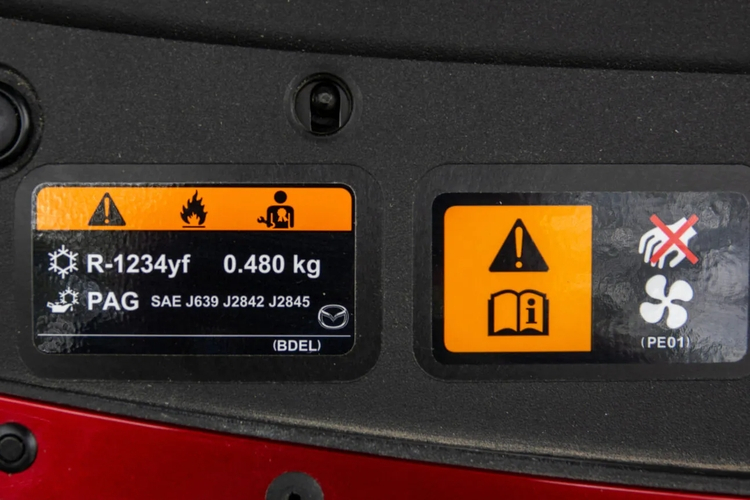
The automotive industry requires manufacturers to comply with rigorous standards at every stage of vehicle production. One such requirement is labeling that is resistant to the factors present during production processes and long-term operation. Choosing a certified supplier guarantees the use of durable and legible labels, allowing manufacturers to meet the requirements of the global automotive industry.
What types of labels are used in the automotive industry?
Only 10-15% of the labels used in vehicle production are visible to drivers and passengers. However, the rest still play a very important role. Several types of labeling are used in the automotive industry:
- technical labels (rating plates, information labels, cable and wire markings),
- specialized labels (warranty seals, tire labels, electronic component markings),
- identification labels (barcodes, QR codes, RFID).
Identification labels account for the largest share of labeling used in the automotive industry. Vehicles are built from thousands of individual parts. As a result, up to 30,000 labels are required for the production of a single unit. At the production stage, each component receives a label that enables its identification. This is of great importance for car manufacturers – an incorrect label poses a threat to the accuracy and efficiency of processes, which entails serious financial consequences for both the manufacturer and the supplier. Therefore, labels used in the automotive industry must be durable and legible, and their quality should be confirmed by appropriate certificates.
How to meet the rigorous requirements of the automotive industry?
Automotive labels must remain fully intact and legible throughout the entire service life of the vehicle. During years of operation, the markings will be exposed to factors such as moisture or temperature changes. The production stage itself requires the identification label to come into contact with high temperatures, harsh chemicals, lubricants, or strong water jets, which could damage the labeling and, consequently, cause difficulties in the process. Therefore, manufacturers take various measures to ensure the durability and legibility of labels and to meet the rigorous requirements of the industry.
– The automotive industry is extremely demanding. Given the rigorous requirements and the need for industry knowledge, it is important that those handling it have the appropriate knowledge and competence. That is why at Etisoft we have created a special dedicated team of specialists, which includes qualified experts from the technology, quality, and sales departments – explains Mariusz Bielecki, Junior Product Manager for labels and markings at Etisoft.
To prevent costly production downtime, in the case of variable data printing at the label application stage, using label printers with a code verifier can also be a practical solution. However, simply being aware of the need to care for the quality of automotive labels is not enough. IATF certification is used to verify suppliers. The technical specification standardizes the quality requirements of the management system in companies associated with the automotive industry. This applies to all companies supplying materials, components, sub-assemblies, and services to motorcycle and car production or assembly lines. One of the important documents is PPAP, which is the process of approving parts for mass production before it starts. It is used for new implementations, changes in raw materials, machinery, production technology, or in the event of a supply interruption longer than one year.
– Etisoft provides labels used in the automotive industry in quality compliant with the current IATF 16949:2016 standard. In 2022, we obtained a certificate covering the production of self-adhesive labels, functional elements for marking, automatic identification, protection, and assembly. As a label manufacturer, Etisoft was also the first organization in Poland to implement the PGAA program, which is part of the UL certification required by the American and Canadian markets – says the expert.
IATF certification confirms that the selected manufacturer has the capabilities and qualifications to create high-quality, legible, and durable labels used during vehicle production. This guarantees that labels produced by a certified entity will meet the rigorous requirements of the automotive industry.